

SMF president wants to help SMEs go green

Tessa Oh
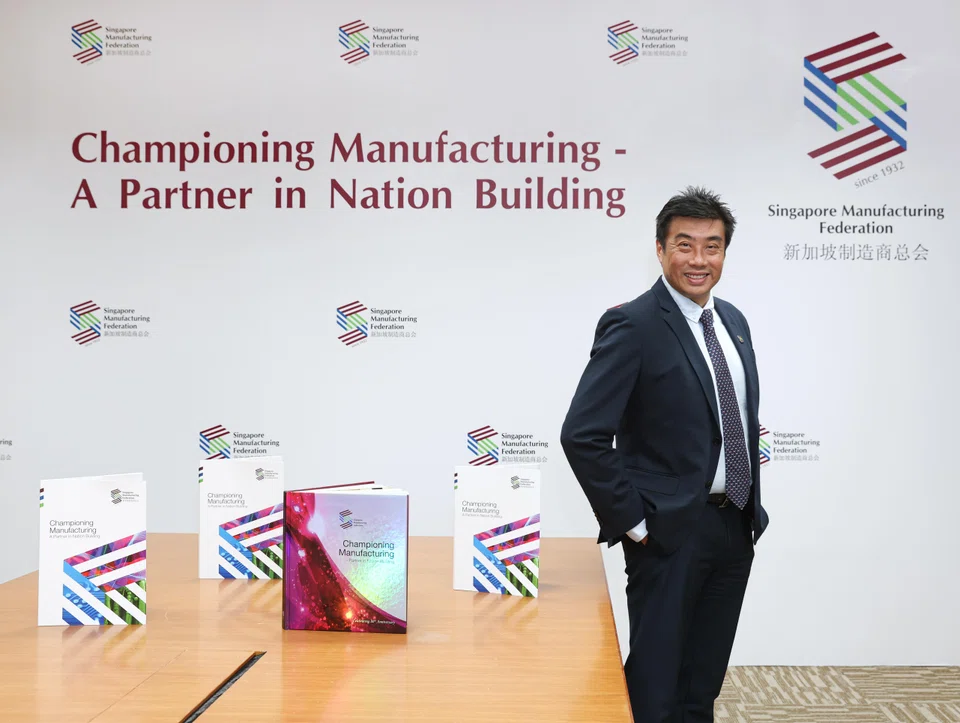
MANUFACTURERS must make a start on longer-term issues such as sustainability, even as they tackle immediate problems such as manpower and costs – and the Singapore Manufacturing Federation (SMF) will help them to do so, with training and expert support.
One of SMF’s four priorities is encouraging companies – specifically, small- and medium-sized enterprises (SMEs) – to go green, said president Lennon Tan, who took office last May.
The other priorities are productivity, internationalisation and human capital. This is in line with the government’s Manufacturing 2030 goal of growing Singapore’s manufacturing sector by 50 per cent by 2030.
“Being sustainable” does not just mean using less paper or switching from plastic to paper packaging, noted Tan. Rather, businesses should look at making improvements throughout the entire manufacturing process, he told The Business Times in a recent interview.
Tan succeeded previous SMF president Sakae Holdings chairman Douglas Foo, who had held the post since 2014.
Immediate worries
Granted, as SMEs face more pressing worries, adopting sustainable practices may not seem urgent, Tan acknowledged, adding: “To be quite honest, sustainability doesn’t come up tops today. I think what comes up top is manpower, rising costs and some of the supply chain issues that they face because of the recent (Ukraine) conflict.”
This is especially with the manufacturing sector now in a slump due to lacklustre global demand, which he believes could stretch into early next year.
For the semiconductor industry specifically, the recent down cycle is likely a correction from the “phenomenal” pandemic-era growth of the electronics sector, he noted. “For businesses in the tech sector, this is a chance for them to look at how to manage costs to ride through this slump.”
On the labour front, businesses can no longer bet on an influx of foreign workers. “There will not be a reversal (of foreign manpower policies), where you can have all the employment passes that you want. That’s not possible,” he said. “The only way forward is tighter and tighter, and more and more expensive.”
But some issues can be important even if they are not urgent – and may be precisely what companies need to address the urgent problems, he added. For instance, pressing manpower issues can be tackled via productivity improvements, upskilling workers and taking labour-intensive operations overseas.
To stay competitive, another “important but not urgent” focus is intellectual property (IP). “IP is what gives you unique positioning,” he added. “You can command a higher value in the market.”
Under an agreement signed last August, 57 of SMF’s member companies will get IP-related training from the World Intellectual Property Organisation.
Then there is sustainability. If SMEs do not start going green soon, they may be caught off guard when new regulations kick in, he warned.
“We do have quite a number of MNCs (multinational corporations) who tell us that in three to five years’ time, SME bosses are going to have a rude awakening when they receive a letter saying: ‘In six months’ time, if you don’t comply to all these things, we can’t buy from you anymore’,” he said.
“So if you look at sustainability that way, don’t you think if you’re the boss, you need to pull out all the stops right now?”
Training, officers, certification
SMF has been running sustainability training for members to “get them up to speed” on what sustainability means and how to become more green.
The federation also plans to appoint dedicated sustainability officers, whom SMEs can approach for advice on how to embark on their green transformation.
“Most SMEs do not have the resources to have a technical expert to come up with a sustainability plan for them. So through this service, they can engage some of these officers to go down and help them to come up with a programme,” said Tan.
Also in the works is a sustainability label scheme where manufacturers can get their products certified “green” on e-commerce platforms such as Amazon.
Some members had noticed that products from other countries had a green label on Amazon, and asked SMF how they could get their products certified. The federation was informed that Amazon recognises third-party standardised green schemes.
SMF decided to create its own label scheme – tailored to the needs of local manufacturers – to help them compete on the global scene faster, said Tan.
Expanding abroad
Another focus for SMF is encouraging members to go international. This is familiar territory for the new president, who started his entrepreneurial journey in China after seeing how companies that ventured there in the late 1990s gained from the country’s rapid economic growth.
He left his role in an MNC and went to China in the early 2000s, taking over a small smart card manufacturing business. This has since grown into tech company Adera Global, where he is now group chairman.
SMF works with companies and government officials abroad to coordinate trips for Singapore bosses to familiarise themselves with the business landscape overseas. Such trips are held not only within the region – such as in Vietnam, Indonesia and the Philippines – but also in far-flung locations such as South Africa and Eastern Europe, where there are emerging opportunities.
“Businessmen will not decide to expand overseas just because of a trip, but at least they would have gone and seen for themselves (what opportunities are available),” said Tan.
During these trips, SMF tries to introduce participants to Singapore businesses that have found success in the host countries. “They can then directly ask (these businesses) questions, and then maybe something will click.”
Forming connections is what SMF hopes to do more broadly, not least at home. “What SMF offers are platforms where businesses come together and interact and mingle,” said Tan.
This year, the federation is holding members’ evenings on the last Friday of every month. While business topics will be discussed, the real point is to create opportunities for members to meet, said Tan, adding: “When people meet, ideas happen, connections happen – and this is what we want.”
TRENDING NOW

Two Singapore-listed palm oil firms named in Greenpeace report on Indonesian plantation fires

Singapore Airlines flight returns to San Francisco after ‘unruly’ passenger incident

Singapore looking into which companies responsible for haze-causing fires: PM Wong

Deluge IPO 3.86 times subscribed ahead of SGX debut

