

SMU commits S$5 million to new Resilient Workforces Institute amid rapid AI change
ResWORK aims to advance workforce resilience and lifelong learning
Jermaine Fok
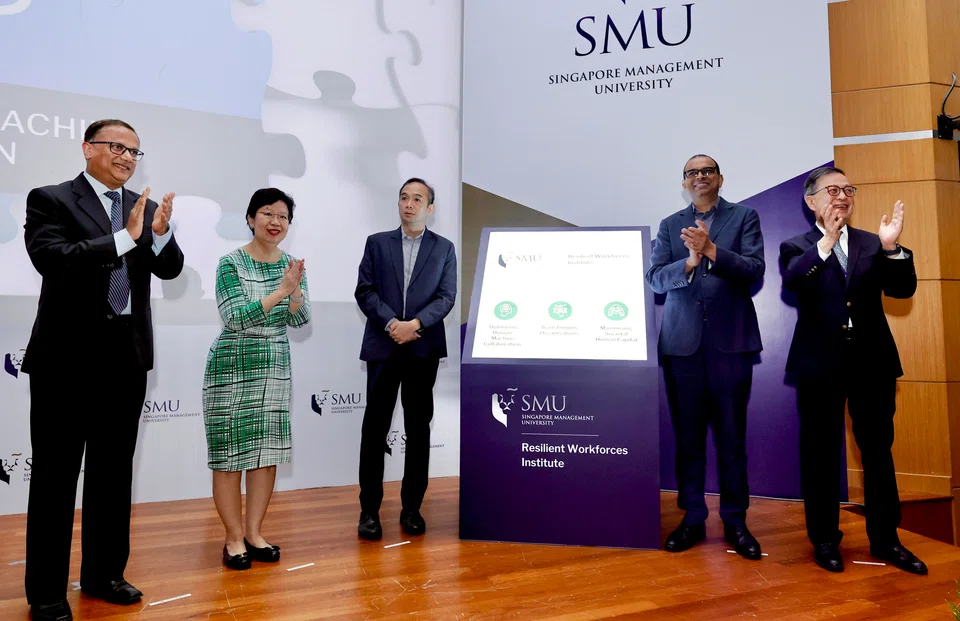
[SINGAPORE] The Singapore Management University (SMU) has launched the new Resilient Workforces Institute (ResWORK) to advance “workforce resilience and lifelong learning amid accelerating technological change”.
The university has committed S$5 million to the research institute over the next five years, with a goal of securing an additional S$8 million to support its operations within three years.
SMU said ResWORK is “among the first institutes in Singapore and the region to jointly study adult learning and the future of work through an integrated, interdisciplinary lens”.
The institute was launched on Tuesday (Jan 20), with Senior Minister of State in the Ministry of Education and Ministry of Sustainability and the Environment Janil Puthucheary as guest of honour.
He said that the institute will adopt an integrated, interdisciplinary approach spanning economics, management, behavioural science, and technology that will “shape the future of work and learning”.
He added that there was a need to take on such an approach to examine the issues and challenges arising from technological advancements.
“Even though technology and AI (artificial intelligence) have brought immense benefits, these changes are taking place rapidly and we must learn to harness them well,” Dr Janil said.
He noted the importance of a whole-of-society partnership in the face of rising AI and technology so that “every Singaporean can maximise their potential and thrive amid these changes”.
New partnerships
At the event, SMU and SkillsFuture Singapore (SSG) signed an agreement to drive strategic research on how AI and technology are reshaping jobs, skills and learning.
The two-year memorandum of understanding outlined their commitment in translating research into policies that sustain “employability and inclusive growth”.
SMU president Professor Lily Kong said the institute will help Singapore and the region navigate the profound changes reshaping work and learning in the age of AI.
The institute involves 20 faculty members across SMU’s six schools and has secured the participation of several globally renowned visiting scholars.
ResWORK is built on three core pillars: optimising human-machine collaboration, transforming organisations and maximising societal human capital.
Currently, there are nine research projects that are internally seed-funded, as well as multiple externally funded research programmes. Collectively, these projects are valued at more than S$1.5 million.
Among the externally funded projects, digital infrastructure company Equinix contributed S$450,000 to SMU to advance applied research.
The amount will support a flagship systemic research project on occupational exposure to AI within Singapore’s labour market.
Leong Yee May, managing director of Equinix Singapore, said: “It represents a collaborative approach to research and education directly aligned with Singapore’s national ambition to build technical literacy and AI fluency across all sectors.”
The internal seed-funded research projects focus on the institute’s three core pillars.
One such project uses an AI large language model (AI-LLM) exposure index to measure the degree of compatibility between tasks performed in a given job and the capabilities of current AI-LLMs.
Professor Li Jia, the dean of SMU’s School of Economics who heads this project, said that by monitoring such data, the index can distinguish between the complementary and substitutive effects of AI on human labour.
This will enable SSG to “more efficiently allocate resources to provide more relevant courses and training programmes for citizens”, he said.
Decoding Asia newsletter: your guide to navigating Asia in a new global order. Sign up here to get Decoding Asia newsletter. Delivered to your inbox. Free.
Share with us your feedback on BT's products and services
TRENDING NOW

Once staunchly pro-China, Malaysian Chinese businesses are now distancing themselves from Beijing

Looking beyond looming CEO succession, should UOB potentially pursue a transformative merger?

Could stablecoins be the future of money?

Grab CEO’s wife Chloe Tong on life with Anthony Tan and finding her purpose

