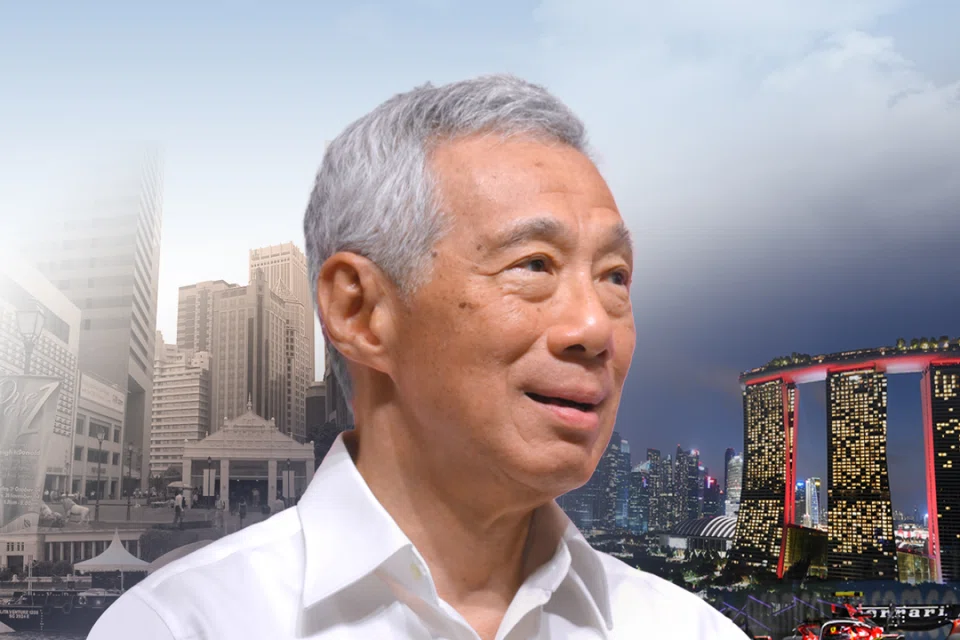
An economy transformed: Lee Hsien Loong’s 20 years as Singapore’s Prime Minister
He will soon hand the reins to his deputy Lawrence Wong at a time of looming domestic challenges and a rapidly changing world order

WHEN Prime Minister Lee Hsien Loong was sworn in as Singapore’s third leader in 2004, he sought to build a vibrant and competitive economy as a means to create good jobs and improve citizens’ lives.
“Without the resources that come from growth, we cannot achieve much,” he said at his inauguration. “But prosperity is not our only goal, nor is economic growth an end in itself.”
Those words helped shape his leadership style and frame his government’s priorities as he guided the nation into the modern and thriving economy that it is today.
Few at that time, however, could have predicted how Singapore under PM Lee’s leadership would be repeatedly tested amid a series of global crises and a rapidly changing world order.
In the two decades that followed, the world experienced a global financial crisis, a trade war between the two largest superpowers, a once-in-a-century pandemic, and debilitating conflicts that have not been seen since World War II.
Yet despite the upheavals, “Singapore has stayed true to its roots of being a small open economy that punches above its weight”, said OCBC chief economist Selena Ling.
“This economic openness, pre-emptive and long-term policy planning, coupled with a healthy economic paranoia, helped Singapore to navigate various crises, overcome numerous challenges over the decades and help the Singapore economy continue to reinvent itself,” she added.
The city-state’s successes have also benefited Singaporeans, with median salaries more than doubling over the same period. However, like many other countries, the Republic also faces a widening income gap even as it reaps the fruits of trade and financial globalisation. Rising inequality has prompted the government to increase social transfers to mitigate this concern.
Ahead of the leadership handover to Deputy Prime Minister Lawrence Wong on May 15, which will see PM Lee become senior minister, The Business Times examines how Singapore’s economy and socio-economic policies have transformed under his watch.
Economic growth
Measured in current prices, Singapore’s gross domestic product (GDP) at the end of 2023 was S$673.3 billion, compared with S$194.4 billion in 2004. In real terms, the economy has grown 2.3 times over the last 20 years.
GDP per capita has also more than doubled over the same period. It has risen significantly from S$46,664 in 2004 to S$113,779 in 2023. Singapore is now among the top 10 countries in the world in terms of living standards, based on data from the International Monetary Fund.
From 2004 to 2023, the Singapore economy experienced some years of high growth, punctuated by various crises. In the wake of the severe acute respiratory syndrome outbreak in 2003, Singapore’s economy recovered swiftly amid a diversification towards modern services and high-end manufacturing; that is, until the Global Financial Crisis towards the end of the decade saw it enter a recession in the last quarter of 2008.
In 2010, the economy rebounded strongly with a record 14.5 per cent expansion from the milder-than-expected recession. In the same year, the Economic Strategies Committee recommended a new growth plan for Singapore to raise productivity and restructure the economy away from its reliance on low-skilled workers.
From 2012, economic growth dipped below 5 per cent, heralding a period of slower progress as Singapore became a more mature economy. According to the Monetary Authority of Singapore’s biannual macroeconomic review in October 2023, growth will continue to slow over the next 10 years as demographic constraints such as a low birth rate and an ageing population become “more binding”.
“PM Lee has steered the Singapore economy through several business cycles, capitalising on the upturns and cushioning the downturns,” said Maybank senior economist Chua Hak Bin, adding that the city-state has strengthened its position as a global financial centre and wealth management hub.
“This was not an easy feat, as in the early 2000s, Hong Kong was riding high on China’s rise and an avalanche of China listings and investments.”
At the heart of Singapore’s progress was a drive to continually move up the value chain and stay relevant – an imperative that remains abiding, said Eugene Tan, a law professor at the Singapore Management University.
“In that sense, we continued to identify new trends ahead of the curve and gained first-mover advantage,” he said.
One notable achievement, said Dr Chua, was how the government maintained Singapore’s manufacturing base and kept the sector’s share at about 20 per cent of GDP, despite a limited labour pool and competition from China, arguably the factory of the world.
Keenly aware that Singapore would never be able to compete on cost, the government invested S$500 million from 2014 to 2018 to support a pivot towards advanced manufacturing.
Also in 2014, PM Lee launched the Smart Nation initiative, which kick-started Singapore’s digital transformation.
These developments, part of other policy initiatives to reposition the Singapore economy for the future, together with the reserves accumulated over the years, helped the country weather its worst recession since independence – when the Covid-19 pandemic swept the world in early 2020.
Importantly, what helped Singapore ride out the storm was its “global mindset”, when it “leaned against the temptation to turn inwards or resort to protectionist measures” at a time of backlash against globalisation, said OCBC’s Ling. Instead, the Republic continued to diversify and embrace new growth industries, as well as engage with like-minded partners.
Having previously found growth engines in the biomedical, semiconductor and precision engineering sectors, Singapore has already zoned in on its next frontier: a S$1 billion investment over the next five years in artificial intelligence.
Population trends
When PM Lee took office in 2004, 7.5 per cent of the population was aged 65 years and above. By 2023, the proportion of this segment had more than doubled to 16.8 per cent.
It is estimated that Singapore will become a “super-aged” society by 2026, when the proportion of its population aged 65 and above will reach 21 per cent.
Another population statistic not working in the country’s favour is its total fertility rate (TFR). Preliminary estimates show that the TFR fell to 0.97 in 2023, dropping below one for the first time in Singapore’s history.
These demographic trends, which first emerged in the late 1990s, have resulted in significant shifts in economic and social policies over the last 20 years.
Bringing in foreign talent to supplement the slowing citizen population growth and local workforce was an approach that was widely adopted across different economic sectors.
In 2007 and 2008, the number of foreigners who moved to the city-state hit a record six digits. A total of 321,000 foreigners took up residency in Singapore in those two years.
“The urgency to inject economic growth in the noughties contributed to the runaway immigration rates seen then, which unsettled Singaporeans,” said SMU’s Assoc Prof Tan.
Amid feelings of overcrowding and employment anxieties, a significant number of Singaporeans made their unhappiness known at the 2011 General Election (GE), which led to the ruling People’s Action Party’s worst showing at the polls since Singapore became independent in 1965.
A controversial Population White Paper put out in 2013 detailing the government’s plans to develop sufficient capacity to accommodate up to 6.9 million people by 2030 also triggered a groundswell of negative sentiments.
Population and immigration, together with housing and transport infrastructure, have since become highly scrutinised public issues.
In a 2015 media interview, PM Lee revealed that he regretted not ramping up infrastructure alongside the rapid population growth during his first 10 years at the helm.
Assoc Prof Tan said the imperative to augment the quality and quantity of Singapore’s population has always been a salient aspect of its overall economic policy.
But while immigration remains a necessity, he believes the concerns of Singaporeans are now “more prominent and also factored into the policymaking” in the wake of GE 2011.
“Immigration remains a hot-button issue – the immigration genie had been let out in 2011,” he said.
Labour force
At a dialogue with women professionals in October 2009, PM Lee said that for the economy to grow and advance, Singaporeans would have to “raise our productivity and increase labour participation, which means more people have to be working, which means more men, which means more women, and more older men and women”.
This, he said, can be achieved not by “exhorting people to come back to work but facilitating it” – through flexible work and family-friendly policies.
Among the measures he introduced at his inaugural National Day Rally (NDR) in 2004 were childcare leave and longer maternity leave, and such offerings have increased in variety over the years.
As of 2023, nearly two-thirds of Singapore’s female population participate in the workforce, up from slightly more than half in 2004.
At the same time, the proportion of older workers who have stayed in the labour force has tripled over the same period – the result of policies that encourage the hiring and rehiring of seniors, as well as a progressive increase in the retirement age.
But even as foreign manpower rules have been tightened progressively over the years, PM Lee said at NDR 2022 that Singapore would still need to attract top international talent “who can contribute to our Singapore story”.
Social safety nets
While most Singaporeans have seen their salaries grow in the last two decades, the nation’s income gap is widening.
The median gross monthly income of full-time employees in 2023 was S$5,197, compared with S$2,543 in 2004. For workers in the 20th percentile, generally used to define lower-income workers, their income rose from S$1,356 in 2004 to S$2,826 in 2023.
For years, Singapore society operated on the principle of self-help, with the government wary that the Western-style welfare state could dilute the incentive for people to work hard.
However, a shift in policy direction towards collective responsibility has been palpable, evidenced by the rise in social spending over the years.
By 2023, annual social development spending had risen to about S$53.1 billion, an increase of more than three times, compared with S$12.4 billion in 2004. In terms of government spending, this broad category, which includes education and healthcare, rose from 42 per cent in 2004 to 47 per cent in 2023.
Most notably, the Ministry of Health’s bill has ballooned over the years as the population greyed: healthcare spending was 16.3 per cent of total expenditure in 2022, nearly three times the proportion in 2004.
On the social redistribution front, data shows that government transfers have helped to bridge the income gap, as indicated by lower Gini coefficient values, a measure of income inequality.
In a written parliamentary reply in 2018, PM Lee said that while globalisation and technological disruption have widened income inequality, the government has intervened more aggressively to support the less well-off over the years.
“If we fail – if widening income inequalities result in a rigid and stratified social system, with each class ignoring the others or pursuing its interests at the expense of others – our politics will turn vicious, our society will fracture and our nation will wither,” he said.
Five years later, at the Bloomberg New Economy Forum, editor-in-chief John Micklethwait asked PM Lee if Singapore has been “drifting to the left” with increased handouts for retirement and to fight inflation, even as he noted that former prime minister Lee Kuan Yew “came in famously as a socialist and ended up as a Thatcherite”.
“We have been sailing carefully to a more comfortable place,” PM Lee replied, explaining that Singapore is “in a phase where we have to do more together”.
SMU’s Assoc Prof Tan believes this “centre-of-left shift” began with the introduction of the Workfare Income Supplement in 2007.
“Under PM Lee’s watch, Singapore has become welfarist, which should not be mistaken for a welfare state,” he said.
“Under a welfarist approach, fiscal spending and tax policy are geared towards strengthening individual and societal well-being balanced against the imperatives of a balanced budget, equitable distribution of the nation’s wealth, self-reliance, family responsibility and gainful employment.”
In contrast, a welfare state achieves similar objectives through high individual taxes and even growing budget deficits, he added.
“Societal changes have necessitated the state to do more as double-digit economic growth is a thing of the past, and economic growth has not quite enabled the aphorism of a ‘rising tide raising all boats’,” he said.
“The reality is that some boats are raised much more than others.”
TRENDING NOW
Deal between tycoon friends sparks scrutiny of Philippine power sector
Canada is upping oil flows to Asia, but South-east Asia’s refineries aren’t ready to handle them yet
Grab CEO’s wife Chloe Tong on life with Anthony Tan and finding her purpose
China got cool for foreigners. But can they find a job there?