Cutting approval drag, keeping costs in check: How the team behind this condo is getting sign-offs done faster
By consolidating key regulatory submissions into a one-stop digital platform, CORENET X trims overall approval times by up to 20 per cent – and early adopters say the learning curve pays off on every project after

FOR built environment firms, one of the biggest challenges to project timelines and margins is a drawn-out approval and coordination process.
Anyone in the project chain knows the friction points: shifting requirements, repeated clarifications and late-stage issues that lead to rework, delays and higher costs.
The risk rises on projects with stricter planning or environmental requirements, where more agencies are involved and coordination becomes harder.
To streamline that process, a multi-agency one-stop initiative, CORENET X, was introduced in 2018. It brings regulatory submissions and agency responses into a single workflow, cutting overall approval time by up to 20 per cent, according to the Building and Construction Authority (BCA).
The initiative is co-led by the BCA and the Urban Redevelopment Authority (URA), along with partner agencies GovTech, National Parks Board, Singapore Civil Defence Force, Land Transport Authority, Public Utilities Board, National Environment Agency, Housing and Development Board, JTC Corporation and Singapore Land Authority.
Since its soft launch in 2023, CORENET X has been used in more than 100 projects involving over 180 firms, spanning residential, commercial, institutional and infrastructure developments. It is currently mandatory for new projects exceeding 30,000 sq m of gross floor area.

For developers, the value of a single workflow becomes clearer on projects where coordination is the hardest.
Real estate group and property developer GuocoLand is using CORENET X on Springleaf Residence, a condominium project launched last year, to surface issues earlier and keep its partners aligned from the outset.
These include architect ADDP Architects, civil and structural consultant KCL Consultants, mechanical and electrical consultant J Roger Preston (Singapore) and contractor China Construction (South Pacific) Development Co (CCDC).
Located beside Springleaf Forest and the Central Catchment Nature Reserve, the approximately 345,000 sq ft project was planned with biodiversity as one of the core considerations.
There is also a conserved building – a school block that was part of the former Upper Thomson Secondary School – that is being repurposed as residences within the development.
It also secured approval from URA’s Design Advisory Panel (DAP), which is convened for strategic projects that need closer design guidance – in this case, to ensure the development responds sensitively to the ecological spaces around it.
Securing DAP approval is good news, but it also means more decisions must be locked in earlier, with less room for late changes.
Shares GuocoLand residential development director Jois Phoo: “The complex and sizeable nature of Springleaf Residence calls for many different government agencies’ consideration and discussion.
“With CORENET X, we can engage the various agencies at the same time, so it has certainly been beneficial.”
Keeping timelines and budgets on track
In the past, developers, architects, builders, engineers and others had to submit plans separately with different government agencies – clocking more than 20 key approvals over the course of a project.
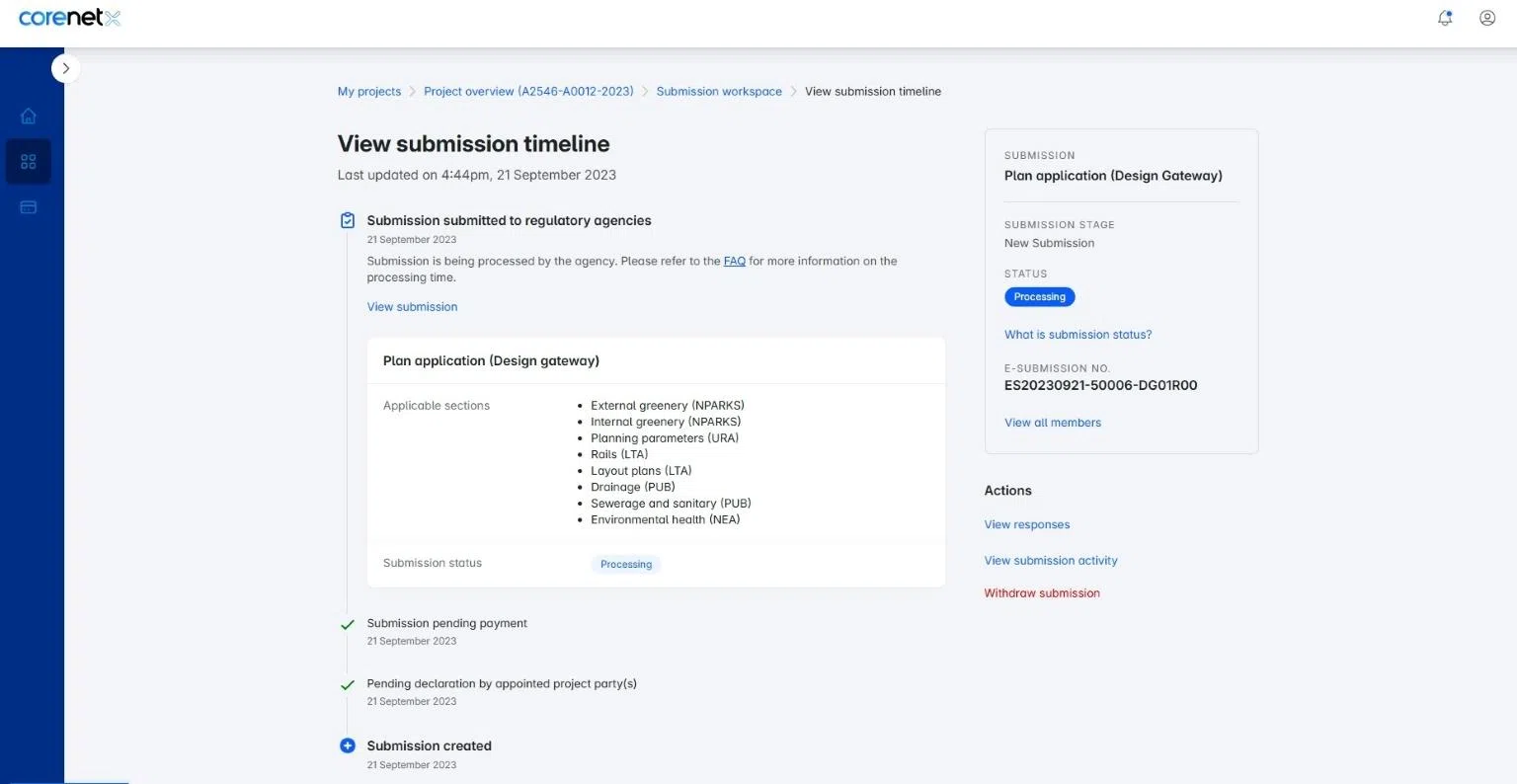
CORENET X streamlines that into one digital route. Rather than making multiple submissions to different agencies, firms move through three main submission stages on the platform.
This means fewer moving parts for teams to manage, and less time spent chasing various agencies for updates.
“From the developer’s perspective, upfront coordination helps make things more efficient,” says Phoo.
“With all the agencies’ comments and compliance requirements addressed early, we will spend less time on these areas during construction. Contractors can also better focus on the quality of work on site.”
In line with the CORENET X workflow, CCDC, its subcontractors and consultants also built a shared digital model of the development from the start, so everyone could work off the same set of coordinated plans.
This Building Information Model (BIM) pulls inputs from different disciplines into one consistent set of drawings.
CCDC’s deputy project director Wu Fei says: “Traditionally, the main contractor usually does not pay as much attention to some parts of a project, such as drainage or sewerage plans, at the beginning.
“With CORENET X, we looked at and coordinated everything, from the piling works to the building of the rooftop.”
The shared model also had to follow tighter digital standards required of CORENET X, so teams had to be more detailed and consistent upfront.
“This means that we flagged and fixed mistakes and clashes before any construction, significantly reducing errors and costly reworks down the line,” says Wu.
Building a scalable playbook
The benefits of CORENET X do not stop at a single project. For firms running multiple developments, the bigger payoff is building a repeatable way of working – so future projects need less coordination efforts, fewer rounds of revisions and less time fixing preventable issues.
Before GuocoLand adopted CORENET X for Springleaf Residence, its first CORENET X project to date, its project team members studied the platform’s Code of Practice and attended training courses.

Phoo adds: “We also consulted with firms that had participated in pilot projects and discussed the process with agencies to prepare ourselves.
“Still, the real learning comes from going through the process together with your consultants and contractors, and the agencies, so it is important to carefully plan for time and costs.”
That upfront effort is time well spent, as it helps teams get comfortable with more detailed digital submissions and align their internal processes early.
For example, ADDP Architects’ BIM managers took time to learn the new standards, then spent several months training colleagues so the wider team could apply them consistently. The architecture firm has since harnessed CORENET X for their other projects.
Shares its senior associate partner Tang Kok Thye: “It does become much smoother after the first time. We had a clearer understanding of the process and the modelling standards required.”
With that, Tang adds, they can address common modelling issues upfront, and speed up checks and approvals.

On the delivery side, the platform also pushes teams to coordinate more closely, especially when several parties are working off the same BIM model and making updates along the way.
On Springleaf Residence, its first of two projects using CORENET X, the CCDC team found that changes made by different parties could lead to discrepancies if they were not clearly communicated.
To solve that, it planned thrice-weekly meetings with GuocoLand and its consultants to ensure everyone was on the same page.
“Setting out a clear timeline, with crucial milestone dates, and establishing a comprehensive list to track who is in charge of each CORENET X submission item and the progress made, also helps,” Wu adds.
For the Springleaf Residence team, using CORENET X has been worthwhile.
Tang says it best: “If you’re willing to approach CORENET X with an open mind and be prepared to tweak and adapt your processes, you’ll be able to unlock the full benefits that the system offers.”
Learn more about the CORENET X platform here.

Share with us your feedback on BT's products and services