A*Star, JTC, Grab enter partnerships with robotics firm Sharpa to build Singapore’s physical AI sector
Autonomous robots will be deployed at Punggol Digital District to explore various use cases, among other plans
Chloe Lim &
Jermaine Fok
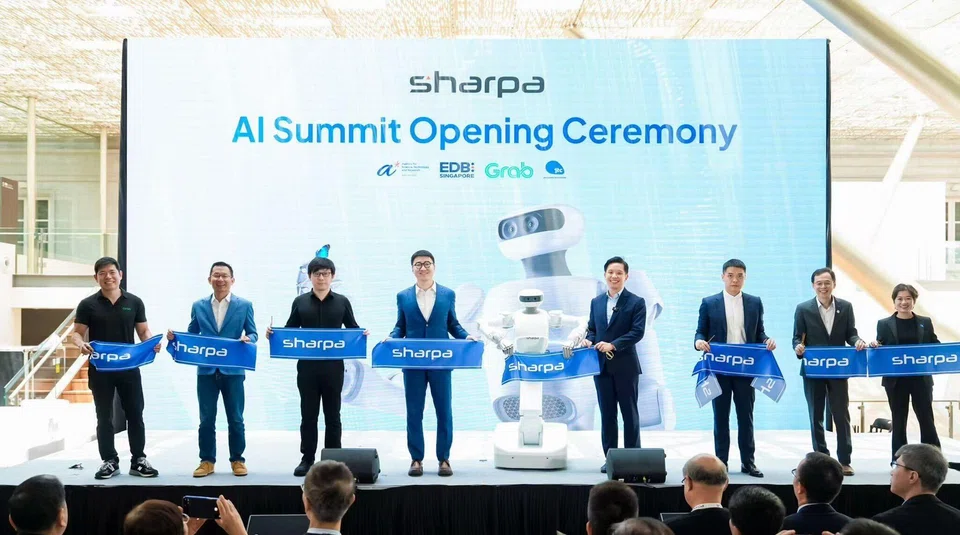
[SINGAPORE] Artificial intelligence robotics company Sharpa will hire various AI scientists, mechatronics specialists and solutions engineers in Singapore over the next three years.
This is as it aims to deepen its R&D efforts in the region, it said on Tuesday (Apr 28).
Headquartered in Singapore, Sharpa plans to grow its headcount to around 150 employees in the city-state, with more than 50 per cent of them in “high-value” R&D roles.
It will also enter strategic partnerships with ride-hailing giant Grab and government agencies JTC and the Agency for Science, Technology and Research (A*Star), Sharpa announced at an event at the National Gallery.
These pacts aim to “develop the physical AI industry in Singapore”, Sharpa said. Physical AI refers to the ability of robotic systems to engage with, and act autonomously in, the real world.
For instance, Sharpa and the A*Star Institute for Infocomm Research will co-handle the development of AI-enabled robotic functions for container handling at ports.
Speaking at the event, Minister of State for National Development as well as Trade and Industry Alvin Tan noted: “This (will) give us a glimpse of what the productivity of tomorrow… might look like, where ports are integrated with robotic systems that can perform complex tasks.” Such tasks include twist-lock coning and deconing, which refer to container-securing processes at terminals.
Tan also said that the agreements reflect the importance of public-private sector collaboration in turning “research into application”.
Sharpa develops general-purpose, autonomous AI robots capable of “human-like dexterity”, aimed to assist consumers and businesses with repetitive, labour-intensive or high-risk tasks.

Deployment in Punggol Digital District
Under JTC and Sharpa’s partnership, the AI robotics company will deploy a fleet of its flagship North robots within the Punggol Digital District (PDD) across various settings – such as retail and food and beverage (F&B) – and use cases. Sharpa debuted its autonomous North robot in January.
Spanning 50 hectares, PDD is a new-generation business park for tech sectors including robotics, AI and cybersecurity. It is expected to be fully completed in 2026.
Besides deploying robots, Sharpa will establish an innovation lab in the district. In turn, JTC will grant the firm the use of certain facilities, including the Open Digital Platform, which offers businesses and students access to real-time district data.
Sharpa co-founder David Li said that leveraging PDD’s infrastructure will allow the company to refine its autonomous robots in a real-world setting.
With Grab, it will also explore the use of robotics in F&B operations and logistics at PDD.
Talent development in Singapore
One focus of Budget 2026 was how Singapore will build capabilities in embodied AI, via investments in R&D.
This is mainly to address complex problems in the sectors of advanced manufacturing, maritime and aviation, noted Tan. However, he stressed that it is just as important to develop and invest in the “right (human) talent” for a sustainable future.
He said: “Through existing schemes such as (the Economic Development Board’s) Industrial Postgraduate Programme, we will continue to support more companies and talents to build a steady pool of people that are ready to ride this technological wave.”
The jobs for which companies like Sharpa are hiring – such as AI engineers – are “exactly the type of high-quality jobs” that Singapore wants to create here, he added.
Sharpa was founded in 2024 and also has manufacturing and R&D operations in Shanghai, as well as business operations in Mountain View, the United States.
Decoding Asia newsletter: your guide to navigating Asia in a new global order. Sign up here to get Decoding Asia newsletter. Delivered to your inbox. Free.
Copyright SPH Media. All rights reserved.