

Strong December factory output to drive upward revision in Singapore’s Q4 growth: economists
Factory output expands 8.3% year on year in the final month of 2025, beating economists’ expectations

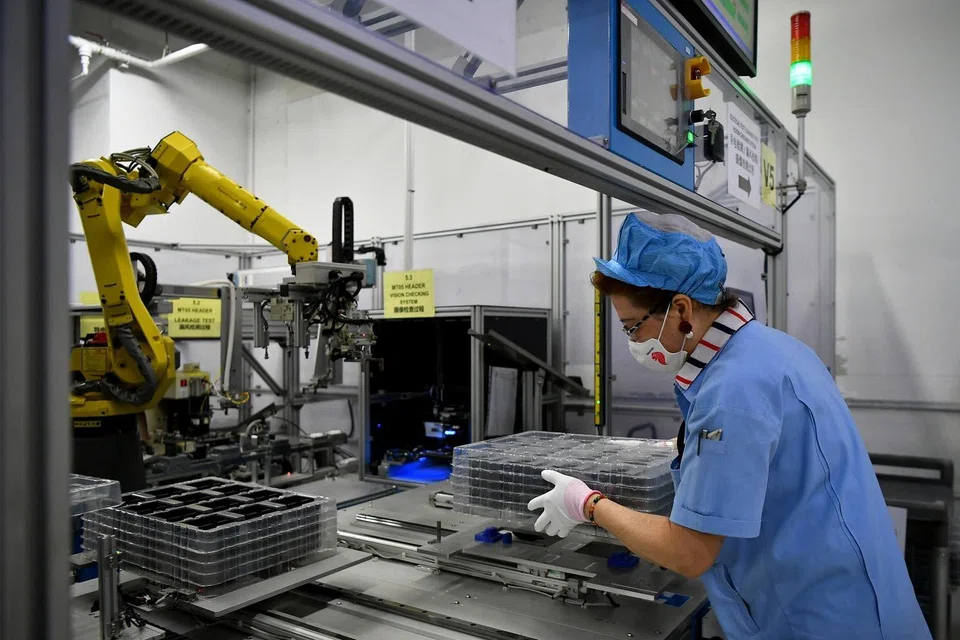
[SINGAPORE] The Republic’s stronger-than-expected factory output in December 2025 is likely to push fourth-quarter and full-year growth higher than initial estimates, said private-sector economists.
Factory output increased 8.3 per cent year on year in December, a sharp moderation from the previous month’s 18.2 per cent rise, data from the Economic Development Board showed on Monday (Jan 26).
Still, December’s figure beat private-sector economists’ median expectations of a 7.4 per cent rise, a Bloomberg poll indicated.
OCBC chief economist Selena Ling now expects fourth-quarter growth to be revised upwards to 6.5 per cent year on year, from January’s advance estimate of 5.7 per cent.
Meanwhile, Maybank economists Chua Hak Bin and Brian Lee expect fourth-quarter growth to be upgraded to “around 6.5 per cent”, implying full-year growth of 5 per cent, versus the flash estimate of 4.8 per cent.
RHB analysts Barnabas Gan and Laalitha Raveenthar similarly expect fourth-quarter GDP expansion to be revised upwards to 6.6 per cent.
For the whole of 2025, they noted, industrial production expanded 8.7 per cent, making “the biggest improvement since 2021”.
Excluding the volatile biomedical cluster, manufacturing output grew 16 per cent year on year, a jump from November’s 9.1 per cent increase.
On a seasonally adjusted month-on-month basis, manufacturing output fell 13.3 per cent in December, following November’s 7.8 per cent contraction.

“Manufacturing and export growth will likely remain firm at least into the first half of 2026, supported by the AI investment boom tailwind,” said Maybank’s Dr Chua and Lee.
RHB’s Gan and Raveenthar maintained their industrial production forecast of 4 per cent for 2026.
“Singapore’s manufacturing sector is poised to build on its recent recovery, underpinned by strong global demand for AI (artificial intelligence)-related semiconductors, servers, and other technology products,” they said.
Still, they cautioned that the momentum observed towards the end of 2025 may moderate in the second half of 2026 due to high base effects.
While AI-related demand momentum “still appears resilient”, OCBC’s Ling expects manufacturing momentum to ease to around 3.3 per cent year on year in the first half of 2026, and further to 1.3 per cent in the second half.
External headwinds such as geopolitical uncertainties and potential US tariffs on sectors including pharmaceuticals and semiconductors remain; however, “the silver lining is that the activity in the transport engineering cluster remains healthy... given the sustained travel demand supporting the MRO (maintenance, repair and overhaul) pipeline”, she said.
Cluster performance
Most clusters recorded growth in December. Factory output for the electronics cluster grew 30.8 per cent year on year, led by the semiconductors segment, which grew 32.4 per cent on “sustained and strong” demand for AI-related products.
UOB senior economist Alvin Liew highighted in a research note that “recent data continued to signal persistence in global AI-related demand”, pointing to Taiwan’s sustained tech export acceleration to the US, as well as South Korea’s semicon exports hitting an all-time high of more than US$20 billion in December.
The transport engineering cluster grew 19.9 per cent, supported by growth in the aerospace as well as the marine and offshore segments.
Precision engineering grew 3.4 per cent in December, on the back of growth from the precision modules and components segment.
Meanwhile, general manufacturing remained unchanged.
In contrast, the chemicals cluster declined 1.6 per cent year on year, with growth in the specialities and petroleum segments offset by a 23.2 per cent decline in the petrochemicals segment.
Biomedical manufacturing tumbled 38.8 per cent, dragged by a contraction in the pharmaceuticals segment, which fell 69.7 per cent due to a diffferent mix of active pharmaceutical ingredients being produced compared to a year earlier.
Decoding Asia newsletter: your guide to navigating Asia in a new global order. Sign up here to get Decoding Asia newsletter. Delivered to your inbox. Free.
Copyright SPH Media. All rights reserved.






