From tea bags to canned beverages, Gryphon brews a new identity
Srinidhi Ragavendran
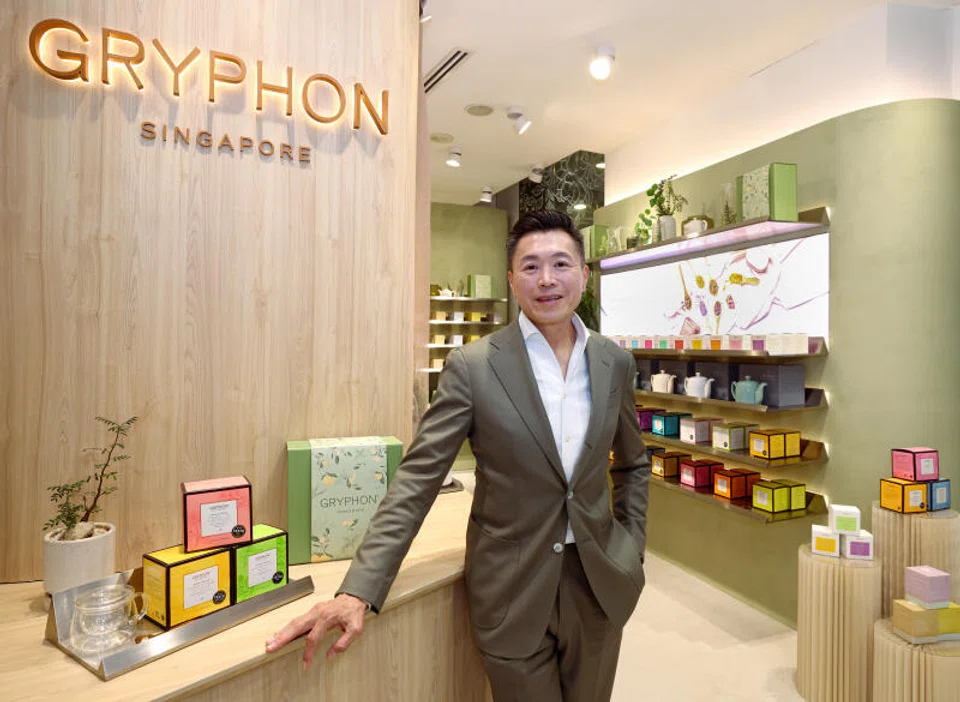
KNOWN for its tea bags and loose-leaf tea, Gryphon Tea now offers canned tea-based beverages and is rebranding simply as “Gryphon” – in a further step away from its parent company, tea wholesaler Lim Lam Thye.
Gryphon’s founder Lim Tian Wee, part of Lim Lam Thye’s fourth-generation leadership, has been interested in prepared beverages since 2004, when a supplier approached the parent company to formulate a limited-time-only iced green tea for McDonalds.
After that project, Lim did not continue working on beverages because he was focused on developing a consumer tea brand – which would become Gryphon Tea.
But the idea never left him. Said Lim: “Since then, I knew that I wanted to do beverages because I felt (its) adoption is much quicker compared to the tea bags.”
Canned beverages can be consumed quickly and are easy to understand, in contrast to tea bags or tea leaves that customers have to brew, he added.
In 2017, Gryphon finally developed bottled beverages: three flavours of cold-brewed sparkling teas. These were only sold business-to-business to restaurants and cafes – until last September, when canned versions were launched on Gryphon’s online shop.
Gryphon now has four beverages available in canned and bottled form, and one each that is canned-only or bottled-only. The flavours, all of which have a Nutri-Grade B rating, include Hanami With White Peach green tea and Coba Cabana With Pineapple rooibos tea. Another two flavours will be added by end-2024.
After barely half a year, beverages already account for a fifth of Gryphon’s revenue, with the rest coming from tea bags and leaves.
Noting the fast pace of growth, Lim said: “That’s why it’s very realistic to see that the beverage business will overshadow our tea business in three years.”
Lim expects beverages to account for 60 per cent of sales by 2027, with only 40 per cent from tea bags and leaves.

Blending tradition with new strategies
After a decade in sales distribution, Lim joined the family business in 2002. Lim Lam Thye’s main business is trading tea leaves and processing tea in Singapore to be sold to businesses in bulk.
“When I joined the business, I thought it was not sustainable, and we were still very far away from our (end)-customers,” said Lim.
In 2006, Lim started Gryphon Tea, producing tea bags. These were supplied to hotels such as Fullerton Hotel and Capella Singapore, and sold by retailers such as Tangs and Isetan.
Gryphon Tea products became available in supermarkets in 2008, and on e-commerce platforms in 2010.
Today, the bulk of Gryphon’s six-figure annual revenue comes from both supermarket retail and sales to food and beverage (F&B) outlets, which contribute equally. E-commerce makes up 15 per cent of revenue.
“Lim Lam Thye complements Gryphon with its strong network of suppliers and production capability. This allows Gryphon to focus better in its business of distribution and marketing,” said Lim. Gryphon sources its tea leaves from countries such as Egypt, Croatia, US, Paraguay, China, Japan, India and Sri Lanka.
The need to pivot
Despite having the idea of beverages for years, Lim did not act on it. “I knew it was a big undertaking (to be) a beverage company.”
The move was eventually prompted by rising costs in the wake of pandemic-era disruptions. Supply-chain costs have risen over 20 per cent since pre-Covid, while higher oil prices have raised the cost of plastic, meaning higher packaging costs for Gryphon’s tea bags and leaves.
Post-pandemic, Gryphon raised the prices of its teas by 10 per cent, but this was not enough to cover the rise in costs.
Supply chain issues have become “a lot more expensive and complicated to manage” with the Red Sea crisis, noted Lim. “Typically, our raw materials coming from Europe take a month. Now, this has been extended to between two and three months.”
Given these production-side challenges, Lim saw a need to boost demand by creating new products to reach non-traditional customers.
“Beverages have allowed us to extend our distribution wider, pushing to attract new customers and younger audiences, which allows the brand to rejuvenate. That has given us a light at the end of the tunnel.”
While Gryphon’s teas are sourced from overseas and processed in Singapore, beverage production is outsourced to factories in Malaysia and Vietnam to stay asset-light and minimise capital expenditure.
Brewing an overseas strategy
Gryphon’s tea products are distributed in most South-east Asian countries (except Laos, Vietnam and Myanmar) as well as in South Korea, Japan and the Maldives.
Gryphon made its first forays into South Korea and Japan in 2016, but only managed to break into the latter in 2023.
In 2016, Gryphon entered Japan through a small distributor, but this venture stagnated and ended after two years. In 2020, Japanese lifestyle magazine Kateigaho made Gryphon’s tea available to readers for purchase – but this was a one-off shipment.
Finally, in 2023, Gryphon made a breakthrough by working with Japanese supermarket chain Meidi-Ya, which has a distribution arm. Meidi-Ya Singapore has been Gryphon’s customer since 2010.
As for the reason to enter Japan despite the strength of its local tea production, Lim said he realised that Japanese consumers are interested in varieties besides green tea, which is widely produced there.
Japan is also one of the first markets – along with the Philippines – where Gryphon has introduced its canned beverages.
Lim hopes to bring Gryphon’s teas and beverages to China and the US, with a different business model: not exporting products, but licensing beverage recipes to local manufacturers.
“This reduces the cost of goods, making the products more competitive,” he said.
Gryphon has found a distributor in China and hopes to enter the market by the third quarter of 2025. The current priority is to stabilise beverage distribution in Singapore and South-east Asia, said Lim.
Defying expectations
A more typical path for a tea company, he noted, is to go into retail or F&B. “People will expect you to create a tea shop or tea cafe.”
But he said: “I don’t want to be a tea shop that just sells boxes and cans of tea. It doesn’t engage the customers or give the brand owner (the chance) to tell the brand story.”
Nonetheless, Gryphon opened a year-long pop-up in BHG Bugis last August, as Lim felt that the brand had a large enough range of products to showcase. Some customers have also been unable to find Gryphon’s full tea range in supermarkets, he noted.
Sales have been encouraging, said Lim. While there are no plans to extend the pop-up, “experiential retail” concepts are in the works, he added, declining to give details.
“Nobody expected us to roll out canned drinks, because it was (a) very different (business) for us.”
But Gryphon cannot stay in its comfort zone forever. He added: “We need to jump into a different space where there are a lot of bigger fish with a big mission, where we are just guppies in the big ocean.”