

Tripartite partners pledge to guide workers, firms through AI’s challenges, opportunities
The 3 partners also announce formation of Tripartite Jobs Council to support workers and enterprises in an AI-driven economy

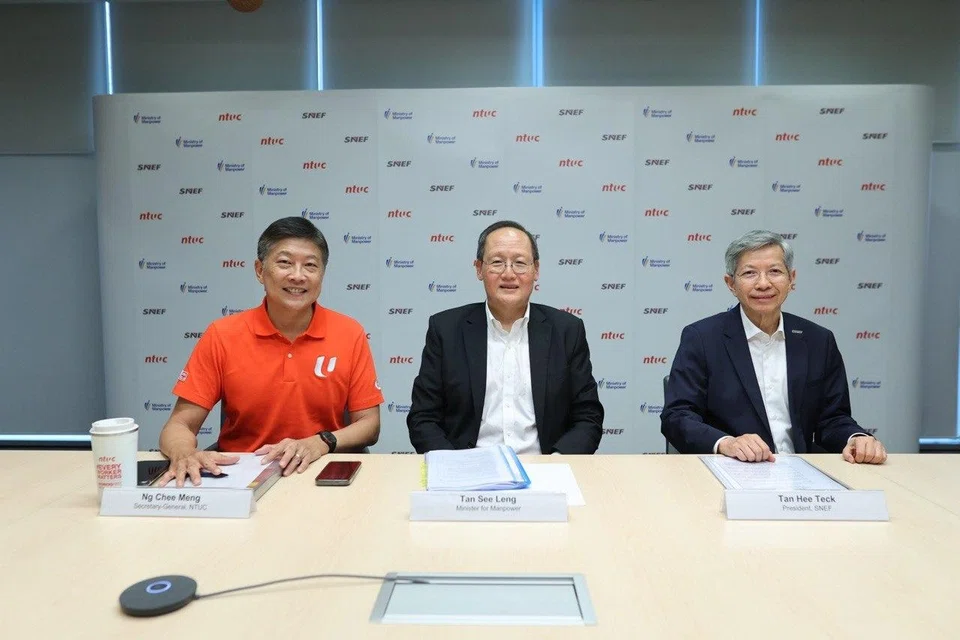
[SINGAPORE] Artificial intelligence will bring both disruption and opportunity for Singapore’s workers and businesses, and the city-state’s tripartite partners have pledged to help navigate both, they said in their annual May Day messages on Thursday (Apr 30).
In separate messages, the Ministry of Manpower (MOM), the National Trades Union Congress (NTUC) and the Singapore National Employers Federation (SNEF) each acknowledged that AI was simultaneously the biggest source of anxiety for workers and an opportunity to raise productivity.
The three partners also announced the formation of the Tripartite Jobs Council to support workers and enterprises in an AI-driven economy.
Manpower Minister Tan See Leng said Singapore’s investment in lifelong learning for more than a decade had built “a deep source of resilience and strength” that workers and businesses could draw on as AI reshapes industries.
“We will ensure that Singaporeans are equipped to thrive in an AI-enabled economy so that no one is left behind,” he added.
NTUC secretary-general Ng Chee Meng and president K Thanaletchimi pledged to leverage AI and technology to secure better jobs for workers, committing to training support and funding to offset the cost of selected AI tool subscriptions.
SNEF president Tan Hee Teck urged employers to view AI as a complement to human capability rather than a substitute.
“When managed well, AI presents an opportunity to raise productivity and create better jobs,” he said. He called on companies to invest in AI adoption and equip workers with skills to harness it, so that technology enhances expertise and opens up higher value-added roles.
Navigating a super-aged society amid global headwinds
Singapore is grappling with rising geopolitical tensions and growing business uncertainty, with the Middle East conflict exacerbating these pressures and driving up energy prices, said Dr Tan, the manpower minister. These pressures will impact businesses and workers, he added.
SEE ALSO

Domestically, Dr Tan noted, Singapore will become a super-aged society this year. This will fundamentally reshape its workforce dynamics as people live longer, and career aspirations become more diverse.
Over the past five years, real incomes for the median worker grew 1.6 per cent per annum. Those of lower-wage workers had faster growth of 2.8 per cent annually, aided by tripartite initiatives including the Progressive Wage Model, Dr Tan said.
Against this backdrop, Dr Tan flagged three priorities: equipping Singaporeans for an AI-enabled economy; reviewing the Employment Act to keep employment standards current; and bolstering retirement adequacy as career patterns grow more varied.
Navigating AI disruptions with support
“Change will continue, but workers will not face it alone,” said Thanaletchimi and Ng. NTUC will step up efforts to help workers progress at every stage of life – from fresh graduates and mid-career workers to those preparing for retirement.
NTUC’s focus, they said, would be on helping workers build relevant skills, supporting companies in redesigning jobs responsibly, and improving job matching. With this, workers can move into better opportunities.
On worker representation, Thanaletchimi and Ng pledged to expand support for persons with disabilities, strengthen return-to-work pathways for workers who acquire disabilities, and build on NTUC’s capacity to represent professionals, managers and executives – including access to legal assistance where appropriate.
For everyday needs, the union said it will continue to support workers and their families through financial assistance programmes.
This includes efforts to ensure that help reaches more families through broader income eligibility thresholds.
Employers as partners in transformation
As jobs evolve, roles must be redesigned, noted SNEF’s Tan. Reskilling will thus be essential for businesses to remain competitive.
SNEF has committed to working with MOM and NTUC on targeted reskilling interventions and better job matching for workers displaced by technological change. This is in line with the Economic Strategy Review’s recommendation to strengthen transition support.
On inclusion, Singapore’s ageing population remains a long-term structural challenge, said Tan. SNEF will work to promote age-friendly workplaces and extend the productive longevity of senior workers through the Tripartite Workgroup on Senior Employment.
A well-integrated foreign workforce will also be needed to complement local talent and address manpower constraints, he added.
Decoding Asia newsletter: your guide to navigating Asia in a new global order. Sign up here to get Decoding Asia newsletter. Delivered to your inbox. Free.
Copyright SPH Media. All rights reserved.
TRENDING NOW

Britain’s mansion tax shows the difficulty of targeting wealth

Once staunchly pro-China, Malaysian Chinese businesses are now distancing themselves from Beijing

The only common thing in S-E Asia is that we all eat rice: Cisco’s Asean president
Singapore data centre operator DayOne opts for US IPO at likely US$20 billion valuation

