Turning trash to treasure in India’s waste management sector

Renald Yeo
Renald Yeo

Published Wed, Nov 8, 2023 · 02:00 PM
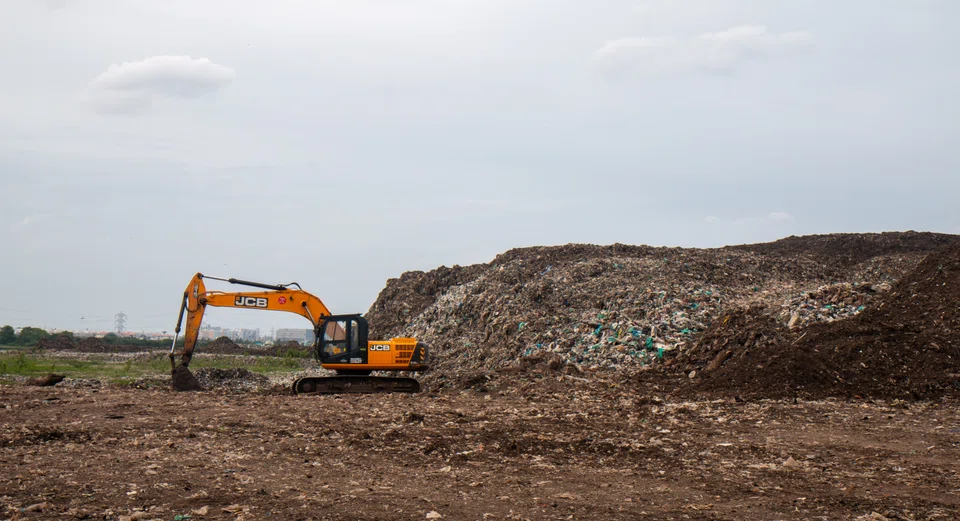
    • India generates some 150,000 tonnes of municipal solid waste each day, according to a 2023 report from the New Delhi-based Centre for Science and Environment.
    • India generates some 150,000 tonnes of municipal solid waste each day, according to a 2023 report from the New Delhi-based Centre for Science and Environment. PHOTO: RENALD YEO, BT

    [BENGALURU/CHENNAI] India’s rapid urbanisation has meant growing environmental problems arising from municipal waste – but for Singapore’s waste management players, these represent business opportunities.

    “Waste management is a key area of growth within the urban sector,” said G Jayakrishnan, executive director for South Asia, the Middle East and Africa at Enterprise Singapore.

    India generates some 150,000 tonnes of municipal solid waste each day, according to a 2023 report from the New Delhi-based Centre for Science and Environment.

    “This opens new avenues for Singapore companies to enter the market and provide value-added services, to contribute and advance urban development in India in areas ranging from solid waste to water resources and now, even e-waste management,” said Jayakrishnan.

    Two Singapore-based companies have found a niche in India’s vast waste management sector.

    Vans Chemistry: Getting gold from e-waste

    Vans Chemistry strips down collected e-waste, separates it and ships it to third-party players for recycling, says founder and chief executive Venkatesha Murthy. PHOTO: RENALD YEO, BT

    Old laptops. Dusty monitors. Spoilt printers. For most companies, these are IT assets at the end of their depreciation cycle, to be junked to make way for new gadgets.

    For Vans Chemistry founder and chief executive officer Venkatesha Murthy, however, they are the vital raw materials for his e-waste recycling business.

    The company collects e-waste in Bengaluru to be stripped down, separated by type and shipped to third-party players for recycling. The eventual plan is for Vans Chemistry to take over parts of the recycling process, such as precious metals smelting, said Murthy.

    E-waste containing valuable metals can fetch a premium, he added. “Those that contain aluminium, nickel, copper and in some cases, precious metals like gold – we need to pay money to collect them.”

    In contrast, the company is typically paid to handle e-waste that is toxic or hazardous, such as light bulbs or cathode-ray tube monitors.

    It is contracted to collect some 3,000 tonnes of e-waste in 2023, up from close to 2,000 tonnes in 2022.

    Before certain types of IT equipment – such as laptops – are dismantled, an employee checks if they can be repaired or refurbished. Said Murthy: “We try to extend the life of certain electronic products whenever it is possible, instead of directly going for recycling.”

    If that is not possible, the equipment is dismantled and separated into individual plastics and metals components. Components such as printed circuit boards (PCBs) with trace amounts of precious metals – such as gold – are especially valuable.

    PCBs make up about 2 per cent to 3 per cent of Vans Chemistry’s e-waste by weight. Plastics typically account for 40 per cent and metals, around 55 per cent. Much of the remaining material, which includes rubber and glass, cannot be recycled.

    While plastics and metals are sent to recyclers within India, the PCBs have to be exported to Japan and Europe – at least until Vans Chemistry’s own facility is ready. Said Murthy: “There are no such refining companies in India so far, which is an opportunity for us.”

    The company is building its own precious metals smelting facility in Bengaluru to improve the efficiency of its supply chain – and capture more of the value.

    The S$10 million, 60,000 square foot facility is expected to come online by the second half of 2024. At full capacity, it will employ some 150 to 200 workers, adding to Van Chemistry’s existing 20,000 sq ft space and 25 employees.

    “We will be a totally integrated, one-stop solution: from the collection, to the dismantling, to recycling, recovery and refining,” said Murthy.

    This comes as consumers demand more sustainable practices, he added. “In the best gold mines, you may have five or six g of gold per tonne of ore, but in the recycling of electrical components, it’s at 20 to 30 g of gold (per tonne of waste).

    “You’re wasting a lot of resources by mining because (of) deforestation, safety and environmental issues – recycling is much more sustainable.”

    Blue Planet: Reclaiming green spaces from landfills

    Blue Planet Environmental Solutions co-founder and CEO Prashant Singh (left) with co-founder and CEO of local waste management company Zigma, Ku Tha Ilangovan. PHOTO: RENALD YEO, BT

    In the waste that Blue Planet Environmental Solutions handles in Chennai, one would be hard-pressed to find any e-waste, or even conventionally recyclable items such as plastic bottles, said co-founder and CEO Prashant Singh.

    Any waste that makes it to the Perungudi dump yard – where Blue Planet won a government tender to operate – has already been extensively sifted and sorted for anything of value, he added.

    What remains, therefore, is waste of low economic value: “You won’t find a plastic bottle or a bottle cap, but you will find the plastic film that was around the bottle.”

    The Perungudi dump yard sits on some 91 hectares of ecologically sensitive marshland. Blue Planet is working with Indian waste management company Zigma to process and remove waste from part of the site, so it can return to being a natural habitat.

    Founded in Singapore in 2017, Blue Planet won the local government tender for this project in February 2021. This was after the company’s first foray into India in October 2018, when it acquired an Indian company working on converting waste plastic into fuel.

    To turn the dumpsite back into marshland, the waste is first sampled to gauge its physical and chemical composition.

    It is then piled into long rows, sprayed with a microbial solution and frequently raked to aerate it, accelerating the breakdown of organic matter. Once the waste has stabilised, it is mechanically separated based on size and density at Blue Planet’s on-site facility.

    Apart from a “very small percentage” of recyclable material, up to 30 per cent of the separated waste – essentially the combustible component – is turned into refuse derived fuel (RDF).

    The remaining 65 per cent to 70 per cent becomes soil, which can be used as topsoil in agriculture or a material in road construction. Said Singh: “We operate on an almost zero-residue model.”

    RDF can be used in place of fossil fuels, and Blue Planet has been supplying it to local cement factories that burn it in their kilns in place of coal.

    As RDF burns cleaner than coal, there are significant carbon emission savings to be had, Singh said. Blue Planet estimates that more than 30,000 tonnes of carbon emissions have been saved through the use of its RDF.

    The company does not make money from this processed output. Instead, its revenue is derived from payments from the local government for every truckload of waste cleared. Blue Planet has cleared more than 95 per cent – or some 38.9 ha – of the contracted waste, and is almost one year ahead of schedule.