

What will power growth amid uncertainty? Asean businesses say answer lies close to home: BT survey
Despite geopolitical risks, 56% of firms expect revenue growth, pivoting of capital and supply chains into the region

[SINGAPORE] Asean businesses are looking closer to home for growth and investment opportunities amid global volatility and trade tensions.
They are consolidating their growth regionally by reallocating capital and supply chains in South-east Asia where they see the strongest opportunities, relative to those in other key markets such as China, the US, the EU and India.
While the Middle East crisis has cast a shadow on the business outlook, overall sentiment among business leaders remains positive.
These were among the key findings from The Business Times Insights: Asean Intelligence 2026, an inaugural regional survey by The Business Times.
More than 500 C-suite and business leaders in the Asean-6 economies – Singapore, Malaysia, Indonesia, Thailand, the Philippines and Vietnam were polled.
Working with market research firm Kantar, surveys were done in February and April 2026 to reflect more accurately the impact of the Middle East conflict on business sentiments.
For both survey waves, overall outlook was positive. In the first wave, 92 per cent of the 538 respondents said they were“somewhat positive” or “very positive” about the business outlook for the rest of the year.
In the second wave, this fell to 76 per cent.
Notably, there was a significant drop in the percentage of business leaders who were “very positive” about the outlook – from 52 per cent of the sample pre-crisis to 31 per cent after the crisis unfolded.
SEE ALSO




Asked to compare their revenue expectations for their organisation in 2026 compared to the previous year, 56 per cent of businesses said they expect growth in revenue this year in the survey tranche during the conflict, versus 77 per cent in the pre-conflict period.
The top three risks identified by businesses in both survey waves were similar, but there was a difference in their rankings.
Geopolitical tensions rose to the top of the chart in the second round of the survey after the Iran war broke out, with 59 per cent of respondents citing it as the top concern, up from 48 per cent in the previous round.
The other key risks were persistent cost inflation and supply chain disruption.
All business leaders also reported that the Middle East conflict would affect their business plans. Over a third (37 per cent) deemed the impact as significant; 45 per cent described it as moderate.
In particular, they cited cost management (63 per cent), supply chain concerns (62 per cent) and expansion plans (47 per cent) as the areas most affected.
With uncertainty reinforcing defensive business planning, companies are looking closer to home. All respondents said they plan to allocate new capital within the intra-Asia region in the next three years.
Investment is overwhelmingly focused on Asean (90 per cent) and domestic markets (77 per cent). China took the third spot, at 64 per cent. Only 31 per cent said they are considering investments in the US, and 24 per cent in the EU.
There is also a strong momentum towards supply chain regionalisation. Operationally, eight in 10 Asean businesses are looking to move more of their supply chains into the region, amid trade tensions and disruptions.
Businesses cited infrastructure quality and ease of doing business as their top priority (44 per cent), followed by market access (40 per cent) and supply chain resilience (35 per cent). Brian Lee, an economist at Maybank Securities, said that as businesses “shift from ‘just in time’ to ‘just in case’ production patterns, supply chain resilience becomes key”.
“Firms have been diversifying, and continue to diversify production bases to multiple jurisdictions,” he added. “Asean has been a beneficiary of this shift, with Malaysia and Vietnam being leading beneficiaries.”
Why capital is flowing to Asean
At a macro level, there are already signs that organisations are looking to deploy new capital within Asean.
Approved foreign direct investment (FDI) climbed 20.9 per cent to RM207.1 billion (S$66.6 billion) in Malaysia in 2025, the Malaysian Investment Development Authority said.
In Thailand, total investment applications jumped 67 per cent to US$60.23 billion, driven primarily by FDI applications, which rose 66 per cent to US$43.65 billion, said the Thailand Board of Investment.
In Singapore, fixed-asset investment commitments (both foreign and local) rose 5.3 per cent in 2025 to S$14.2 billion, going by figures from the Economic Development Board.
One reason for this could be optimism over Asean’s economic integration. Almost seven in 10 (67 per cent) of the survey respondents expressed high confidence that integration would strengthen in the next three years.
Geographically, business leaders from Vietnam were the most optimistic: 84 per cent expressed high confidence that the integration would strengthen over this time frame.
Singapore-based firms were more cautious in their outlook, recording only 39 per cent in the “high confidence” range.
South-east Asian business leaders said they think Asean (63 per cent) and their own domestic markets (62 per cent) represent the biggest opportunities.
Lourdes Gutierrez-Alfonso, the president and CEO of Megaworld Corporation, is upbeat about 2026. The developer, the Philippines’ largest player in the integrated urban townships sector, is on track to launch 12 new projects with its subsidiaries this year. It is projected to deliver 32 billion pesos (S$664.2 million) in project turnover.
It is also opening six new hotel developments in the next three years.
“While we exercise financial prudence, we will continue to build in locations where there is market demand,” said Gutierrez-Alfonso. “We believe that the township concept that Megaworld pioneered in the Philippines will be able to contribute to the country’s economy.”
Almost nine in 10 (87 per cent) of leaders said they expect Asean to be their most important growth partner by 2028, followed by China (70 per cent).
Expectations of increased importance are more muted for the US and EU (both 57 per cent), suggesting a relative shift towards regional and Asia-centric partnerships.
The politics of business
Asked about their longer-term plans, a majority of businesses (41 per cent) said they planned to deepen ties with both the US and China.
The second-most common approach (23 per cent) was to diversify away from both powers into neutral or regional markets; 15 per cent of businesses said they were looking to reduce exposure to the US in favour of China.
DBS chief economist Taimur Baig and senior economist Chua Han Teng noted that regional economic integration between Asean and China has strengthened over time and will remain close.
They added that their deeper economic cooperation is supported by initiatives such as the Regional Comprehensive Economic Partnership (RCEP) and the Asean-China Free Trade Area 3.0 Upgrade.
“South-east Asia also stands to benefit from China’s competitive advantages in areas such as technological innovation and green energy,” they added.
This tracks with the 63 per cent of business representatives surveyed, who said they believed that regional trade agreements such as RCEP and Comprehensive and Progressive Agreement for Trans-Pacific Partnership are somewhat or far more important than US bilateral relations for their future supply chain security.
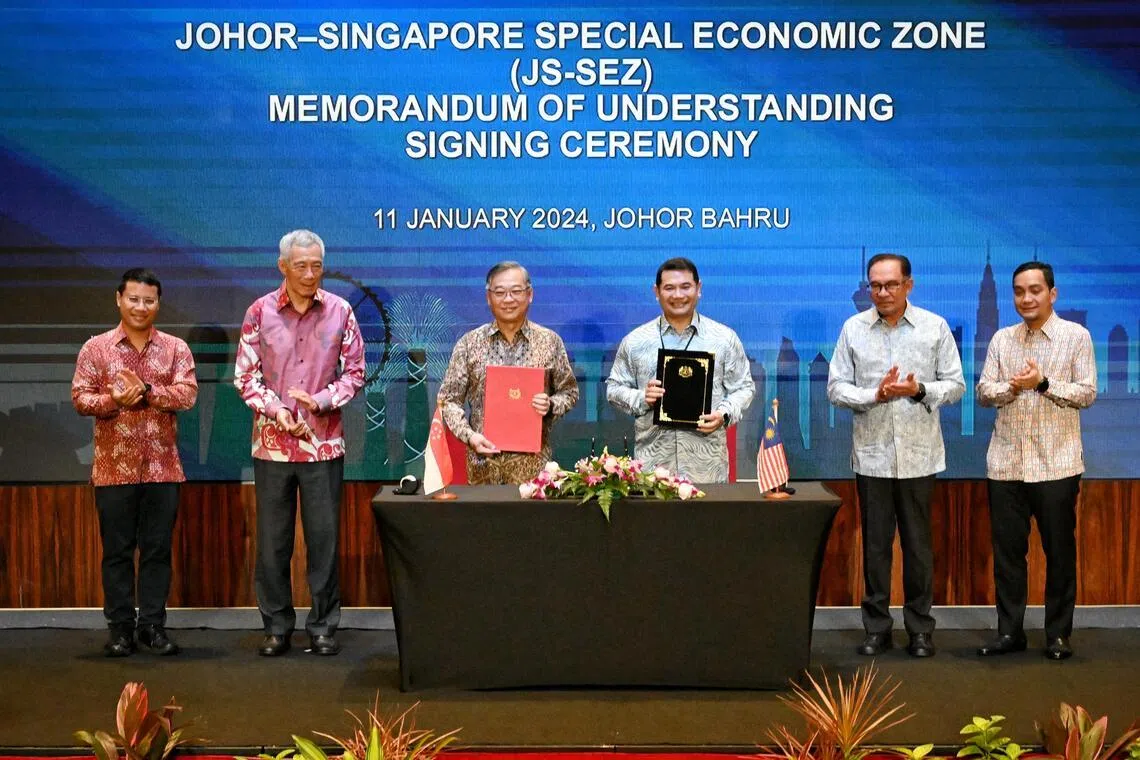
Eight in 10 respondentsidentified the Johor-Singapore Special Economic Zone (JS-SEZ) as the most attractive intra-Asia investment corridor for 2026 to 2028.
Interest is significantly stronger among Malaysian, Indonesian and Philippine companies. Vietnamese chose the Hanoi-Hai Phong manufacturing cluster as their most attractive investment corridor.
“Asean continues to benefit from China+1 opportunities,” said DBS’ Baig and Chua. This is supported by factors such as a strong legacy of manufacturing excellence, a largely friction-free supply chain, competitive and high-quality labour, and plentiful capital, they added.
“By our forecasts, Asean is poised to become the world’s fourth-largest economic bloc by 2030.”
Gain deeper insights into the future of business and be better informed as you navigate what is ahead with The Business Times Insights: Asean Intelligence.
About the survey
This year, The Business Times commissioned market research firm Kantar to conduct a survey to capture the pulse of leadership across the region.
The first wave of the study, conducted in February 2026, polled 538 business leaders in the Asean-6 economies: Singapore, Malaysia, Indonesia, Thailand, the Philippines and Vietnam. They are from diverse industries including manufacturing, consumer and retail, healthcare, and financial services. Most of them are in C-suite or senior management roles, or are business owners.
About 65 per cent of respondents are from large enterprises, and 35 per cent from small and medium enterprises.
In April 2026, a second, more targeted wave of fieldwork was conducted to gauge the impact of the Middle East conflict on business sentiments. It polled 246 business leaders of a similar high-level profile.
“Our mission is to move beyond the surface-level narrative of regional growth,” said BT editor Chen Huifen. “By investing in our own proprietary intelligence, we are ensuring that our readers have access to the ground-level truths that external observers might miss. It is about bringing a home-grown perspective to a global audience, and providing the spark to help leaders turn volatility into opportunity.”
Decoding Asia newsletter: your guide to navigating Asia in a new global order. Sign up here to get Decoding Asia newsletter. Delivered to your inbox. Free.
Copyright SPH Media. All rights reserved.
TRENDING NOW

DBS, OCBC, UOB rout lops billions off STI as inflation, rate concerns spook investors

Grab CEO’s wife Chloe Tong on life with Anthony Tan and finding her purpose

OCBC sheds S$8 billion in value as shares close nearly 6% down; analysts cautious on banks

Deal between tycoon friends sparks scrutiny of Philippine power sector

