


Lease renewals, operational uncertainties cloud reopening for nightlife players
Government's green light may be too little, too late for operators who have already given up their spaces

Singapore
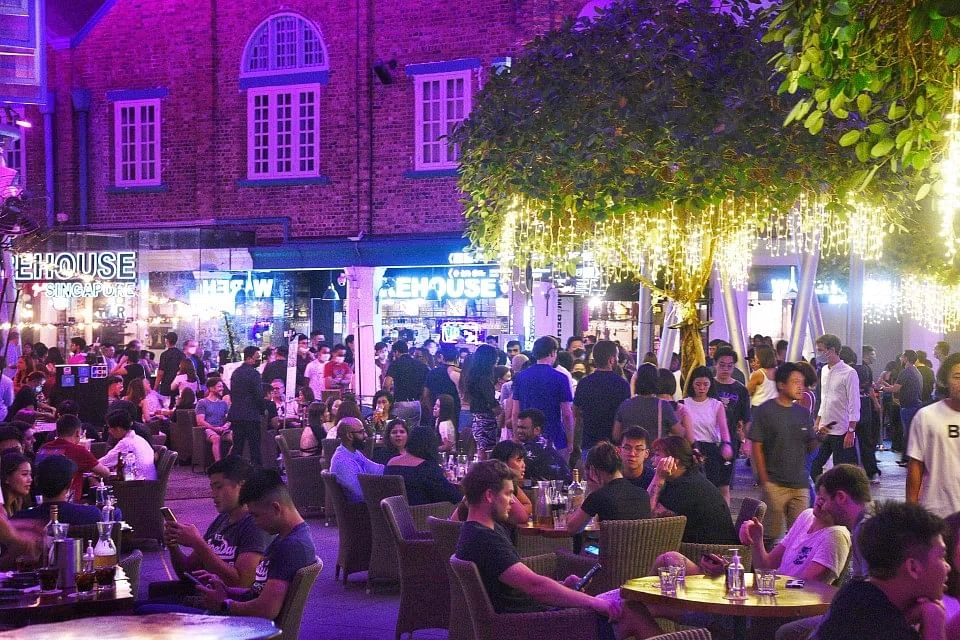
DESPITE nightlife businesses finally being given the green light to reopen, it may be a case of "too little, too late" for existing and former operators, some of whom have given up their spaces and remain cautious about future Covid-19 waves that could shut out the embattled industry here once again.
After defaulting on payments since last November, Frank Per, the owner of Sing My Song Family Karaoke, had the lease of his Paya Lebar Quarter outlet involuntarily terminated on Mar 28.
This was just a week before the government announced that all nightlife businesses - including bars, pubs, karaoke establishments, discotheques and nightclubs - could fully reopen from Apr 19.
"We tried very hard to survive for the last 2 years, so I'm very sad that the reopening news came just after they seized my unit. I've appealed to the landlord to get the unit back, but the chances of reinstatement are slim," Per said.
While his Jurong West outlet is slated to reopen on Apr 19, being able to operate the Paya Lebar branch in tandem would allow him to more quickly recoup the S$1 million in losses he has sustained since 2020.
Per is prepared to search for a new location as a worst-case scenario, though renovations will set him back by an extra S$300,000. It will also take 2 to 3 months for the new unit to be ready, he said.
For Francesca Way, co-founder of A Phat Cat Collective, she and her business partners have no immediate plans to re-enter the nightlife industry after permanently shutting retro discotheque NINETEEN80 and steampunk bar Rails last September. They also shut hip-hop bar-club Pinball Wizard in March 2020.
A potential return will hinge on whether her team can find new suitable locations to house their nightlife concepts.
For one, the Tanjong Pagar shophouse NINETEEN80 previously occupied has since had the use of its premises permanently changed from a nightclub to a restaurant by the landlord.
Another key concern is whether Singapore's nightlife industry will be hit with a fresh round of measures in the future should new Covid-19 variants emerge, Way added.
"At the end of the day, Covid-19 still surrounds us. Nightlife was one of the first sectors to shut, and one of the last to reopen. Is it risky and financially viable to reopen your business after being shut for 2 years?"
Caine Poon, managing partner of Cash Studio Family Karaoke, said the biggest challenge nightlife operators face moving forward is renegotiating for favourable lease renewals once their terms are up.
With the leases of 2 of his 5 outlets expiring in May and June respectively, Poon hopes his landlords will make some concessions in the event that the sector is forced to shut again, such as charging a basic maintenance fee for the space in lieu of full rent.
"Today, operators are renewing their leases knowing there is the risk that the next wave may come. If a wave comes again, there will be no fallback, so we can only try to plan ahead by negotiating for better terms with the landlord," Poon said.
The Singapore Nightlife Business Association (SNBA) told The Business Times that a total of 320 exit grant applications from former nightlife establishments were approved, allowing businesses to receive a one-off payment of S$30,000 from Enterprise Singapore (ESG) to defray business cessation costs.
Over 400 former nightlife establishments have pivoted to other approved uses as at Jul 21 last year, said a joint statement by the Ministry of Trade and Industry and ESG.
SNBA president Nasen Thiagarajan shared concerns on whether pivoted players can renew their existing public entertainment licences or have new ones approved in a "timely fashion", so they can return to business as usual.
"Licensing may be a little more stricter today than what we think we know. How quick is the renewal process, and has any legislation changed in terms of precincts? If so, what adjustments must players make to consider whether it's worthwhile going back to their original form, or staying in their pivoted format?" he asked.
Following the reopening news, the Singapore Police Force (SPF) received 25 applications on Apr 4 and Apr 5 for public entertainment licences that allow dancing and singing within the premises - a "marked increase" in applications as compared with pre-Covid times, a SPF spokesperson said.
The current criteria for licence approval and licencing conditions "are the same as pre-Covid", he noted.
He added that it will take approximately 3 weeks for licence applications to be processed, which is no different from before.
Joseph Ong, managing director of food-and-beverage lifestyle collective 1-Group, had much earlier on accepted that clubbing would "never return in the same way."
This spurred him to redefine the nightlife experience for his nightclub Yang Club - which has been shut since 2020 - and permanently pivot the business for the Covid-19 era.
In the last 18 months, Ong has spent S$100,000 revamping Yang Club and its Clarke Quay premises into Hush, a new "vibe dining" concept which combines the restaurant and nightlife experience into the same environment. Hush is set to open on Apr 19.
"If there was a chance for nightlife to come back, we expected that it could return as something that may still require social distancing," he said.
"Our new concept is more structured and logistically manageable than packing people on one large dance floor, considering the Covid-19 measures that remain in place. We wouldn't have the same problems related to safety and security that a club would face."
READ MORE: Devaluation of airline miles likely with air travel resumption, but impact unlikely to be severe
TRENDING NOW

LTA proposes combining car COE categories, adding rebate-surcharge system

StarHub to acquire MyRepublic’s mobile business amid ongoing telco consolidation
DBS, OCBC, UOB rout lops billions off STI as inflation, rate concerns spook investors

Grab CEO’s wife Chloe Tong on life with Anthony Tan and finding her purpose

