Cadi Scientific aims to bring tech to more hospitals in South-East Asia, Greater China, Middle East

MEDICAL technology (medtech) player Cadi Scientific hopes to bring its digital monitoring technology to more hospitals in South-east Asia, Greater China and the Middle East, looking to these markets for further growth after having established itself in Singapore.
Its flagship Cadi SmartSense digital health solutions use Internet of things (IoT) devices to monitor various aspects of hospital operations. These include indoor location tracking of patients, contact tracing, hand hygiene, compliance monitoring, infant safety monitoring, automated blood supply management and vital signs monitoring.
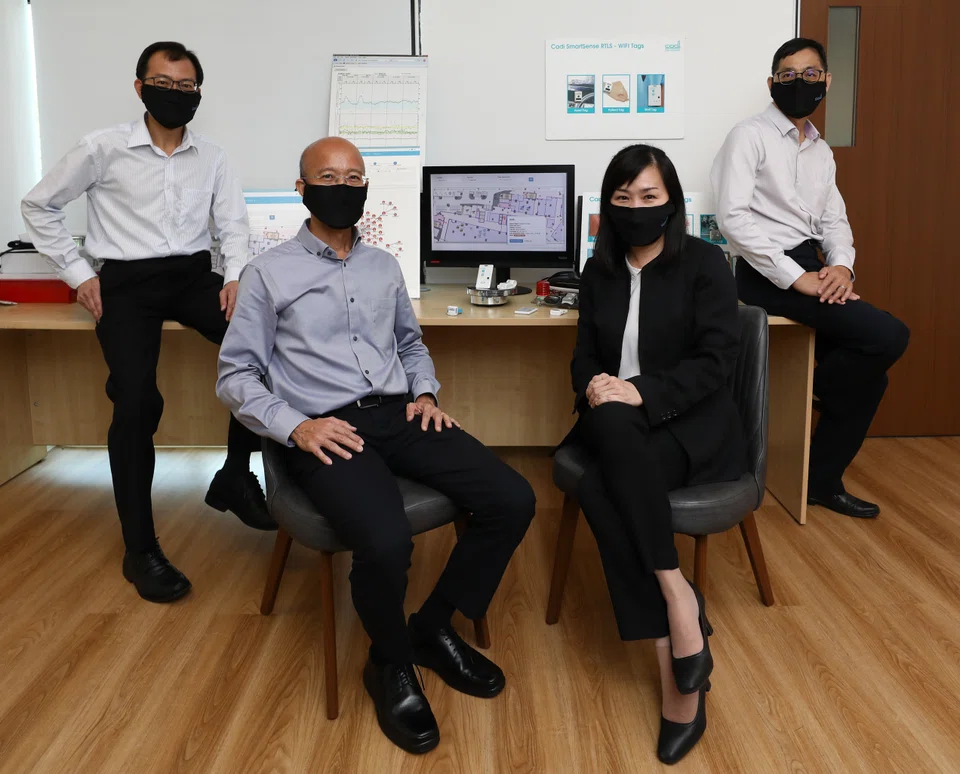
Cadi Scientific was started in 2003 by 4 co-founders who had previously worked together as scientific researchers in a national research centre. The company initially struggled with business development and getting local hospitals to adopt its technology, said director and chief executive officer (CEO) Dr Goh Zenton.
But fast-forward to 2022, and now 70 per cent of Singapore’s hospitals have adopted or are in the process of adopting at least one module of Cadi SmartSense, he noted. These include National University Hospital, Singapore General Hospital, Mount Elizabeth Novena Hospital, and KK Women’s and Children’s Hospital.
“The key thing is our product is already proven in Singapore,” he said. “It has helped hospitals’ workflow and staff.”
Since 2012, Cadi’s products have also been deployed across hospitals in Malaysia, Vietnam, Hong Kong, and Saudi Arabia.
“We are already starting to see some demand from the Middle East and the Greater China region,” said Dr Goh. “We have some use cases there. So now the next step is to look for more good partners to bring us into more hospitals.”
In its initial stages of internationalisation, the company’s strategy was to look for overseas partners who had any point of entry into hospitals – for instance, medical device distributors.
However, Cadi soon realised that picking the right type of partner is critical to getting past barriers in overseas markets. Partners need to be proficient in medical technology and preferably have experience in deploying technology at hospitals, Dr Goh noted.
“Say Singapore and Saudi are different, right? That's why we need a partner because we probably don't understand the language, the culture of Saudi Arabia – and (they can) work with us to make adjustments to our product so that the product is useful for Saudi Arabia (hospitals),” Dr Goh added. “Once we manage to get partners of this kind of profile, the rest is pretty smooth.”
The continued search for the right type of partners is the company’s current preoccupation, as it sets its sights on expansion.
Cadi has been profitable for the last 5 years and registered overall sales of around S$8 million in 2021. Most of this came from Singapore, but as the company expands, Dr Goh expects a greater share of revenue to come from overseas.
With last year’s sales dampened partly by supply chain disruptions amid the Covid-19 pandemic, he also expects better revenue figures this year.
Plug and play
Cadi differentiates itself from competitors by offering “plug and play” convenience, in contrast to hospitals having to reach out to vendors with their specific requirements, said Dr Goh. Rather than sourcing and creating technology from scratch, hospitals can simply work with Cadi to deploy proven technology, he added.
One use case for Cadi’s solutions is in monitoring hand-washing compliance by healthcare professionals, as Singapore hospitals are required to monitor and report this to the Ministry of Health. For instance, doctors and nurses need to wash their hands after visiting a patient and before visiting the next, to reduce hospital-acquired infections.
Without Cadi’s technology, hospitals would typically need to conduct a manual audit of their hand-washing compliance rate once a month or once every 3 months. But with Cadi’s wearable smart tags, compliance can now be digitally monitored. If hands are not washed when they are supposed to be, the tags give a reminder by turning red and sounding an alarm, and by turning green after washing.
“The tech remembers the whole entire process of events: before contact, after contact and duration,” said director and chief marketing officer of Cadi Scientific, Dr Lim Soh Min. “There are a lot of algorithms integrated within the tech.”
This hand-washing tag technology was adopted by the National Centre for Infectious Diseases (NCID) even before the Covid-19 pandemic, with more hospitals requesting it during the pandemic, Dr Goh noted.
“Our core purpose is to provide solutions that really help make people’s lives better. We have the mindset and culture of ensuring that our product really works and really helps our customers, to make them feel that it is something good and useful in their daily life, not just a white elephant,” he said.
Cadi plans to further develop the big data analytics and artificial intelligence (AI) side of its business, to generate operational insights and help hospitals optimise their workflow and resources.
With such data analysis and AI, Cadi could help hospitals achieve reduced patient waiting times, better use of hospital equipment, and reduced costs, said Dr Goh. “Today, our tech has captured so much data – all of this will be useful if we put them together and do some data analytics.”