

F&B catering's back, but not at a sprint yet
Industry hopes that self-service buffets will resume soon

Megan Cheah
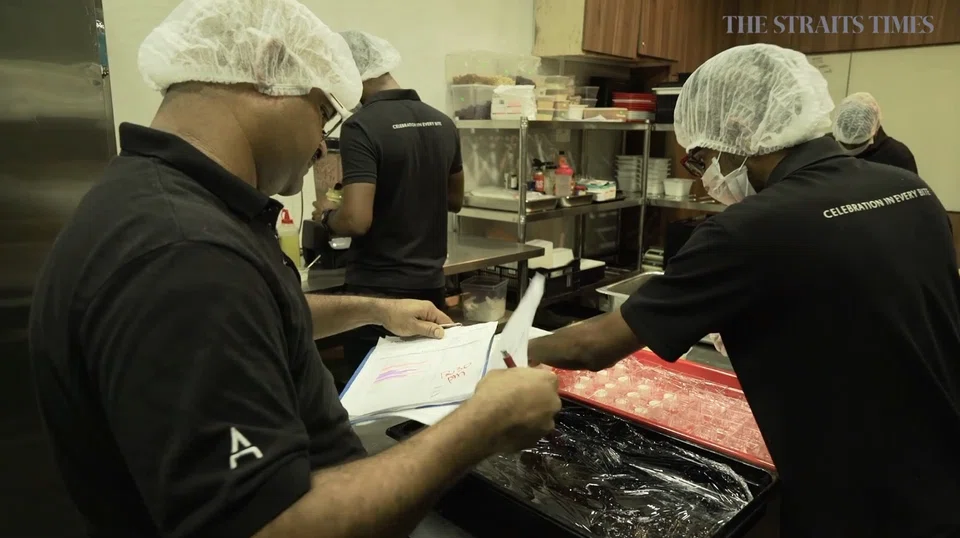
FOOD catering services have been seeing an uptick in business, and anticipate further increases following the easing of safe management measures on Tuesday (Apr 26).
However, sales remain a fraction of pre-pandemic levels, and businesses remain concerned about curbs to events and the manpower shortage that has been plaguing customer-facing sectors.
Alan Tan, managing director of Rasel Catering, said the group has seen around a 50 per cent increase in enquiries for its bentos and buffets served by waiters since last Friday’s announcement that there will no longer be a need for safe distancing and limited group sizes from Apr 26.
This increase is projected to add around 20 per cent to its sales, compared to during the pandemic.
“Everyone is looking forward to a return to normalcy to carry on with dinner and dances and whatever gatherings they had (before Covid-19),” he said.
Amici Events and Catering chief executive officer Willie Tan also credited the relaxing of safe distancing to sales picking up, with former clients returning along with new enquiries.
He sees the group’s business for the year to be 75-80 per cent of its pre-pandemic level, considering the higher number of restrictions faced in the first 3 months.
Caterers were heavily impacted by the government-imposed restrictions during the Covid-19 pandemic, such as the suspension of self-service buffets.
Business came to a near halt then, said Amici’s Tan: “Sales plummeted 85 per cent at the start of Covid-19. A few months into (the pandemic), we were still down by 70 per cent.”
To keep their companies afloat, many turned to serving bento boxes, where meals were packed in individual portions.
Rasel’s Tan said bento boxes, which were only 15 per cent of its business before the pandemic, became its main revenue source in the last 2 years as buffet line equipment went into “cold storage”.
And even after staff-served buffets returned in April last year, bento boxes continued to be popular among clients, accounting for 70-80 per cent of Rasel Catering’s sales.
“We always have to be on 2 modes,” Tan said: “Although staff-served buffets have returned, some customers are more conservative and still prefer to order bento boxes.”
Other ways in which caterers pivoted include offering ready to cook and ready to eat options, as well as delivery, said Vincent Phang, chief executive officer of Tung Lok Group’s events and catering division.
Tung Lok had ventured into this area during the pandemic, offering both halal and non-halal variations of their dishes. These were particularly beneficial at the peak of the pandemic’s restrictions, when both its catering division and restaurants had been unable to serve customers.
Since the easing of measures, sales have picked up, as reflected in the February 2022 food and beverage sales index – food catering sales increased 26.3 per cent year on year, largely due to a low base in February the year before.
But the food catering remains heavily affected by the curbs to events, which still require vaccinated-differentiation safe management measures if there are more than 500 participants.
The government also announced on Monday that self-service buffets will continue to be suspended – a blow to the already labour-strapped sector, as staff-served buffets and packing of bento boxes require more hands on deck.
Phang, who is also president of the Association of Catering Professionals Singapore (ACAPS), said the association is looking to write to the regulatory boards to appeal for the resumption of self-service buffets.
He reckoned that food caterers remain at a disadvantage due to these curbs, as they rely on the high volume from events-heavy sectors such as the meetings, incentives, conferencing, exhibitions (MICE) industry.
“We are still down by 30-40 per cent, compared to pre-Covid days,” said Phang. ACAPS currently counts around 88 caterers and about 80 companies in related fields such as food supply among its members.
Phang observed that bento boxes are not likely to achieve as high a yield as buffets. For example, a bento can be priced at around S$5 per person, but if the food were to be served in a buffet, each person’s portion could be priced at twice the amount.
Another pressing issue for these companies is the lack of manpower. Service and cooking staff are usually foreigners, and that many have returned home when borders opened.
Amici’s Tan said the company had 50 staff members in 2019, but the number dropped to 35 in 2020 and 25 in 2021: “Today, we have gone back to 35, but are still short of our target of 50.”
TRENDING NOW

OCBC customers face difficulties accessing online, mobile banking services

SGX CEO Loh Boon Chye to step down; succession planning under way

Waymo founder predicts ‘landslide’ robotaxi adoption in Singapore, driven by high car costs

Vietnam’s northern provinces, not Hanoi or Ho Chi Minh City, are powering near 10% GDP growth

