


Gripping vision of the future
SODA Vision wants to grab attention with its robotic bin picking technologies.
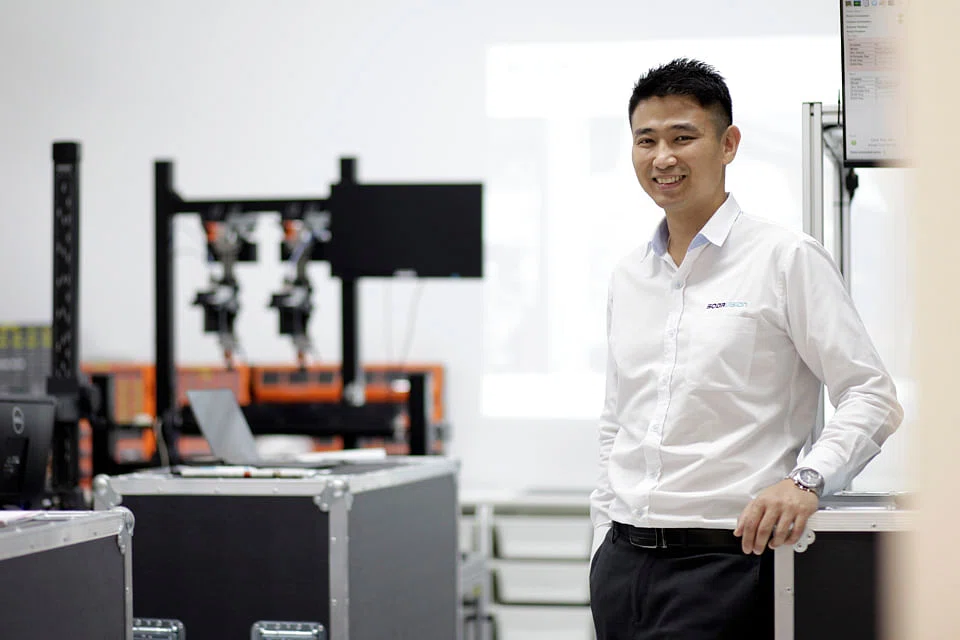
A machine sits on a table, framed by four pillars. In front of it are two bins, one with neatly arranged plastic parts, and the other empty. When an engineer starts the machine, a red light flickers to life and scans the two bins.
The mechanical arm of the machine stretches forward, gripper poised above the bin filled with parts before picking up a part and depositing it into the other bin. It continues until one part is left in the bin. Throughout the entire process, the engineer has not intervened.
This is not a product of the future, but one that has been designed in a collaboration between SODA Vision and Photoneo. It was showcased at this year's TechInnovation in Singapore, an event where local and international technology providers gather.
Founded in 2012, SODA Vision's primary focus is on automating the sorting process.
Last year, SODA Vision collaborated with Photoneo to develop a machine equipped with a 3D scan that enables the machine to recognise objects and automate the sorting process without any human interaction. This saves time, monetary costs, as well as prevents human errors when sorting for quality control.
All about SODA
SODA Vision is involved in trading machine vision components. These components help machine builders and system manipulators build their machines. Managing director and co-founder, Eng Chin Jack, said he named the company SODA because he was inspired by a song from Taiwanese band Soda Green, who his wife also listens to.
When the company was first founded, it was difficult to get business. Mr Eng said: "It was the downturn of the semiconductor industry, 2012 to 2013, so we didn't get a lot of business during the starting phase."
However, after acquiring new staff, business for SODA Vision soon picked up. On their fifth anniversary, the company managed to hit their target of five million sales in five years. Mr Eng said the company hopes to hit another 50 million in the next five years.
SODA Vision met Photoneo during TechInnovation in 2017 (see clarification note). The other company, headquarted in Slovakia, was looking for a partner with expertise in machine vision to promote and sell their products.
Mr Eng said: "Photoneo has one of the fastest and latest 3D scanners in the market. Their technology is advanced and they have a great R&D team. We are happy to work with them to bring the latest technology to South-east Asia."
The companies chose to do robot bin picking because they felt factories in South-east Asia needed more efficient technologies.
Mr Eng said: "The labour market in Singapore is in a crunch and we need new technologies to help us do more efficient jobs and processing in factories. We thought the machine vision industry and 3D was what factories in South-east Asia needed. This technology is able to help factories reduce reliance on human labour by automating the placing process."
From this collaboration, SODA Vision has attended four exhibitions in the region. With the help of Photoneo, the company has done two exhibitions in Malaysia and two in China.
Mr Eng said during those exhibitions, good feedback was generally obtained from customers. Technologies like Mr Eng's are usually used in factories. "The next step for us is to bring the machines down to the customers, to let them try it out."
Moving forward
The company hopes to further develop the technology. Mr Eng says he hopes the company can move to building software that would allow the machine to grab packages. It would help in the e-commerce and logistics industry. It will also feature the same 3D scanner and robotic arm.
SODA Vision currently has its robotic bin picking technologies ready to show at this year's TechInnovation. The application will showcase random bin picking technology without human intervention.
"It's going to be very exciting to this market, because throughout the exhibitions in Singapore, we have not seen an actual demonstration of 3D bin picking.
SODA Vision hopes to continue research and development efforts in merging 3D, deep learning and embedded systems. Mr Eng said: "The three main areas of vision technology involvement would be 3D, deep learning and embedded systems. So our companies would spend more R&D efforts in merging these technologies to create a tool for our Singapore customers to use in their machines."
Mr Eng, previously a photographer by trade, chose to go into the machine vision industry as it combined his work and hobby skills.
He was previously trained in the semiconductor factory and various Japanese lens and optics factories. He said: "I am glad to work in this industry, where I can help people develop better quality control in the factories."
The company has since helped clients in different industries, including aviation. They have also worked with prominent mobile phone companies to help with quality control.
After all, quality control is at the heart of what Mr Eng does.
"I think for humans, when our quality of life gets better, we want to have better products and safer products for the environment, that is why I think quality products are very important."
Clarification note: In a previous version of the article, it was written that the product was showcased at last year's TechInnovation event. It was this year.






