Singapore firm budgets up to S$15m for a full smart factory
Singapore
AMID manufacturing headwinds, Fong's Engineering and Manufacturing is prepared to spend up to S$15 million to launch a full-fledged smart factory in the next three to five years, in a bid to boost revenue and productivity.
Fong's, which manufactures high-end medical devices largely for US medical devices companies, aims to run its production round the clock with minimal human intervention, aided by an integrated manufacturing shop floor with advanced robotics and autonomous robots.
The system will also come with Industrial Internet of Things (IIoT) capabilities for collecting data, allowing the company to track the performance of individual machines and conduct production planning.
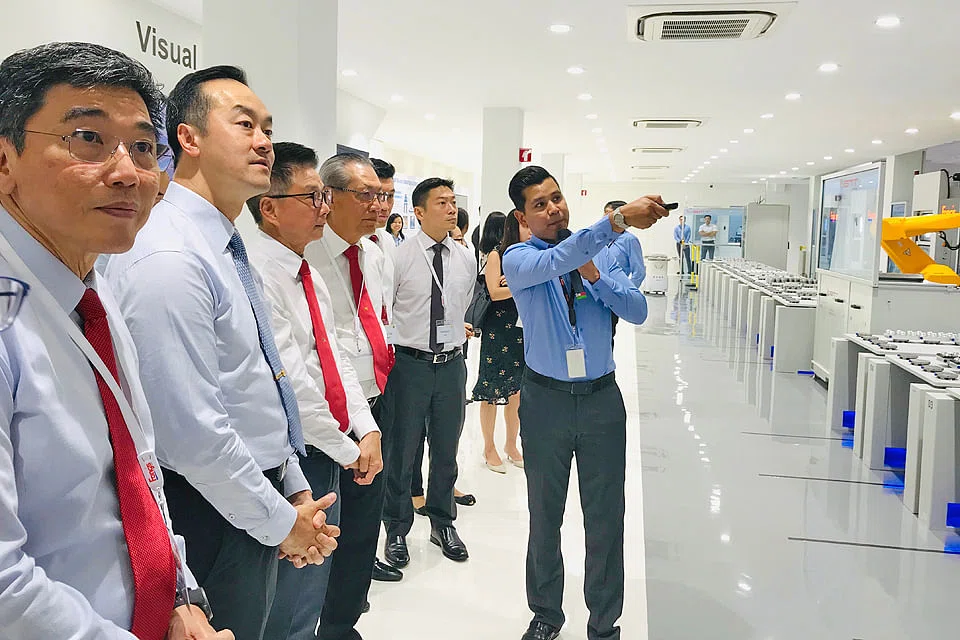
One of its three production lines has already been transformed, for over S$3 million, said Jeremy Fong, chief executive officer at Fong's, during the launch of the company's smart factory journey on Tuesday.
The revamp is expected to raise Fong's revenue by 20 per cent year on year; the company recorded S$30 million in revenue last year, Mr Fong told The Business Times. It's also expected to up Fong's productivity by at least 30 per cent.
Senior Minister of State for Trade and Industry Koh Poh Koon, who was the guest-of-honour at the event, commended Fong's "bold move" to harness the potential of Industry 4.0.
"The manufacturing sector has been facing strong headwinds lately due to the weakening global economic environment coupled with some tightening of our domestic constraints," said Dr Koh.
But this is not the time to slow down, he said. "We must press on with our transformation efforts in order to weather the storm, and more importantly, seize new opportunities when the dark clouds clear."
In 2018, the manufacturing sector accounted for over 20 per cent of Singapore's gross domestic product and about 13 per cent of the workforce.
A Boston Consulting study has estimated that the adoption of Industry 4.0 in Singapore could improve labour productivity by about 30 per cent, create 22,000 new jobs with better wages, and grow total manufacturing output by S$36 billion by 2024.
To other precision engineering firms looking to follow in Fong's steps, Mr Fong said: "Before transforming your machining shops or your smart line, you must look into your business first, make sure that your business model is in the right direction."
Firms also need to persist through challenges, he said, such as changing the leadership and employees' mindsets.
Fong's, which employs about 170 people, is putting its workers through training in line with the shift towards smart manufacturing. Employees can also benefit from better wages, to the tune of a 5 per cent hike, according to Mr Fong.
In his speech, Dr Koh also called on companies to put workers at the forefront of Industry 4.0 to "better catalyse acceptance, adoption and actualisation of technology".
"The Industry 4.0 will not happen without Worker 4.0," he pointed out. "If it were so easy to just buy technology, Industry 4.0 would have succeeded years ago."