Singapore robots make their way to European factories
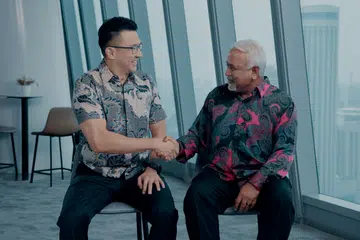
SESTO Robotics partners Germany-based automation specialist firm Baumüller to extend its reach globally.
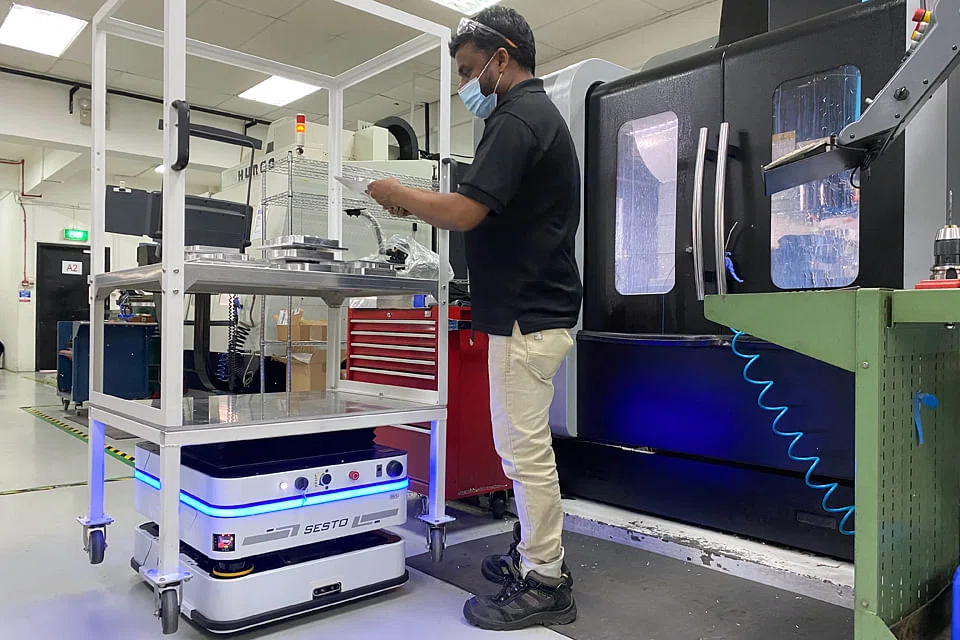
SINGAPORE-DESIGNED and manufactured autonomous mobile robots (AMRs) will soon be toting materials and equipment around manufacturing plants in Europe, helping the industry there adapt to changing demands that call for frequent retooling of factory processes and set-ups.
Under a partnership announced last month between local technology company SESTO Robotics and Germany-based automation specialist Baumüller Anlagen-Systemtechnik, Baumüller will take SESTO's flagship AMR, the SESTO Magnus, to Baumüller's customers in Germany, Austria and Switzerland.
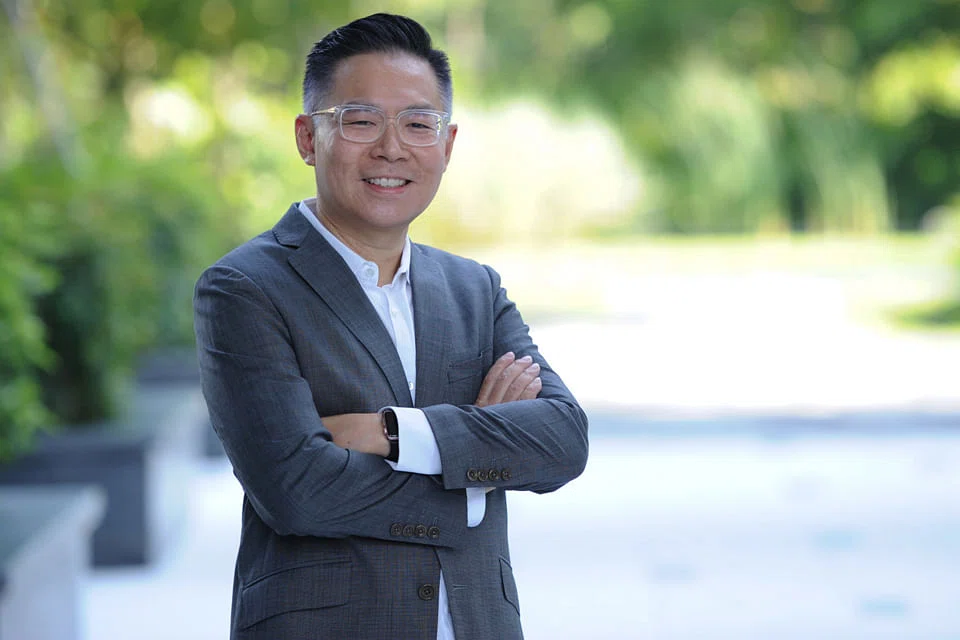
In an interview with The Business Times, SESTO chief executive Ang Chor-Chen said the Magnus is an ideal solution for the changing demands faced by manufacturers looking to automate more of their processes.
Developed over 12 months and launched in August 2020, the Magnus includes features such as self-navigation, easy-to-configure software and the highest payload rating in its class.
These are important for manufacturers trying to keep up with new trends in manufacturing such as shorter and faster production cycles and high-mix, low-volume production, Mr Ang said.
"When companies need to react to market demands of shorter and faster product cycles, meaning they need to update their product features and specs very frequently, they constantly need to retool and re-setup their different production lines and stations.
"Our robot is able to navigate freely. That fits in very well with the requirements that are accelerated by these trends."
The partnership with Baumüller taps the electric drive and automation systems manufacturer's existing network of customers and contacts in Europe to reach a ready market. Mr Ang noted that the Magnus is a higher value addition to Baumüller's line-up of solutions and products in its automation projects, and Baumüller will derive recurring revenue from providing deployment and wholesale support to the end customers.
Potential to reach other industries
Although this partnership targets manufacturing companies as the initial market, Mr Ang believes there is potential to work with Baumüller further to reach other industries that could also make use of the Magnus.
In particular, he is keen to expand the AMR's applications beyond delivery, intralogistics and in-house delivery to healthcare. For example, SESTO launched a disinfection robot solution in early 2020 to help tackle the Covid-19 pandemic, and has designed the Magnus to be able to carry a disinfection module too.
The Magnus is equipped with Light Detection and Ranging (LIDAR) technology that enables it to navigate on its own using an internal map. This is unlike automatic guided vehicles (AGVs), which require magnetic strips or other guides to direct them in fixed routes around a production floor.
End users can configure the Magnus further, to move faster in certain zones or floors of a building and slower in high traffic environments, for instance.
It can carry a maximum payload of 300kg, while still being small enough to move through openings or corridors as narrow as 90cm, such as between trolleys or hospital beds parked along corridors. The Magnus can carry a variety of payloads, such as robot arms for testing and inspection in manufacturing and food warmers in healthcare settings.
SESTO is working with healthcare providers to understand the scheduling and workflow required to deliver meals to patients. The robots will be able to identify the right food carts and where they need to go, and deliver them to the wards so that the nurse attendants can retrieve them easily and serve the meals.
"This is one solution we have developed for our own market that Baumüller could market to their territories," Mr Ang said.
Prior to the partnership with Baumüller, SESTO's focus was in Asia, doing direct sales in Singapore and working with partners and distributors in markets such as Malaysia, Thailand, Taiwan and Hong Kong.
Mr Ang declined to reveal how sales of the Magnus have performed so far, but said it has been "well-received" and sales per unit are expected to grow almost five times this year with the addition of the European markets.
SESTO will continue extending its reach through partnerships with distributors who have the right capabilities and can value-add to SESTO's solution for their customers, he said. The company intends to add partners in the UK and Australian markets this year.
Even as large manufacturers often lead the way in making large investments in automation projects, SESTO is keen to include small and medium-sized enterprises (SMEs) in the digitalisation and automation journey.
It is doing so by offering a leasing programme to make the Magnus more affordable for SMEs, which may not have the resources to make a large initial capex investment. The Magnus cost more than S$500,000 to develop and is sold for S$60,000 to S$70,000 per unit.
"Having a leasing alternative helps different companies and SMEs in particular to be able to adopt our solution and almost pay-as-you-go-along on a leasing programme," said Mr Ang. "That helps to expand our market, because it will be more accessible to different types of customers and companies."
SESTO will continue to expand through product diversification and original equipment manufacturing (OEM) partnerships with multinational corporations (MNCs) that want to launch their own AMR products.
"By entering more heavy industrial markets in Europe where automotive is still a very important core segment of manufacturing, there will be requirements for higher payload AMR solutions, so we will likely come up with a higher payload solution," Mr Ang said.
"At the same time, there are more requirements coming from the service sector. There is an opportunity for us to build a lighter payload AMR to suit the service applications where it's more about performing tasks for commercial spaces versus manufacturing and healthcare environments."
Becoming an OEM vendor for MNCs will allow SESTO to scale up faster, Mr Ang added.
He believes that South-east Asia will benefit from the broader trend of reshoring manufacturing activities into the region as a result of trade conflicts, and there is room for SESTO to leverage this trend.
"While South-east Asia traditionally has lower labour costs, the larger companies that are reshoring will still want to automate because that's what they believe in - the value of automation in providing consistency of output. That bodes very well for companies like ours."
Decoding Asia newsletter: your guide to navigating Asia in a new global order. Sign up here to get Decoding Asia newsletter. Delivered to your inbox. Free.
Share with us your feedback on BT's products and services