Steering MDIS beyond the Red Dot

A Graduate Employment Survey (GES) published in April noted the perceived gap between Private Education Institutions (PEIs) and public universities, in that graduates from the three publicly funded universities - the National University of Singapore (NUS), Nanyang Technological University (NTU) and Singapore Management University (SMU) - landed jobs much more quickly than graduates from private schools.
The private education industry has of late undergone a shake-up, wrought by a series of stringent requirements imposed on PEIs by the Committee for Private Education (CPE): Some of these requirements include a minimum credit rating and mandatory participation in yearly graduate surveys.
The operating environment for PEIs has thus become increasingly challenging, which has opened up the gulf between private and public institutions.
Saturated education sector
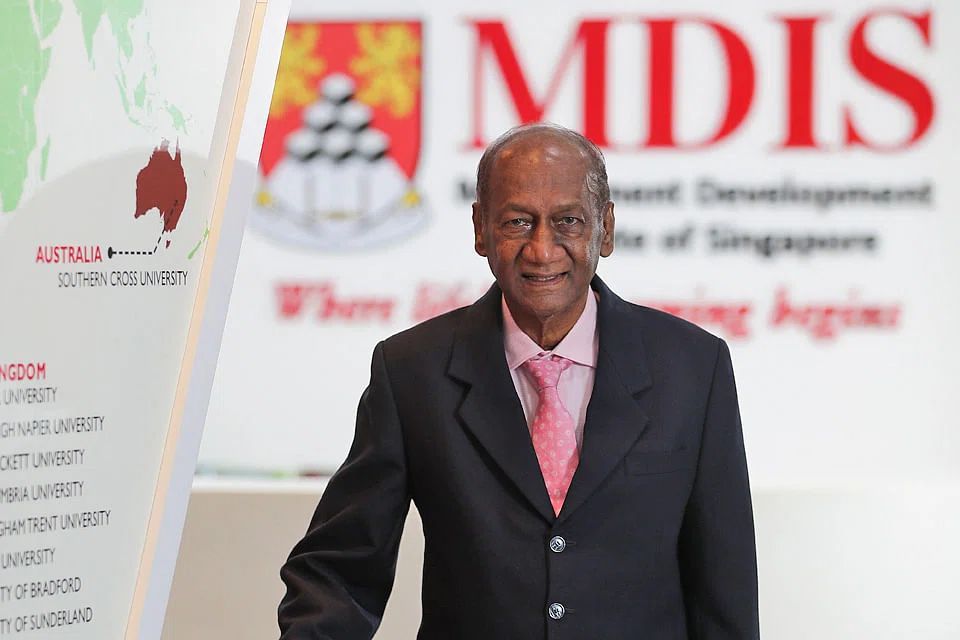
R Theyvendran, secretary-general of the Management Development Institute of Singapore (MDIS), noting how saturated Singapore's education industry has become, with hundreds of players vying for a limited pool of students, said: "Students who wish to study in Singapore have an abundance of choice."
Private education institutions thus need to build solid reputations for quality to ensure their survival.
MDIS, in a testament to its track record, picked up its second Enterprise 50 (E50) award this year.
Through its 62 years of history, its management team has evolved into one that constantly reviews the school's course offerings and engages with key stakeholders to implement expansion plans.
It is a non-profit institution, and a fiercely self-reliant one. Its governing council plays a vital role in managing the school's resources and charting its path.
The institution is determined not to let complacency creep in, despite having another E50 award to its name.
Its vision is to become an institution for lifelong learning, to become a recognisable name globally, and to find new ways to grow.
Its current focus is on improving its students' skill sets and on finding new opportunities for international collaborations.
Dr Theyvendran said: "As a forward-looking institute, MDIS wants to lay down the foundations for new programmes and facilities before the industry realises its needs.
Future-ready skills
"This involves equipping students and mid-career professionals with future-ready skills to meet evolving industry demands."
The institute has attained Approved Training Organisation (ATO) status for its bakery and culinary studio.
It has also launched a National Certificate in Professional Cookery programme, which complements its tourism and hospitality courses, and plans to introduce other skills-based vocational programmes and Singapore Workforce Skills Qualification (WSQ) certifications.
Over the years, MDIS has built up partnerships with universities in Australia, France, the United Kingdom, and the United States of America.
It recently partnered with leading universities in the UK, including the University of Portsmouth and Coventry University, both of which have attained a "gold" rating under the Teaching Excellence Framework.
MDIS' management has also worked to set up international collaborations, and will continue to do so, said Dr Theyvendran.
"The school is looking to have 100 new industry partnerships by 2020, to provide avenues for students to gain practical skills and experience," he said.
Education beyond borders
With operating in Singapore being challenging, it has become important for MDIS to look for alternatives to achieve organic growth.
The first opportunity to expand overseas came in 2008, when the institution was approached by the Uzbekistan Banking Association (UBA) to set up a campus in Uzbekistan.
The central Asian nation has 52 state universities, but MDIS offered the lure of a Singapore-accredited education.
As a result, MDIS Tashkent (MDIST) was set up.
Today, more than 2,500 students are enrolled at MDIST; they hail from countries such as South Korea, Ukraine, Afghanistan, Kyrgyzstan, Tajikistan and Kazakhstan.
The response to MDIST's programmes has been encouraging; to cater to the increasing demand for places, the campus is now undergoing an expansion to accommodate 5,000 students.
After MDIST was set up, strategic partnerships followed - first in Malaysia, followed by India.
Regional expansion
MDIS is now exploring opportunities in Myanmar, Indonesia and the Philippines to expand its regional presence.
Jesline Wong, MDIS' senior director of communications, said: "We have grown with the nation, and we are proud to have brought the Singapore flag overseas."
Where most institutions focus on the needs of an increasingly international student body, few have gone the extra mile to set up full-fledged campuses overseas, and driven the Singapore brand of education beyond the shores of this "little red dot".