Small in size but giants in influence
Ireland and Singapore may be on opposite sides of the world, but more similarities mark these islands than differences.
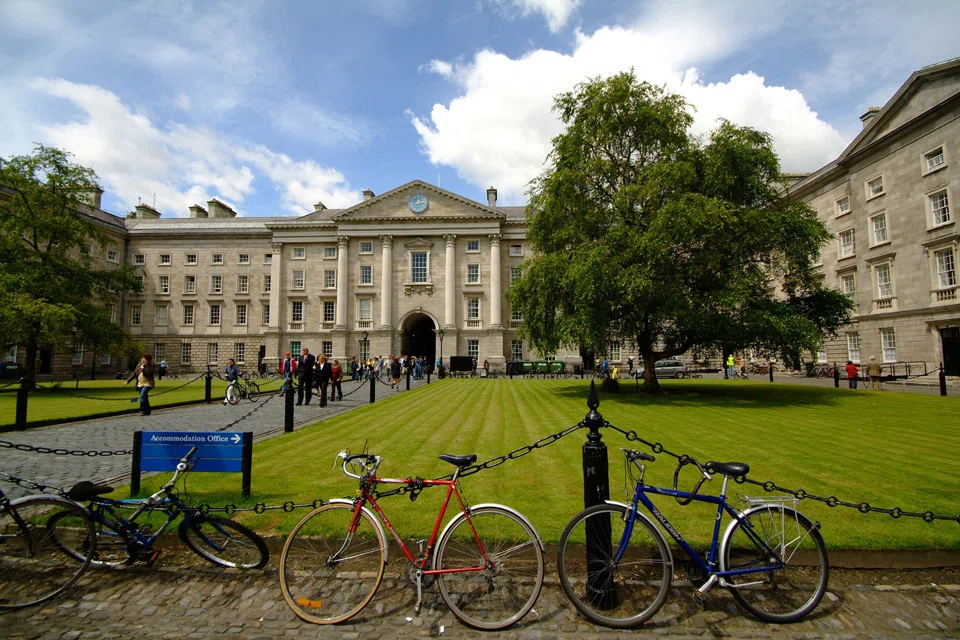
ST PATRICK'S Day falls on Mar 17 and is Ireland's national day. In Singapore, as in Ireland, St Patrick's Day celebrations usually include enjoyment of Irish food, drink and revelry with friends at restaurants and watering holes.
Ireland and Singapore are like 2 dots - one green and the other red. Ireland, also known as the Emerald (green) Isle, has large expanses of greenery and pastureland.
Singapore, on the other hand, also known as the Little Red Dot, is an island with large swathes of concrete jungle and less greenery than in Ireland. Both countries may be a long way from each other, and have very different histories, but there are also many parallels between them.
Size and location
Ireland and Singapore are located on the edges of large continents and surrounded by large neighbouring countries.
Ireland is on the edge of Europe and has the United Kingdom as a neighbour, while Singapore sits at the edge of Asia and has Malaysia to its north and Indonesia and the Philippines to its south and east.
Ireland and Singapore were both former British colonies, and both still use English for education, business and cultural exchange, in addition to other major languages - Irish in Ireland, and Malay, Mandarin and Tamil in Singapore. Their populations are also similar - Singapore with 5.7 million people, and Ireland with 5 million people.
Gateways to their regions
Both countries initially depended on farming and agriculture, but have since gone on to become successful knowledge-centred economies. Singapore serves as a major trade and transportation hub for business with Asean and Asia, while Ireland acts as a gateway to the European Union. So, firms that invest or trade into Ireland have unfettered access to that much larger consumer market.
Economic powerhouses
When Ireland became independent from British rule in 1922, it had humble beginnings, but has now grown to have a per capita gross domestic product (GDP) of US$73,200 as of 2017. In 1987, the creation of a 10 per cent low-tax "special economic zone'' helped transform Ireland's economy, and transformed the country into a global leader in technology and financial services.
The establishment of hubs such as Dublin's International Financial Services Centre led to strong and sustained economic growth in Ireland, which became known as the Celtic Tiger - a reference to the way in which its growth was similar to that of Asian countries such as Singapore.
When Singapore achieved independence in 1965, its per capita GDP was lower than that of India, but it now has a GDP per capita of US$94,100 as of 2017.
Between the early 1960s and 1990s, Singapore underwent rapid industrialisation and maintained exceptionally high growth rates, thanks to export-oriented economic policies and low tax rates. The country was known as one of the 4 Asian Tigers - the others being South Korea, Taiwan and Hong Kong.
Political systems
Singapore and Ireland are both republics and parliamentary democracies. Both countries are known for their political neutrality and as "honest brokers" in international relations. Both are active members of their respective regional blocs - Singapore within Asean and Ireland within the European Union, which it joined 50 years ago.
Despite their small sizes, Ireland and Singapore punch way above their weight in diplomacy.
Ireland is credited with developing the Treaty on the Non-Proliferation of Nuclear Weapons, and is currently a member of the United Nations (UN) Security Council. Former Irish president, Mary Robinson, was UN High Commissioner for Human Rights from 1997 to 2002, and is now a leading member of The Elders group.
Singapore, for its part, has played an important role in shaping UN treaties such as the UN Convention on the Law of the Sea, and Singaporean Noeleen Heyzer was under-secretary-general of the UN and executive secretary of the UN Economic and Social Commission for Asia and the Pacific, and is now UN special envoy to Myanmar.
Quality of life
Singapore and Ireland share similar quality-of-life indicators. According to livingcost.org, Singapore and Ireland are ranked first and third best countries to live in the world, respectively.
Singapore's average life expectancy is 86 years (83 years for men and 89 years for women) as of 2020. Ireland's average life expectancy is 81 years (79 years for men and 84 years for women) as of 2020.
Ireland is a popular destination for many Singaporeans, especially for those who want to study medicine, dentistry, nursing and physiotherapy.
Hotelier and restaurateur Loh Lik Peng was born in Dublin as his parents were doing their medical training there. Trinity College Dublin, University College Dublin and the Royal College of Surgeons Ireland are popular choices for Singaporean students.
Similarly, many Irish study in Singapore.
Well-known Irish in Singapore include George Drumgoole Coleman, the Irish civil architect who designed St Andrew's Cathedral, Raffles Institution and the Armenian Church of Saint Gregory the Illuminator, and Brother Joseph McNally, Irish De La Salle Brother who founded the Lasalle College of the Arts. He was also a teacher at St Joseph's Institution and former principal of St Patrick's School.