From baseball to banking, companies race to invest in new wave of AI
Enterprise software providers see growing demand from companies to build in-house AI tools, but concerns over regulation remain

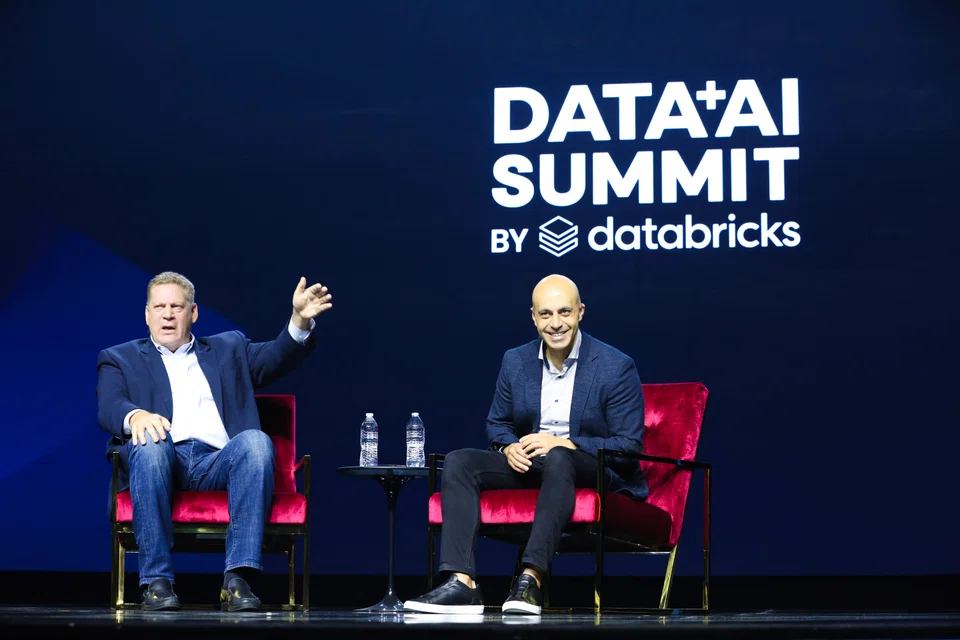

[SAN FRANCISCO] What does it take to win a baseball championship? It’s not just about having the best coaches and players anymore. Some teams, such as the Texas Rangers Baseball Club in the US, are turning to artificial intelligence (AI) to gain an edge.
The team uses markerless motion-capture technology to track players’ arm swings and joint movements. This can refine their hitting approach and even help predict and prevent injuries, said Alexander Booth, the team’s assistant director of research and development.
More recently, the Rangers started harnessing weather data to model the air flows in ballparks.
Booth, who was speaking at the Data + AI Summit last month in San Francisco, an event organised by software company Databricks, said: “It’s just crazy… Now for every hit you make, we can tell you how lucky it was that it was a home run; did the wind help it or did it not.”
Baseball is just one among the diverse range of industries – such as banking, healthcare and education – in which demand for AI has grown in recent months.
Companies are racing to invest both in predictive models, which can anticipate future trends, and generative AI tools, which can create text, images and videos like humans. The aim is for AI to serve as a “co-pilot” to employees, boosting productivity and performance.
The release of ChatGPT last November stoked interest in the potential of AI, noted Ali Ghodsi, chief executive of Databricks. The 10-year-old company provides enterprises with a range of tools to streamline and manage their data, and harness it for AI applications.
In January, Databricks had about 700 customers tapping large language models (LLMs), the technology that underpins AI chatbots such as ChatGPT. That figure had doubled to 1,400 as at May.
“There was no technological breakthrough in November, but I think one should not underestimate the awareness revolution… Everybody’s now interested in what we are doing, and it’s just harder to keep up with the demand,” Ghodsi told The Business Times.
Wide use cases
Databricks has noted companies’ interest in generative AI for applications such as conducting sentiment analysis on consumer reviews, as well as reading financial documents and summarising risks; in healthcare, these models could summarise doctors’ notes for electronic medical records.
Here in Asia, there is interest in LLMs that understand and generate content across multiple languages – especially “low-resource” languages that are widely used but not well-represented online, such as Hindi, Vietnamese and Thai.
“Just take a country like India, where there are over 200 languages… These models are very, very good at quickly understanding and learning these low-resource languages,” said Ghodsi. He noted that potential applications include translating press statements into these languages and tracking consumer reviews.
Like Databricks, Amazon’s cloud unit is seeing strong interest in generative AI solutions, with many companies asking how they can tap LLMs to better communicate with customers, said Olivier Klein, chief technologist of Amazon Web Services (AWS) in Asia-Pacific.
AWS has received many requests to optimise call-centre operations. “Most customers don’t look necessarily to automate the entire customer conversation, but rather to enhance the (call-centre) agent experience,” he told BT at a Singapore media briefing on Jul 5.
For instance, businesses can use AWS’ platform to plug into an LLM trained in in-house data, which can provide call-centre agents with quick responses to queries, instead of requiring the agents to look it up themselves.
It’s about “making your agent a lot more efficient, so that they can focus on having a great interaction with the customer, rather than browsing your internal knowledge base”, he said.
Companies are also keen on predictive AI. Singapore-based car-sharing platform GetGo has been exploring how AI could help with predictive maintenance of its fleet. By crunching data on the usage of the car, an AI model could indicate when the tyres need to be replaced, for instance.
“One of our top priorities (is) fleet analytics... If we can try and predict when to send the car in for servicing, that will solve a big headache for customers,” GetGo’s head of data science and engineering, Maximilian Jackson Yap, told BT at the Data + AI summit.
Big money, big risks
Amid strong demand from enterprises, Databricks has doubled down on its generative AI capabilities. On Jun 27, it announced plans to buy MosaicML, a nascent challenger to ChatGPT maker OpenAI, for US$1.3 billion.
This comes amid other mega AI investments by big-tech giants such as Google and Microsoft. Amazon last month announced that it was investing US$100 million in a centre to help companies tap generative AI.
While the potential of AI is seemingly limitless, companies are also wary about the pitfalls of the technology. Generative AI tools in particular are prone to “hallucinations”, or fabricating information.
As former Google chief Eric Schmidt warned at the Data + AI Summit, the technology could also be used by bad actors for biological threats or spreading misinformation.
Larry Feinsmith, JP Morgan Chase’s head of global tech strategy, innovation and partnerships, also sounded a note of caution in a dialogue at the summit.
“We at JP Morgan Chase will not roll out (generative) AI until we can mitigate its risks. You want to talk about responsible AI… You want to talk about having the right cybercapabilities, so that the models aren’t poisoned or tampered,” he said.
The bank is “working through those risks as we speak, but we won’t roll it out until we can do this in an entirely responsible manner”, he added.
That said, the potential of AI is undeniable for major industry players such as JP Morgan Chase. Previous media reports indicate the bank is developing an AI tool called IndexGPT for “analysing and selecting securities tailored to customer needs”, according to a patent filing.
At the summit, Feinsmith pointed to a telling detail from the shareholder letter by chief executive Jamie Dimon.
“AI and ML (machine learning) (were) mentioned 19 times in Jamie’s shareholder letter. The only words that were mentioned more were interest rates, of course,” he said.