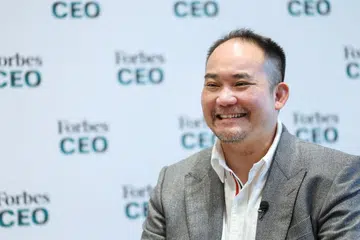
5 Questions with Kelvin Teo, fintech man on a mission

Claudia Chong
STARTUP and crises often go hand in hand. Be it tackling a black swan event such as Covid-19 or navigating a sudden change in the operating environment, overcoming near-death experiences are a rite of passage for startups.
Kelvin Teo, co-founder of fintech company Funding Societies, has been through a number of these experiences since starting in 2015. He has had to cope with sticky situations, including investors pulling out at crucial moments.
In this edition of 5 Questions, Teo shares how he kept the company together and why he often chooses to share Jack Ma’s advice with younger peers.
1. Tell us about your career journey, and how you co-founded Funding Societies and raised money while at Harvard Business School (HBS).
I came from Malaysia to Singapore at 15, thanks to the Asean scholarship, so there is an underdog mentality. After graduating as valedictorian from NUS as part of its entrepreneurship program (NUS Overseas Colleges) at UPenn, I went to Accenture, McKinsey and KKR Capstone to learn about tech, strategy and execution. After four years of intense work, I applied to MBAs for a break. Harvard was the only offer I got, so I went.
In the presence of many brilliant minds, HBS makes you believe that you can “make a difference”. I met my classmate and co-founder Reynold Wijaya. We talked about life and dreams and wanted to help other underdogs and make a positive impact in South-east Asia. We studied the most innovative US firms in the last three years, assessing them by passion, impact and path to Number 1. Small and medium enterprises (SMEs) resonated with us, and financing is their biggest pain point, so we started Funding Societies | Modalku in 2015.
We hired via Startup Jobs Asia, interviewed using Skype and paid employees through internet banking, working 8pm to 3am out of Boston to virtually be with the team in Singapore. Our first hire Vikas Jain, now our senior director, suggested that we join a pitch competition held by a renowned tech news website. We won. It got the attention of Alpha JWC for our seed round during our summer holidays and later Sequoia India for Series A upon our graduation. Frankly, the investment caught us by surprise. Alpha JWC’s Chandra Tjan told us: If you can execute like this while studying, what’s more if you work on it full-time?
2. Many startups experience close brushes with death. What were your experiences like, and how did you pull through?
Our company had two hard experiences in the last seven years. Two weeks before we graduated and returned to South-east Asia in June 2016, the regulator announced that securities-based crowdfunding platforms must hold a licence, with immediate effect. By then, Sequoia had not finished their due diligence, the country accounted for 90 per cent of our business and we had two months of cash runway. If Sequoia had pulled out, we would have shut down. As the last stand, we temporarily pivoted our business model to balance-sheet lending in Singapore, which we eventually offered and replicated in our subsequent markets; applied for a licence, and faithfully updated Sequoia and lenders. We were fortunate that our stakeholders believed in us, and the regulator gave us the provisional licence at unprecedented speed in November 2016.
Covid-19 was another unprecedented challenge for all of us. As we were closing our Series C, two key investors in Korea, one of the earliest Covid-19 countries, pulled out. Fortunately, Softbank Ventures, Sequoia, BRI, Qualgro and a Japanese mega bank believed in us and continued to fund us with US$45 million. However, with less capital and an uncertain market, our runway could shorten very quickly. Our analysis concluded that most tech firms must rightsize. To raise our team’s employment chances, we decided to be the first few to do it. Tech layoffs were unheard of until then. The team was naturally disappointed and blamed the company, morale was low and the right-sizing was amplified by the media. It was sad and frustrating. Eventually, our staff secured great jobs and more tech layoffs did happen within the industry, but we had still sustained damage. Based on the first follower principle, we rallied the team one by one, instead of all at once. As the overused saying goes, “What doesn’t kill you, makes you stronger.” It was a transformative experience, strengthening us as an organisation and enabling us to raise a US$144 million Series C+ led by Vision Fund 2 in February 2022.
3. What is one thing you would tell your younger self?
There are many lessons that I wish I knew earlier, so I hope to share one that resonates with many folks. From being overworked in a competitive society to the recent Chinese phenomenon of Bai Lan (摆烂) or “let it rot”, the sense of loss and hopelessness is real in conversations among the younger generation in this region. I recall feeling that too and was highly encouraged by Howard Thurman’s wisdom, “Don’t ask yourself what the world needs, ask yourself what makes you come alive, and then go and do that. Because what the world needs is people who have come alive.”
4. What’s the best advice you’ve received?
I’m a fan of many Western and Asian leaders, for different aspects of their leadership. The advice that I find myself giving to myself and many younger leaders came from Jack Ma. He said in Mandarin, “男人的胸怀是靠委屈撑大的”. In my crude translation, a man’s heart is enlarged by grievances.
When investors and partners dishonor their commitment but you have to quietly accept; when a person in the management team messes up, and you have to be accountable, let them go and salvage the situation, yet tell others that they quit the company; and when industry rules and practices are unfair, but there is limited political will to change for the benefit of society, it is easy to turn cynical or fall into self-pity. We just have to time-bound the five stages of grief, accept it and believe that there are greater “plans to prosper you and not to harm you, plans to give you a hope and a future”.
5. Funding Societies has been through several business changes over the past few years and recently made some strategic investments. What is your vision of how the startup will be like in five years, and what will profitability be driven by?
Funding Societies | Modalku’s business model has evolved more than our peers over the years, perhaps due to my training as a competitive chess player. A move may be the same but has vastly different outcomes in different positions. Therefore, we study, experiment and adapt business models globally to South-east Asia’s context.
Our vision is to empower SMEs. Currently, we are funding SMEs in Singapore, Indonesia, Malaysia, Thailand and Vietnam, having given out nearly S$4 billion in loans. Since our inception in 2015, we have focused on regional expansion while deepening and broadening our product scope for SMEs and from 2019 onwards, pursuing fair profitability. This is evidenced from our entry into Thailand and Vietnam last year, our acquisition of Series A payment firm CardUp (subject to regulatory approval), investment into Bank Index in Indonesia and the launch of Elevate (a business expense solution containing a credit line and a virtual card) to increase engagement with SMEs by serving more of their financial needs. Given the market structure in South-east Asia, we will continue to be credit-first to be profitable.
Many successful fintechs were founded in a recession. We expect the next one to two years to be turbulent, but it will also present tremendous counter-cyclical growth opportunities for niche fintechs like Funding Societies | Modalku to complement traditional financial institutions, having been battle-tested in the pandemic.