Grab’s cash-advance scheme for drivers stirs debate, draws calls for more clarity

A NEW cash-advance scheme by ride-hailing service Grab has stoked conversations on whether such a lending product is beneficial to gig workers or could put them at risk of running up debts. The scheme comes four years after the company launched a similar product and then scrapped it.
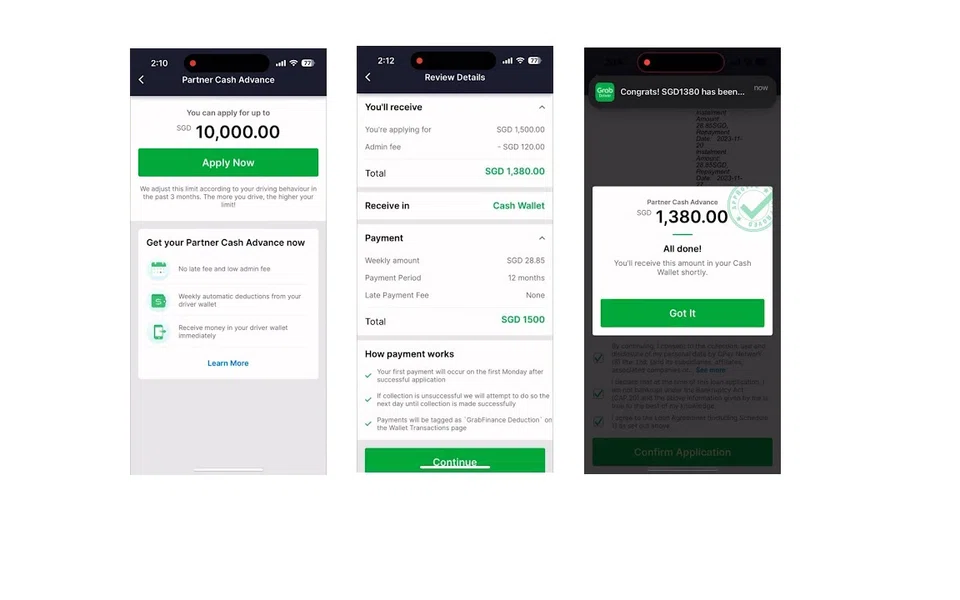
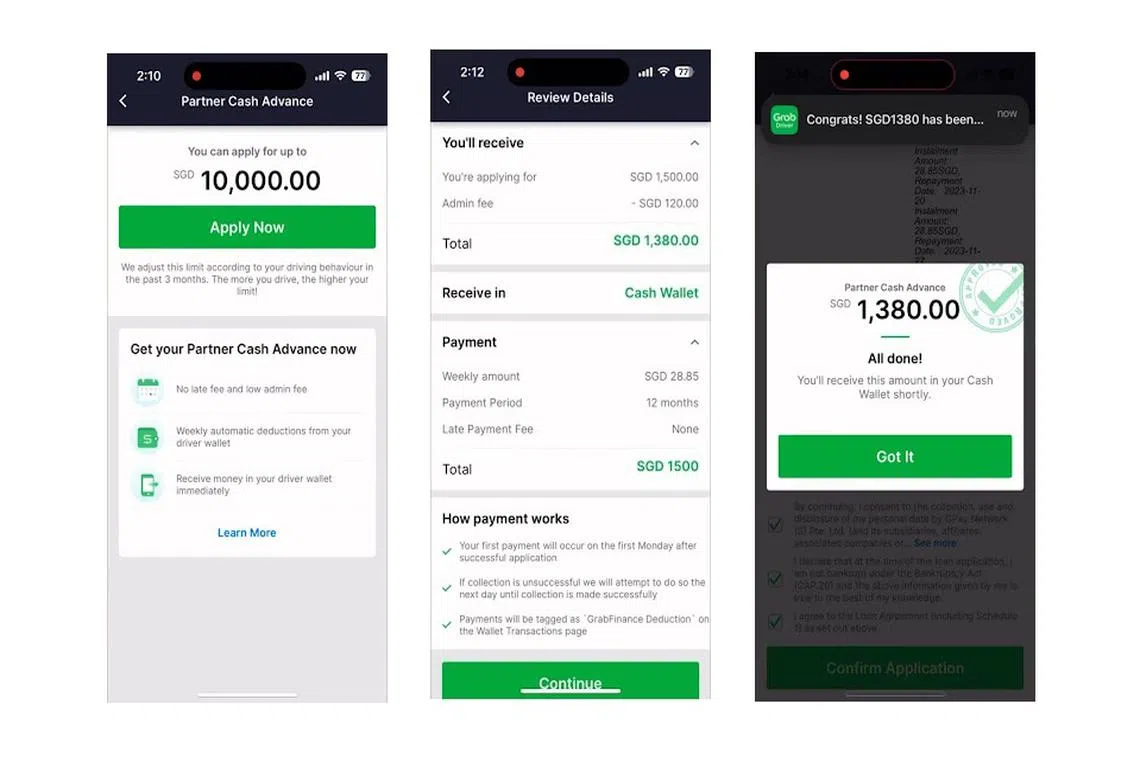
Grab rolled out the new scheme, called the Partner Cash Advance service, in December 2022. It invites eligible drivers and delivery riders to apply for cash advances of between S$1,000 and S$10,000. A one-time admin fee is charged upfront and the net amount disbursed is repaid weekly, over three to nine months.
Grab has not widely publicised the scheme, but word of it got out on social media. A screenshot posted on a Facebook group indicated that a driver could apply for a S$5,000 cash advance from Grab payable over six months, with a S$450 admin fee at 9 per cent of the gross sum. He would have to repay about S$192 every week, with the sum automatically deducted from his in-app wallet.
Social media posts on the scheme have drawn mixed reactions from the public. Some say the 9 per cent admin fee is excessively high, relative to bank loans. Others expressed concern that drivers would become even more deeply entrenched with Grab if they borrow from the platform.
Yeo Wan Ling, adviser to the National Private Hire Vehicles Association and National Delivery Champions Association, noted that the pandemic had reduced the income and savings of many platform workers, and that they were up against economic uncertainty.
“We are concerned that this vulnerable category of workers may find it difficult to meet the repayment deadlines, in the event that injury or illness prevents them from clearing their weekly repayment sums promptly,” she told The Business Times.
In response to queries from BT, a Grab spokesperson said that its scheme is a more affordable source of cash flow than borrowing from licensed moneylenders or drawing from credit cards.
“Personal bank loans do not serve our partners, as many would not be eligible for these bank loans in the first place. Our programme plugs a gap in the market. Unlike banks, we are able to serve our users because we have better risk management through data we have about our Grab partners,” she said.
Some experts BT spoke to echoed this sentiment on the potential benefits. However, they also called for greater clarity on regulation, given Grab’s dominant position and the fact that its workers are technically not employees.
Regulatory exemption
Grab’s similar cash-advance product was launched in 2019. That product, called Grab Upfront Cash, allowed its drivers and riders to receive part of their projected earnings, with the admin fee reported at 8 per cent.
At the time, Grab had said that Upfront Cash was not a loan, and that 97 per cent of advances were repaid in a timely manner. However, the scheme drew scrutiny from a Member of Parliament, and the Ministry of Law said it was looking into the initiative. About three months later, Grab discontinued it.
Grab’s spokesperson said that the Ministry of Law had granted the company a certificate of exemption for the new Partner Cash Advance scheme, and that the certificate requires compliance with certain guidelines under the Moneylenders Act.
The spokesperson added that the Partner Cash Advance scheme is based on insights gleaned from the now-defunct Upfront Cash programme, as well as its collaboration with HL Bank since July 2021 to disburse loans to drivers. Grab had found that working with a bank for the loans resulted in low approval rates.
“While this programme allowed us to quickly offer a cash-loan service to our partners, their applications were still subject to the approval criteria of banks. Ultimately, only about 20 per cent of drivers who applied for the HL Bank personal loan were successful.
“In addition, the application process could not be seamlessly completed within the Grab driver app, which resulted in turnaround times of up to a week,” the spokesperson said.
The admin fee for the Partner Cash Advance scheme is typically set at about 1.2 per cent on a monthly basis, and is capped at 2 per cent per month.
Grab does not charge late fees or compounding interest and allows early repayments without penalty. Those who miss payments may be blacklisted from all GrabFinance products, but will not be disadvantaged in being assigned jobs.
More clarity on such schemes for gig workers
Some experts BT spoke to agreed that such a scheme could be beneficial. The reality is that low-wage workers have always used credit to address unexpected cash needs, given their typically low savings, said Associate Professor Walter Theseira of the Singapore University of Social Sciences.
“Many lower-wage workers are frequently rejected when they apply for credit, especially by financial institutions which have strict credit-risk assessments. Because of this, they often turn to higher-cost loans, and sometimes illegal sources for credit. Thus, this offering may be an important source of credit for some platform workers,” he said.
Professor Ho Yew Kee of the Singapore Institute of Technology believes that as long as there is clear information, credit counselling and some forms of checks, the scheme is another “open market” type of loan.
“Anyway, individuals who get credit-card loans pay exorbitant interest rates and yet it is legitimate on the basis of caveat emptor,” he said, questioning why schemes like Grab’s would be different.
That said, Prof Theseira noted that the main element of risk is that Grab is in a dominant position with respect to platform workers, “and so should refrain from abusing that position to influence partners to take up the advance, or otherwise disadvantage them with the terms of the cash advance”.
The Partner Cash Advance scheme is not an entirely new concept. Employers have long been able to lend cash to their workers as an employment benefit. Such an employer would be considered an “excluded moneylender” under the Moneylenders Act, noted Ong Pei Ching, a partner at TSMP Law.
“The kink here is, of course, that Grab drivers are not considered to be traditional employees,” she said, adding that more regulatory clarity on schemes like this for gig workers would be welcome.
This is especially since Singapore is set to recognise platform workers as a third category of workers, “with fewer rights than traditional employees, but more rights than independent contractors”, said Ong. With this change coming, it is unclear if the platforms are “employers” when it comes to the Moneylenders Act.
The Employment Act provides some protections for workers who borrow from their employers, such as a limit on the total deductions from salary as repayment that may be levied over a given period, generally set at 25 per cent, noted Prof Theseira.
“Given the dominant position that Grab has, and regulatory changes to treatment of platform workers, it seems to me that at least the same level of protection afforded under the Employment Act that covers employers’ treatment of salary advances and loans to staff should apply,” he said.
By having a unified treatment of such loans, it sends the signal that the same standards should apply, regardless of one’s status as an employee or a platform worker.
“This may also be a matter to be taken up in the future, when platform workers are represented by a union or other organisation. I would expect, for example, that a union represents workers’ concerns with respect to employer loans and cash advances in a unionised workplace; so too, this could come under the ambit of industrial relations for Grab,” said Prof Theseira.
In any case, it would also be difficult to try and regulate everything, said Kelvin Tan, dispute resolution director at Drew & Napier.
“Regulations may inhibit business and impede flexibility for everyone involved. I am sure the authorities will watch how the situation develops, and find a nuanced approach if there is unfairness,” he said.