5 Questions with Leslie Teo, economist-turned-techie

Claudia Chong
Published Wed, May 3, 2023 · 10:00 AM
    • The convergence of Big Data, networks and computing power will be the next disruptive force in the world, says Leslie Teo, who quit his job at GIC to jump into the world of tech.
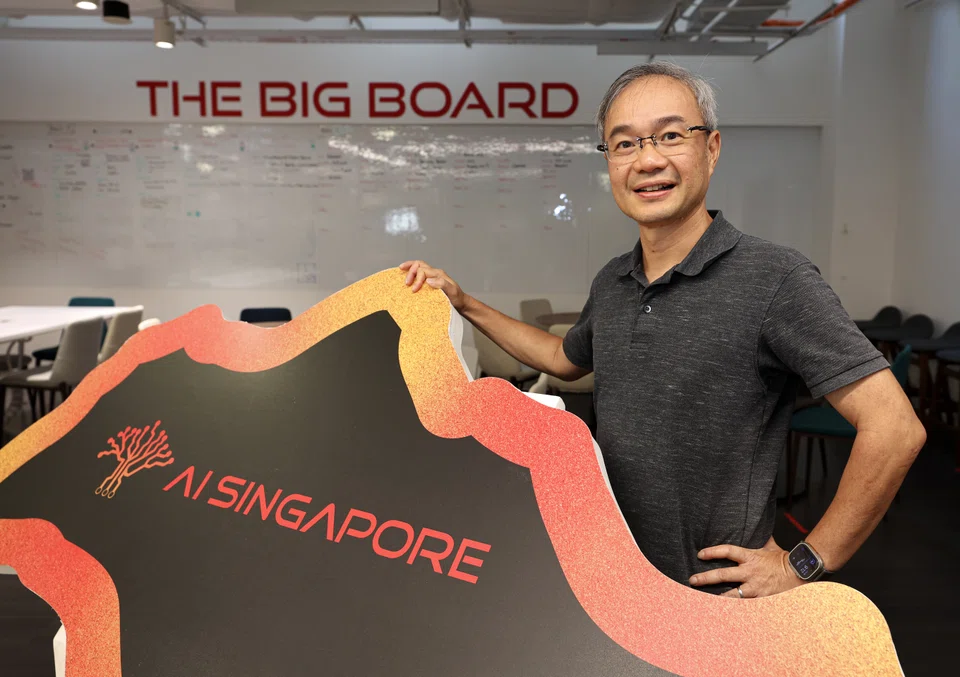
    • The convergence of Big Data, networks and computing power will be the next disruptive force in the world, says Leslie Teo, who quit his job at GIC to jump into the world of tech. PHOTO: YEN MENG JIIN, BT

    GIC’s former chief economist Leslie Teo caused a stir in 2019 when, after 12 years at the sovereign wealth fund, he quit to lead data science at tech company Grab. At Grab, he used data to answer the most pressing questions – can congestion patterns be analysed to increase the efficiency of rides? Can roads be made safer for delivery riders? Today, Teo continues to be part of seismic tech shifts. He is a senior director for AI products at AI Singapore, an organisation set up to build the nation’s capabilities in artificial intelligence (AI). In the latest edition of 5 Questions, Teo shares what it is like to make a career transition at 50, and what people are not asking about ChatGPT, but should be.

    Q: Briefly share with us your educational and early career journey.

    Teo: I grew up in Malaysia and studied there until Form 5, when I received an Asean scholarship to complete my A-Levels at Temasek Junior College in Singapore. This was a game-changing moment for me.

    Though my family could not afford an overseas education, I was awarded a scholarship from the University of Chicago. It turned out to be the perfect school for me. I initially wanted to pursue biomedical research, but got hooked on economics and its power to shape societies and countries for the better.

    My ultimate goal was to work in policymaking, ideally at an organisation like the World Bank. To achieve this, I pursued a PhD at the University of Rochester on a scholarship. Once again I was very fortunate; I did not get into the World Bank but I did join the International Monetary Fund (IMF) as a young economist.

    The IMF provided an excellent environment for learning about macroeconomic crisis management. It offered extensive training and development, in part through exposing me to various world-changing events like the breakup of the former Soviet Union and the Asian financial crisis. Each crisis presented unique challenges that required simple, powerful and implementable solutions. By the time I returned to Singapore, I had probably worked on 40 or so countries, including a few I could barely locate on a map!

    Q: You left a high-flying role at GIC to jump into the world of tech when you took up a data role at Grab. How long had you been planning it for and why did you make the move? What have been the biggest lessons learnt since then?

    My decision to leave was driven by a desire to have a deeper understanding of technology and its power. While GIC offered opportunities for growth, it was not a tech or AI-focused company. I wanted hands-on experience in those areas, despite the uncertainty of switching.

    Similar to how key ideas in economics and finance in the 1970s to 1980s shaped our world today, I believed that the convergence of Big Data, networks and computing power would be the next disruptive force in our world. With 30 years of working life ahead, it was worth investing time in retooling.

    However, the switch took more than three years of planning. As part of a new team at GIC, we had specific goals to achieve and that needed time. I also felt responsible for ensuring a smooth succession. Incidentally, I prefer to describe my role at GIC as senior, rather than high-flying.

    I also used this time to complete a degree in data science at the University of California, Berkeley. The switch would also not have been possible without a very supportive spouse and family.

    Have things turned out as I expected in this new path? In some ways, yes, but in others, no. The experience has been eye-opening, and I feel incredibly fortunate to be able to work on meaningful projects with like-minded teammates, explore cutting-edge tech and manage my own schedule without being confined to an office.

    Of course, you do not get the perks of being part of a large corporation. But I do not think I would have understood what running systems at scale was like without my time in Grab, nor would I have experienced the power of technology to connect and mobilise millions of people across the region. I eventually left the company for more flexibility and to pursue other aspects of AI, but I will always appreciate the opportunity Grab gave me. In fact, I still have meals with Anthony (Tan, chief executive officer and co-founder of Grab) and from time to time, advise him and his team.

    Embarking on this journey has been humbling. I have learnt new things, faced failures, felt like an imposter and struggled to find my place when it was not clearly defined. The journey is ongoing, with its ups and downs, but one thing is for sure – it is never dull!

    Q: Tell us about your role at AI Singapore and what role South-east Asia can play in the development of AI technology.

    Picture this: you ask an AI assistant for examples of successful people or the best places for coffee and shopping. What results are you likely to get? A list of male Caucasians and a recommendation for Starbucks and the mall. But where is the love for our kopitiam or pasar malams? This is where we come in.

    The current large language models (such as ChatGPT), are very good, but as with all such models, they are only as good as the data and feedback that they learn from. Many of the large language models, like those powering ChatGPT, have been trained on data that may under-represent our region and may include biases. This does not always do justice to our region. So, at AI Singapore, we are on a mission to fill that gap by crafting data sets, evaluation metrics and models that embrace our unique context – that is, South-east Asia.

    Why does this matter? For starters, it is crucial from both a social and economic perspective. South-east Asia is a massive market brimming with potential for AI in sectors like healthcare, education, retail and finance.

    Do we want to be stuck with a one-size-fits-all approach, or interact with AI systems that truly understand our regional context? I would say that in fact, inclusivity, fairness and effectiveness demand AI systems that can speak our regional languages and comprehend local customs and nuances.

    AI Singapore is a national initiative aimed at building the nation’s AI capabilities. I lead a small but mighty team focused on training top Singaporean AI engineers and practitioners, while developing useful products that catalyse AI usage.

    I firmly believe that Singapore has the potential to be a platform and node for AI throughout the region. With our diverse and talented workforce, openness, neutrality and supportive environment, we are well positioned to develop AI solutions that resonate with South-east Asia and beyond.

    Q: The recent wave of excitement over AI was sparked by ChatGPT, but there have been calls for the industry to look deeper. In your view, what are questions about ChatGPT that people should be asking, but are not?

    This recent wave sparked by ChatGPT has left me both amazed and unnerved, particularly by the rapid progress of these models. As a young economist at the IMF, I advocated for policies like free trade and open markets, which led to significant economic growth.

    However, there were unintended consequences, such as the impact on jobs and wages for the middle class. Today, we face extreme polarisation, populism, nationalism and anger towards others.

    My hope is that we can avoid these pitfalls with AI and instead, harness its power to solve difficult problems like climate change and make us more productive, but in a manner that is fair and sustainable. Otherwise, I fear more dystopian futures. To achieve this, we must address the following questions:

    • AI adoption and job market: As AI becomes increasingly widespread, what measures should we take to retrain or reskill affected workers? How can we ensure equitable access to AI tools and bridge the digital divide?
    • Ownership and decentralisation: Who should control AI tools like ChatGPT? Should we adopt a decentralised approach to their development and maintenance? Is it better to have one or multiple models, and who should be responsible for creating them?
    • AI regulation and ethics: How can we balance innovation and user protection? What steps are necessary to ensure ethical AI development and use while addressing biases, protecting privacy and preventing harmful or misleading content? Unfortunately, malware, deep fakes and scams will become more pervasive and persuasive.
    • Long-term human development: Will our growing reliance on AI tools like ChatGPT affect human cognition, creativity, critical thinking and emotional intelligence? As an example, I frequently use ChatGPT for my writing, expecting the AI to improve my first drafts. One argument is that such reliance weakens our writing abilities. However, the same argument was made about calculators weakening our mathematical abilities, particularly mental arithmetic. And yet, calculators have enabled us to tackle much more complex problems. Are not AI assistants arguably a boon in this regard?
    • Singapore’s role: How can smaller countries like Singapore remain relevant and competitive in a landscape dominated by larger models that require increasing amounts of data, computing power and talent? What is our comparative advantage?

    Q: What is one thing you would tell your younger self, if you could?

    “Talk less and do more.” Embrace challenges, take risks and seek to grow and learn. And remember, laughter is the best way to navigate the twists and turns life throws at you.