

5 Questions with founder-turned-ecosystem builder Lim Jui
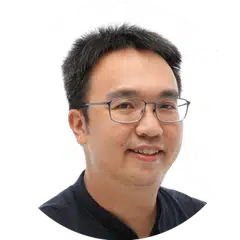
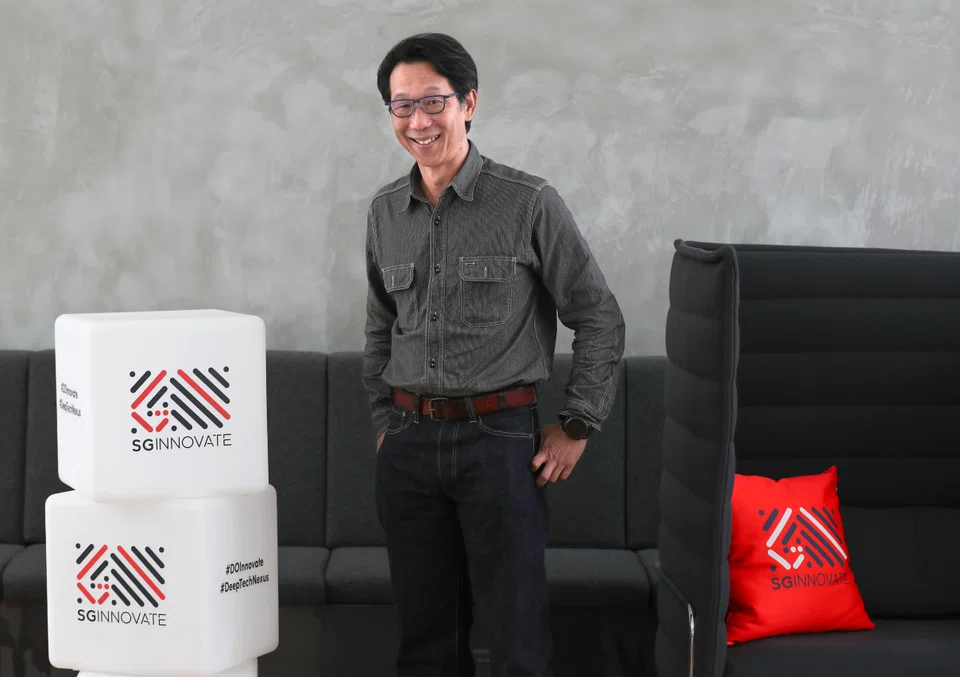
RARELY do you find founders at the helm of government-backed agencies, but SGInnovate chief executive officer (CEO) Lim Jui has bucked that trend.
Dr Lim’s journey is less than conventional. He started as a medical doctor before pivoting into investing in biomedical companies, then running one. Now at the helm of Singapore’s deep-tech ecosystem builder, Dr Lim has his work cut out in nurturing the ecosystem here.
Read on to find out why Dr Lim believes in asking for forgiveness rather than permission, and how he ended up running SGInnovate.
1. How did a start in medicine lead to you running SGInnovate?
Where career planning is concerned, I have always tended to follow my gut. While this might not be the best example to follow, I’ve had the kismet of working with some of the best role models in the business at every stage.
When the human genome was sequenced in 2000, and monoclonal antibodies (laboratory-produced molecules that mimic antibodies in the immune system) were coming to the fore, discussions emerged around a promising future of targeted, precision medicine. I didn’t want to miss out. At the same time, I wasn’t a researcher, so I set my sights on the business of medicine.
Starting out as a young registrar in anaesthesia and surgical intensive care, I embarked on a new career in biomedical investments, joining EDBI’s BioOne Capital to work for Mr Philip Yeo. The role brought me to Europe and eventually placed me in charge of one of our portfolio companies – Merlin MD, a company developing an intracranial stent to treat cerebral aneurysms. Thrown in the deep end, we learnt how to raise funds and develop a clinical trial protocol, and eventually ran an international multi-centre clinical trial that led to a CE Mark approval.
Subsequently, my sights turned towards commercialising academic research, and I was fortunate to meet Professor CN Lee, then chair of surgery at NUS, who had a bold vision of the future of medicine and the place of innovation within it. Together, we created the Medical Engineering Research and Commercialization Initiative with the invaluable support of Professors Barry Halliwell and Tan Chorh Chuan. This exposure was a good foundation to subsequently kickstart the Singapore Stanford Biodesign programme, before moving over to NTU to help build their technology commercialisation infrastructure at a university level.
Years later, I decided to accept another challenge from my current chairman Yong Ying-I, and then permanent secretary of National Research and Development Chan Lai Fung, when they asked me to join SGInnovate. In many ways, it was the perfect match. It allowed me to return to my roots in venture capital, developing people and building communities. So there!
2. What is the most exciting thing about deep tech in Singapore?
For me, the challenge is the mission, and that’s what makes “deep tech” so exciting. There are technology challenges, but there are also larger challenges in culture, market uptake and sectoral change management.
Deep tech isn’t just about the technology itself, we also have to look at the complex ecosystem of goods, services and resources needed to fuel its development, building a sort of deep-tech economy as it were. This is the imperative underlying SGInnovate’s design, thinking and action – the trident of dollar investment, talent development and community building.
On top of this, I get to hear about cool new things on a daily basis, to meet incredible people, and play a part in making Singapore stronger for all our kids.
What’s not to like and be excited about?
3. What is one thing you would tell your younger self?
Start a family younger.
I had my first kid in my late 30s, and the last one in my 40s. Now, looking back, my children have continued to be a source of motivation and direction for me throughout this journey. They ground my perspective when it comes to managing risks and give me a reason to think about the economic opportunities we can create for them in the future.
Also, getting an early headstart means that you’re likely to have more energy.
4. What is the best advice you’ve received, and what was the context/situation?
“Do first and say sorry later”, but also “three strikes and you’re out”.
These are two mantras that I’ve encountered in one way or another through all the people I’ve had the great fortune to work with. Both sum up the initiative, courage and audacity that have made Singapore what it is today and should continue to serve us well into the future.
This has been the same, fair approach I take with the team at SGInnovate as part of our place at the very forefront of the emerging tech landscape. Looking at these technologies at such an early stage is risky, and in many instances, much of what we’re doing – be it in the areas of investments, talent or community building – has never been done before. This makes SGInnovate inherently designed for this purpose.
With these guiding principles in mind, I always encourage the team to experiment and excel in whatever they embark on.
5. What has been your lowest point so far in your startup and tech journey?
My time leading a medical device startup team was the most perilous – but also the most exhilarating – period in my career.
As a new CEO, much of it was learning on the job. Leading a startup can also be a lonely journey.
I joined the team in the mid-2000s, which was an especially challenging time for any young company, and we encountered setbacks every step of the way.
While we had raised money just before the global financial crisis hit, the funding was difficult to access, which had a significant impact on all aspects of our operations, including the ability to pay our staff.
I began writing the protocols for clinical trials from scratch, without prior experience. This also involved having to work with regulators, and execute the trials once approved. As anyone who has been through the process knows, seeing the process through can be extremely sobering as no trials are without side effects.
In spite of this, however, the journey of understanding and overcoming challenges like these is the most important experience for any entrepreneur.
TRENDING NOW

First Resources blames El Nino, outside fires for Kalimantan hotspots amid haze scrutiny

High Court rules against Julius Baer’s Singapore trust arm in US$50 million family trust dispute

Singapore key exports jump by higher-than-expected 68.4% in September, led by non-electronics
MSCI proposes downgrading Indonesia to standalone market status

