Ant, Tencent ride tourism recovery to capture cross-border payments
Both players have different strategies, in line with their competitive edge

Yong Jun Yuan &
Sharanya Pillai
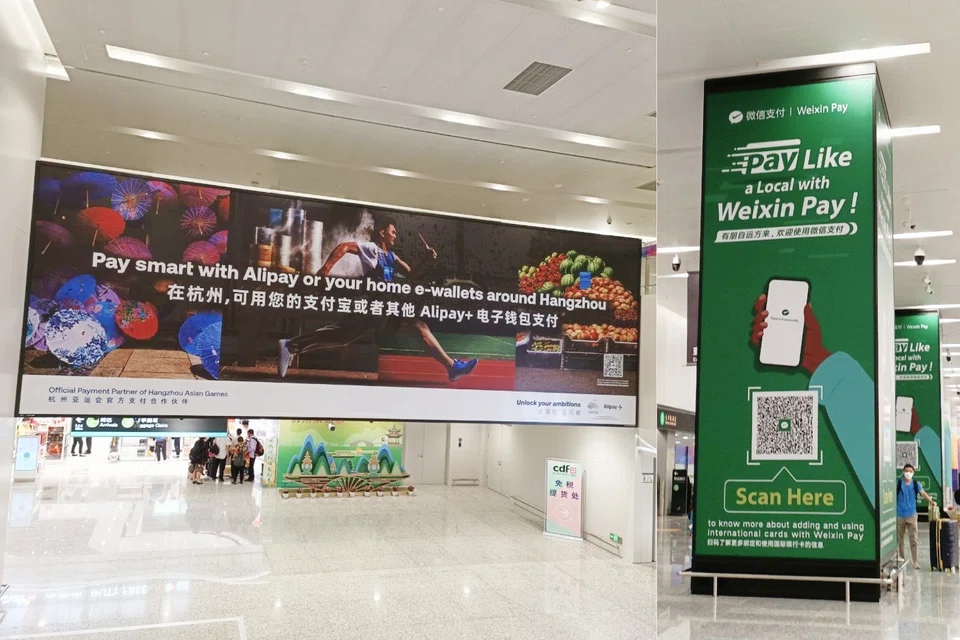
TOURISTS landing in Hangzhou for the recent Asian Games were greeted with huge banners of China’s two biggest fintech rivals.
A banner by Ant Group, stretched across the airport’s walls, urged tourists to “pay smart” in the city, using the Alipay app or even their home e-wallets.
Not to be outdone, Tencent had bright green posters wrapped around the pillars, declaring: “Pay like a local with Weixin Pay!”
The sight offers a glimpse into the next battlefront for China’s fintech giants. Having captured the domestic market, both are focused on expanding their cross-border payments footprint. This is especially with the recovery of tourism into and out of China.
Making payments in China as a foreigner has long been a pain point. Cash is sparsely used in the mainland, with nearly all brick-and-mortar stores taking QR payments via Alipay or Weixin Pay. Meanwhile, foreign credit cards often have unfavourable foreign exchange rates and mark-up fees.
But this year, both Tencent and Ant set out to soothe this pain point. In late-June, Tencent started to allow foreign cards to be used in WeChat Pay, the international version of Weixin Pay, according to media reports.
Ant had already allowed international cards on Alipay since 2019, with further enhancements in 2022. And last month, the company went one step further.
On Sep 19, Ant announced that users of several regional payment apps – such as OCBC Digital and Thailand’s TrueMoney – would be able to directly make QR payments at “tens of millions” of Chinese merchants.
This is made possible by the company’s cross-border payments solution, known as Alipay+, which comes on the back of Ant’s longstanding investments in South-east Asia. As early as 2016, the company has backed South-east Asian e-wallet operators such as Ascend Money, which operates TrueMoney, and Malaysia’s TNG Digital, which operates Touch ‘n Go.
Ant’s years of experience in South-east Asia may inform its current approach, said Li Jianggan, chief executive of insights provider Momentum Works.
“Ant has decided it is difficult and costly for it to build leading mobile wallets in many countries, and its technological knowhow and expertise could provide better value linking different wallets and mobile payment systems,” he added.
Serving Chinese tourists
Beyond inbound tourism, both Ant and Tencent have also focused on serving Chinese tourists visiting the rest of Asia. This is particularly with the recent “Golden Week” holiday – from Sep 29 to Oct 6 – that saw millions travelling abroad.
In a release on Tuesday (Oct 10), Tencent reported daily retail spending through the cross-border payments function on Weixin (the domestic version of WeChat) rose by more than 50 per cent during the Golden Week, compared to the May Day holiday earlier this year.
In Singapore alone, it saw a 44 per cent increase in the daily average number of in-store Weixin Pay transactions. This comes after the Singapore Tourism Board and Weixin Pay inked a partnership in April to better serve Chinese tourists.
Weixin Pay international business marketing director Monica Zheng said that the company has introduced incentives, such as vouchers and preferential foreign exchange rates, to entice more users to the service.
“We would like to work with our overseas merchants to establish digital and smart operating models, and improve the experience of Chinese users wherever they go,” she said.
Ant likewise announced on Wednesday that the average spending of outbound Chinese travellers via Alipay during the first five days of the Golden Week was higher than in 2019. It did not provide specific details.
“Chinese consumers prefer mobile payments for their transparent and favourable exchange rates, discounts and other value-added services offered,” the company said, citing a recent survey.
Competitive differences
Both Ant and Tencent’s moves to capture the cross-border market reflect broader macro trends, said Li of Momentum Works.
“Chinese businesses, facing intensifying domestic competition, will increasingly try to diversify into international markets, with South-east Asia often as a key destination. This is in addition to the anticipated recovery in the flow of tourists,” he said.
Jan Ondrus from the ESSEC Business School Asia-Pacific noted that both companies’ strategies reflect core differences between them.
“Ant aims to enable transactions between e-wallets, facilitating trade between Chinese users and foreigners both inside and outside China. This approach highlights its emphasis on e-commerce,” said Ondrus, who is an associate professor of information systems.
“On the other hand, Weixin, with its vast messaging app user base, has traditionally prioritised serving Chinese nationals. Therefore, its international wallet expansion targets different user segments and needs,” he added.
Robert Lea, Bloomberg Intelligence’s senior technology, media, and telecom equity analyst, similarly believes that Tencent’s prime focus is on servicing and better monetising its existing user base through collaborations with local businesses, such as Grab in Singapore.
In December 2022, Grab launched its Weixin mini programme, which allows users to directly access ride-hailing services within the Weixin app.
Lea further observed that Weixin Pay “dominates” day-to-day purchases in China, including food delivery and taxis, while Alipay is more focused on larger purchases, such as furniture and electronic items.
Zennon Kapron, director of fintech research firm Kapronasia, noted that while Alipay+ represents a more focused push into the market, digital payments in the region remain very localised and competitive.
“Outside of the commercial payments platforms, governments are also innovating with platforms like Singapore’s PayNow and Thailand’s PromptPay being linked to provide even more cross-border alternatives. The payment providers that have been successful across the region are nearly all local players, rather than international,” he said.
Ant may have struggled to gain the traction and the volumes hoped for, Kapron said. Still, he believes the company’s strategy has put Alipay “far ahead of Weixin in their international ambitions”.