Coinbase bets on Singapore despite rocky year

Claudia Chong
CRYPTO exchange Coinbase remains bullish about its prospects in Asia as it embarks on international growth. This is despite a turbulent year marred by a slowing economy, as well as a series of scandals that tarnished the once-booming crypto industry.
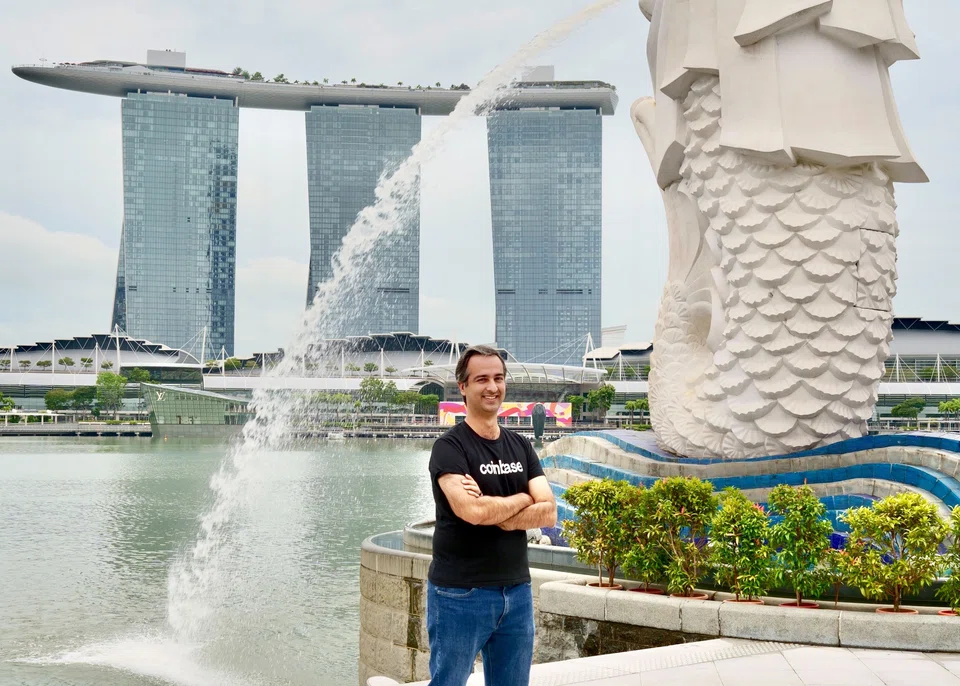
With the rise of blockchain gaming in markets such as the Philippines, and with companies warming up to building on Web3 infrastructure, Asia presents interesting opportunities for Coinbase to tap, said Singapore country director Hassan Ahmed.
He was speaking to The Business Times on the back of Coinbase’s launch of upgrades to its retail platform in Singapore, meant to ease investments in digital assets, even as investors lick their wounds from the crypto market plunge.
The company tapped Standard Chartered’s technology to allow customers to transfer funds to and from their Coinbase account using any bank in Singapore, at no cost. New users can join the platform using Singpass, cutting down time needed for authentication.
Coinbase has been aiming to grow its operations beyond its home market of the US, where it is the largest crypto exchange. The Nasdaq-listed company does not break down its revenue by markets, but the US still accounts for most of it, said Ahmed.
Last October, Coinbase received an in-principle approval from the Monetary Authority of Singapore (MAS) to offer digital payment token services.
But the crypto industry was well into a winter by then, battered by events including the Terra-Luna implosion and Three Arrows Capital meltdown. Shortly after, fraudulent practices at crypto exchange FTX sent shockwaves throughout the finance world.
Crypto’s market capitalisation fell 64 per cent last year, wiping out US$1.5 trillion in value. Trading at Coinbase fell in tandem, with total volume declining 50 per cent and transaction revenue plunging 66 per cent.
Coinbase, after admitting it overhired, joined other crypto companies in slashing staff to save costs. In January, it announced it would lay off about 950 people, or about 20 per cent of its staff, after it cut around 1,100 employees last June.
While the company had plans to expand its team of nearly 100 in Singapore, it has since had to retrench about 15 per cent of headcount and scale back on its South-east Asian expansion. Elsewhere in Asia, its Japan office had to close, though the company still has sites in India, the Philippines and Australia.
International expansion is a priority, and “at one point, maybe we were being more aggressive in accelerating our expansion”, said Ahmed. “I’d say right now, the whole industry is kind of going through a bit of a pause and a reset.”
Two of the most crypto-friendly banks, Silvergate Bank and Signature Bank, failed within a week of each other. Silicon Valley Bank, a key lender to startups, collapsed last week, following a bank run fuelled by concerns over its financial health.
Coinbase said in a tweet on Monday (Mar 13) that it had about US$240 million in corporate cash balance at Signature as at the end of Friday. It expects to fully recover the funds.
The recent events have sparked further discussion around regulations globally, which have largely lagged crypto’s breakneck pace.
Last November, Coinbase’s chief executive Brian Armstrong briefly crossed swords with MAS’ chief fintech officer Sopnendu Mohanty over the regulators’ supposed mixed messaging over crypto.
Singapore’s wish to be a Web3 hub is incompatible with its strict stance on retail trading, said Armstrong at a panel discussion at the Singapore Fintech Festival. But the Republic has maintained that everyday investors are exposed to risks they do not understand.
“We do have the sense that providing and maintaining retail access is paramount. This is not just a ‘trading-only use case’ type of asset class that should only be restricted to high-net-worths,” said Ahmed.
“In fact, bringing mass consumers along for the ride and educating them along the way, and then bringing them sort of on-chain so that they can actually harness the use cases – that’s the position that we have.”
Ahmed said there are opportunities to expand its business lines for retail investors, institutions and software developers in Singapore. In the Philippines, for instance, the company tied up with digital payments company Maya to offer a crypto product.
“So I’m very excited to be able to deliver a much fuller suite of our products and services locally,” he said.