The companies making China a robotics powerhouse
Last year marked a historic milestone for China’s robotics industry.
For the first time, local firms overtook foreign players in the country’s domestic industrial robotics market, according to the International Federation of Robotics.
That segment had been the only category still dominated by foreign companies before this. For the other four segments – collaborative robots, service robots, mobile robots, and drones – Chinese firms now command over 90 per cent of domestic market share, according to a June report by Morgan Stanley.
For this report, Tech in Asia has charted a map of prominent Chinese firms in the industry across different categories. We also spoke to experts about how the country will likely see homegrown champions emerge in what may be the next frontier in robotics: humanoids.
Cleaning up in the home market
As of 2024, around 40 per cent of the global robotics market is in China, and this figure is likely to grow with the country’s faster adoption of intelligent machines, Morgan Stanley analysts predict.
Among categories, drones are currently the biggest – both in the nation and globally – with market sizes of US$19 billion and US$40 billion, respectively.
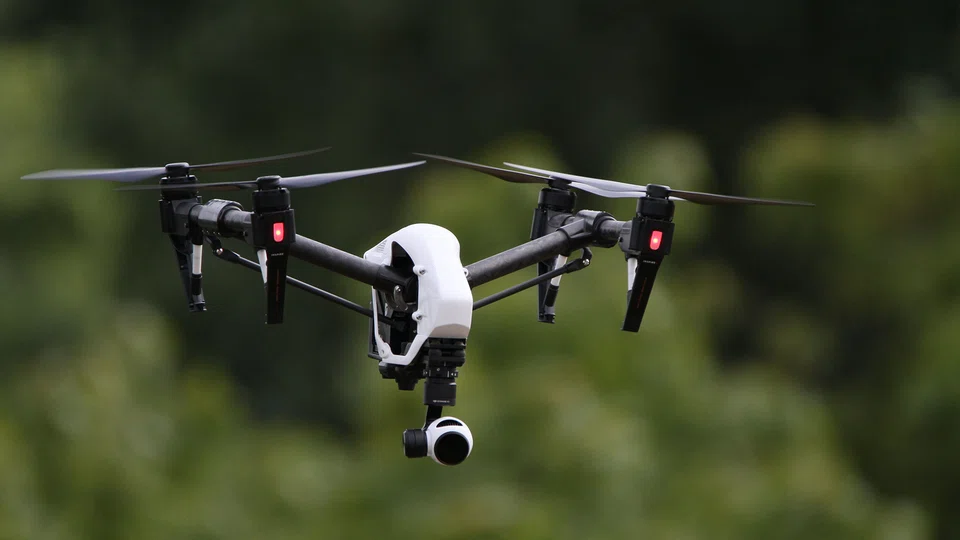
China has an absolute winner here: Shenzhen-based DJI, which holds 54 per cent of the global commercial drones market.
Still, DJI faces a potential ban in the US, as federal lawmakers consider it a cybersecurity threat. Some drone user groups have opposed the move, saying DJI’s products cost one-sixth the price of similar offerings in the US.
The second-biggest sector in Chinese robotics is industrial robots, which is currently worth US$11 billion.
It’s also the most established group, where prominent foreign players like Japan’s Fanuc and Yakasawa, Germany-based Kuka (acquired by China-headquartered Midea in 2017), and Switzerland’s ABB all have histories spanning 50 to over 100 years.
In comparison, China’s leader in the sector, Estun, was founded in 1993, while other key local names like Inovance and Efort were established in the 2000s. This underscores how quickly Chinese players have risen in this space.
The other large robotics segment in China is service robots, which are machines that perform non-industrial tasks to assist humans. Its three main applications – commercial and family, healthcare, and agriculture – represent a combined market of US$10 billion.
In segments like commercial service as well as household cleaning robots, Chinese firms hold nearly 100 per cent of local market share. Prominent names include Shenzhen-based Pudu, Wuxi-based Uditech, Ecovacs from Suzhou, and Beijing’s Roborock.
For the two other categories – mobile robots and collaborative robots – local brands have over a 90 per cent share. The former includes machines like automated guided vehicles and autonomous mobile robots.
Geographically, Shenzhen is home to the most robotics companies on our list, as it’s China’s biggest hardware manufacturing hub. It’s then followed by Beijing, Shanghai, and Hangzhou.
Humanoids fever
That said, one of the most buzzworthy robotics segments is also one that hasn’t created any significant revenue: humanoids.
Like the hype around artificial general intelligence, the promise of a superintelligent machine that can perform a variety of physical tasks is attracting talent and money in China.
The country saw over 400% year-on-year growth in humanoid robotics hiring in just the first five months of 2025. Companies making these automatons and their components raised more than US$3.2 billion in the first seven months of this year, exceeding the total for all of 2024.
Notable Chinese humanoid startups include Shenzhen-based UBTech and Leju, Hangzhou’s Unitree, and Shanghai-based Agibot. UBTech became the first humanoid robot company to go public in late 2023, listing on the Hong Kong Stock Exchange, while the other three are preparing for IPOs.
This month, UBTech claimed to have completed the “world’s first mass delivery” of industrial humanoid robots, delivering “hundreds” of its Walker S2 units to partners, though specific details are undisclosed.
Established Chinese players in traditional robotics sectors are also entering the space, as the annual global revenue of humanoids is projected to reach US$5 trillion by 2050, overtaking all other segments in the industry, according to Morgan Stanley.
Three prominent industrial robotics firms – Estun, Midea, and Efort – are developing their own humanoids. Pudu, China’s leading commercial service robot maker, is another new entrant.
But it’s not just players within the industry that’s joining the chase.
Chinese manufacturers of other tech hardware – smartphone makers Xiaomi and Honor and EV manufacturer XPeng – are also jumping in.
“These firms believe the skills, production lines, and supplier networks they have already developed for making smartphones and electric vehicles can be adapted and extended to make robots,” writes Tilly Zhang, analyst at Gavekal Dragonomics, in a report.
The road ahead
Despite the craze for humanoids, a true general-purpose intelligent machine is likely still many years away.
Felix Zhang, founder and CEO of Pudu Robotics, argues that pure humanoid agents – which can perform many tasks – are better suited for interactive roles and complex tasks in small-scale environments.
For large-scale, long-distance, heavy-duty activities, or those with particularly high cost requirements, specialised bots might still be more appropriate.
He predicts semi-humanoid machines – such as robots with a wheeled chassis and one or two robotic arms – will be more widely used. Still, he tells Tech in Asia that all forms of robots can coexist in the future.
For Neil Zeng, partner at Shanghai-based Linear Capital, the architecture and algorithms of embodied robots need time to be explored, and achieving true generalisation may be a while yet. Linear’s portfolio includes 13 robotics startups out of 66 total companies.
According to Zeng, a few years ago, no one knew how long it would take to launch GPT-3.5, which was eventually released in 2022. He notes that embodied intelligence is now at a stage even earlier than where large language models were at that time.
Most humanoid robot sales in China now fall into two main categories: performance displays – like those for dance or demonstration shows – and data collection, which is the major one.
Led by local governments, many factories across China have purchased large numbers of robots and built controlled environments inside facilities to collect data without disrupting production lines.
Regardless of which companies win the humanoids race, they will likely rely on a Chinese supply chain of parts and components.
For example, US-based Figure AI – the world’s most valuable startup working on humanoids – sources joints, bearings, sensors, motors, and reducers from Chinese suppliers. Similarly, Tesla’s Optimus robot uses actuators, screws, and hand motors from China, writes Gavekal Dragonomics’ Tilly Zhang in her report.
Chinese manufacturers may still lag behind in high-precision components for aerospace and semiconductor lithography compared to European and Japanese players.
But robotics applications require less extreme precision. Instead, they demand mass scale, low costs, and customisations, which fits China’s advantages thanks to its manufacturing capabilities, she notes.
“The robotics boom offers these industrial component makers the prospect of a large new market for specialized products,” she says. “China will certainly be a robotics powerhouse, even if humanoids do not live up to the hype.” TECHINASIA