

‘A fighting chance’: Mirxes on why it chose Hong Kong over Singapore for its IPO
Chief executive Dr Zhou Lihan says Hong Kong offered a better valuation and a more savvy investor pool

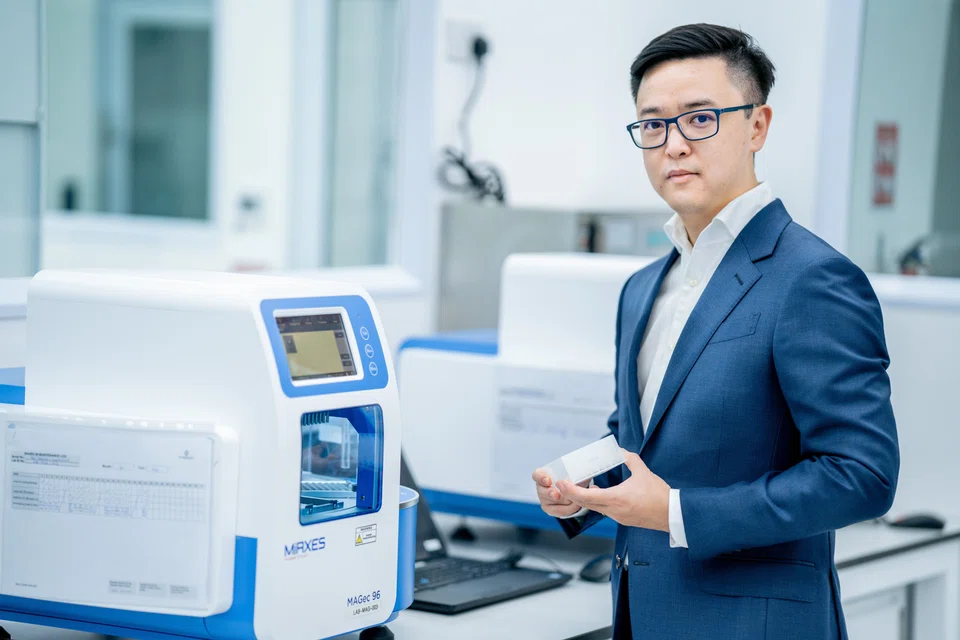
IN THE days after cancer diagnostics startup Mirxes announced it applied to Hong Kong’s stock exchange for an initial public offering (IPO), executives at the company were flooded with questions about why it hadn’t opted to list on the local bourse.
Mirxes has a long history with Singapore’s establishment. It started as a spinoff company from the government-owned Agency for Science, Technology and Research (A*Star). Its backers include EDBI, the investment arm of Singapore’s Economic Development Board.
Mirxes deliberated for a long time between the two stock exchanges, its chief executive Dr Zhou Lihan said. In the end, it boiled down to which ecosystem could better support the company’s next stage of growth. Hong Kong offered a better valuation and a more savvy investor pool.
“It’s not an exit event; it’s a fundraising event. The last thing you want is to say, “Let’s chiong (Singapore slang for “rush”)” because of ambition,” said Dr Zhou.
He has been asked why the company did not list locally at a lower valuation. “We’re in the business of investing long-term, given our gestation period. If we raise at a lower valuation that doesn’t give us enough ammunition, it actually defeats our entire purpose of fundraising,” Dr Zhou told The Business Times (BT), without mentioning specific figures.
“If you under-resource a biotech company, it’s not much of a good thing. It’s either you resource it properly to give it a fighting chance, or you don’t do it.”
Bankers in Hong Kong floated a valuation of up to US$1 billion for the company, sources told The Business Times in April.
Mirxes is still keen on being listed in Singapore, in part to support the local biotech scene, which has yet to find a solid success story.
It is considering a secondary listing by way of introduction, said Dr Zhou. Listing by way of introduction on Singapore Exchange (SGX) is a form of listing that does not require selling new shares or raising funds.
Other companies that have taken this route include Chinese electric vehicle maker Nio, which has a primary listing on the New York Stock Exchange (NYSE), and the Philippines’ largest liquor company Emperador, which is listed in Manila.
But Mirxes will first have to complete its Hong Kong IPO. On Jul 25, it filed an application under Chapter 18A of the Hong Kong stock exchange’s listing rules, which could make it the first company outside China and Hong Kong to list under a provision that supports biotech IPOs.
The company is aiming to raise at least US$100 million from the offering, said people familiar with the matter.
IPO journey
China’s biotech scene has grown rapidly since 2015 as investments in the sector hit historic highs. The country is the largest future market for Mirxes’ flagship stomach cancer blood test Gastroclear – China accounts for 50 per cent of all gastric cancer cases in the world.
In contrast, Singapore’s biotech scene is nascent. Only a handful of companies, such as cancer diagnostics group Biolidics and pharmaceuticals company iX Biopharma, have listed locally. Still, Mirxes seriously considered the local bourse for an IPO, as the city-state is an up-and-coming centre for Asian tech.
“We are considering a secondary listing on SGX while leveraging the valuation benchmark in Hong Kong,” he said, referring to being able to tap Hong Kong’s better valuations while giving Singapore investors access to its shares.
“If we do that, it could make it easier for some of our peers to consider a primary or secondary listing on SGX. We’re happy to start the ball rolling. It does make sense because we have significant business in South-east Asia.”
Mirxes submitted an application to SGX earlier this year, aiming to receive an eligibility-to-list letter from the regulator, BT reported in April.
By then, it had already been in formal talks with Hong Kong regulators for two years. It received a pre-application qualification from the Hong Kong Exchanges and Clearing (HKEX) in August 2021, demonstrating it met HKEX’s criteria for biotech companies.
The company began planning for an IPO as early as late-2020, six years after spinning off from Singapore research agency A*Star. A study of biotech companies in the US showed that most went public around the seventh or eighth year.
At one point, Mirxes briefly explored going public through a new collaboration by SGX and NYSE to allow dual listings on both exchanges.
In a dual listing, a company is primary listed on two stock exchanges.
In comparison, secondary listings involve a company listing its shares on stock exchanges other than its primary one. The exchange that plays host to the secondary listing generally relies on the primary exchange to regulate the company.
Mirxes eventually ruled out the US-Singapore dual listing as no other company had successfully done it. It decided to “wait and see”, and focus on its Hong Kong application instead.
“What will the trading volume be like? Will there be any price differentials? Those would be important questions to any company (going for SGX-NYSE)” said Dr Zhou.
Listing solely in the US was off the table too, given the US-China geopolitical tensions, he added.
Hong Kong eventually emerged as the best option. “We have to do what makes sense. In Hong Kong, there is a clear, viable path. Singapore is new,” said Dr Zhou.
TRENDING NOW

Once staunchly pro-China, Malaysian Chinese businesses are now distancing themselves from Beijing

Britain’s mansion tax shows the difficulty of targeting wealth

Three hats, one goal: How Ng Kian Swan runs sustainability at NUHS

COE review: The gap between luxury and mass-market cars isn’t the only one worth bridging

