
From fund access to matchmaking, ex-F1 champ Nico Rosberg looks to drive value for investors and startups

His firm’s investment strategy provides access to top US venture capital funds for limited partners to invest into
Benjamin Cher
Published Fri, Dec 13, 2024 · 05:00 AM
    • Nico Rosberg says: “If I were doing direct investing into startups, it would be challenging because I was a race-car driver; I am not the greatest venture capitalist in the world.”
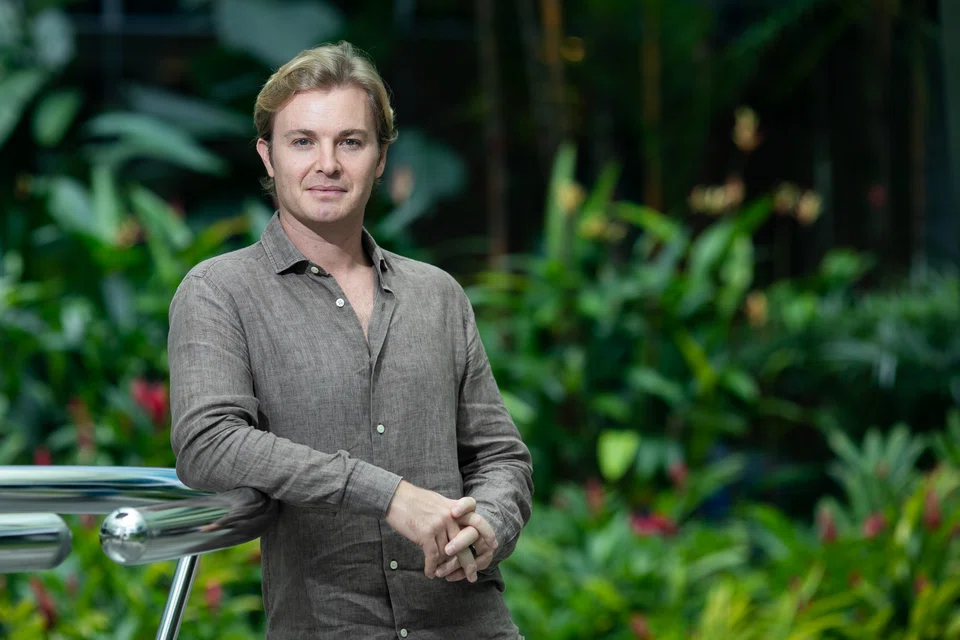
    • Nico Rosberg says: “If I were doing direct investing into startups, it would be challenging because I was a race-car driver; I am not the greatest venture capitalist in the world.” PHOTO: WEE TECK HIAN

    AFTER retiring from Formula 1 (F1) in 2016 as a world champion, Nico Rosberg is back in the hot seat – now, as a startup investor. And it is no surprise that he has gravitated towards those focused on mobility.

    His first investment in the space was into ChargePoint, a US electric-vehicle infrastructure startup – which whetted his appetite. “It was natural for me to get access to mobility (startups),” he told The Business Times.

    Following his foray into the venture capital (VC) space, he invested in other mobility startups such as Volocopter, the company behind electric air taxis.


    But he was to eventually switch up his view: Instead of investing directly in startups, Rosberg took inspiration from the endowment model pioneered by Yale University’s former chief investment officer, David Swensen. Under this model, the approach is to diversify into asset classes such as VCs – driven by the fact that top VC funds in the US generally outperform private and public markets.

    Rosberg wanted investment access to top US VC funds such as Andreessen Horowitz and Kleiner Perkins, which have exposure to the hottest startups.

    He set up Rosberg Ventures, which operates on a fund-of-funds model, providing access to the top US VC funds for its limited partners (LPs) to invest into.

    “If I were doing direct investing into startups, it would be challenging because I was a race-car driver; I am not the greatest venture capitalist in the world,” he said.

    Rosberg also undertakes angel investing, a complementary strategy that benefits Rosberg Ventures and its LPs through its ability to build relationships with VC funds in a startup’s cap table.

    Playing matchmaker, he connects startups to multinational companies controlled by German families. This provides more value to startups and VC funds beyond just capital; it brings about potential revenue. The firm recently closed a US$100 million fund, which was oversubscribed. Rosberg is also a substantial LP in the fund, with skin in the game. About half the fund has been deployed into top US VC funds.

    “The story is so simple: We reached US$150 million, but we cut back everyone and kept the fund size to US$100 million for now, because that is best for performance.”

    Netflix gave him an unexpected leg-up in the US VC community with its series, F1: Drive to Survive, which introduced and popularised the motorsport in the country.

    “Now, everybody in venture capital loves Formula 1 in the US. I would not have been able to make Rosberg Ventures five years ago.”

    Besides European LPs, Rosberg Ventures has received more interest and demand from Asian families as well. The main difference between them and the traditional German families is their higher risk appetite, he noted.

    Rosberg hopes to play matchmaker with Asian LPs the same way he does with German ones, connecting them to startups to drive potential revenue to the ventures.

    Next year, he will focus on raising another US$100 million fund, this time through direct investing. These direct investments will be done in partnership with US VC funds, as Rosberg Ventures will rely on their support for due diligence and expertise.

    “In future, my dream would be to consolidate everything into a proprietary late-stage fund, but this will take time; first are individual opportunities, which would be exciting for us.”


