Gig workers: CPF, injury risk expected to be in focus amid review

Singapore
CENTRAL Provident Fund contributions and work injury compensation are key issues that will likely be in the spotlight with Singapore's review of gig worker protections, reckon some observers.
This sentiment comes as the Ministry of Manpower is convening an advisory committee to look into strengthening protections for delivery riders, private-hire car drivers and taxi drivers. The review was first announced at this year's National Day Rally.
Speaking in Parliament on Tuesday, Senior Minister of State for Manpower Koh Poh Koon said that the committee will focus on ensuring a "more balanced relationship" between platforms and their workers.
He noted that platform workers can resemble employees. Platform companies set the price of the product, determine which jobs are assigned to workers and manage how the workers perform. This includes imposing penalties and suspensions.
Observers told The Business Times that they expect the committee may review existing legislation to plug the gaps for gig workers.
Amarjit Kaur, partner at Withers KhattarWong, anticipates "a focus on health and safety aspects, CPF contributions and other ways to enhance the welfare of gig economy workers".
"The existing legislative regime, including the Employment Act, might well be expanded to afford protections to gig workers akin to those offered to employees," she added.
Ian Lim, partner at TSMP Law Corp, noted that the issue of CPF contributions for gig workers "will need to be statutorily addressed". Otherwise, Singapore may see a growing number of workers who enter their retirement years with little to no CPF savings.
Given the flexible nature of gig work, there might be a need to set a benchmark on which gig workers can qualify for CPF contributions from a platform, said David Leong, managing director of human resources advisory PeopleWorldwide Consulting.
"These are all tech companies, they can measure the frequency and load of work... For example, as long as the person is employed for 12, 24 or 35 hours a week minimally, then maybe the company can contribute CPF. The government must set a benchmark," he said.
Another major issue is work injury compensation, especially for delivery riders, with long hours on the road and significant pressure to deliver on time, Mr Lim noted. Unlike employees, such gig riders cannot claim compensation for work injuries under the Work Injury Compensation Act.
The fact that taxi drivers are included in this review is also interesting, Mr Lim said, given that they have long been considered self-employed contractors. It is possible that labour protections for cabbies are now getting renewed attention as the gig worker pool expands.
"Perhaps because this group has been around for so long, the lack of such protections for them became accepted as status quo and no one really looked too much into it, or maybe it wasn't a large enough group to do something about previously. That should be changing now though," he said.
There is not much data available on the numbers and profiles of gig workers. But in Tuesday's parliament session, Dr Koh revealed that in 2020, out of a pool of 190,000 individuals engaged in self-employment as their main source of income, some 79,000 individuals worked with matching platform companies.
About half of the 79,000 are private-hire car drivers and one-third are taxi drivers. The remainder are mainly car and light goods vehicle drivers performing delivery work.
From 2018 to 2020, the median monthly income of full-time employed residents in the three occupations stood between S$1,500 and S$2,000.
When asked for their reactions to the review, platform companies generally emphasised that their gig workers value flexibility.
A Deliveroo spokesperson said that the company is "in favour of increasing riders' protections, as long as this does not compromise their self-employed status".
The food delivery service, which has over 9,000 gig riders in Singapore, is in touch with MOM and hopes to contribute to the advisory committee.
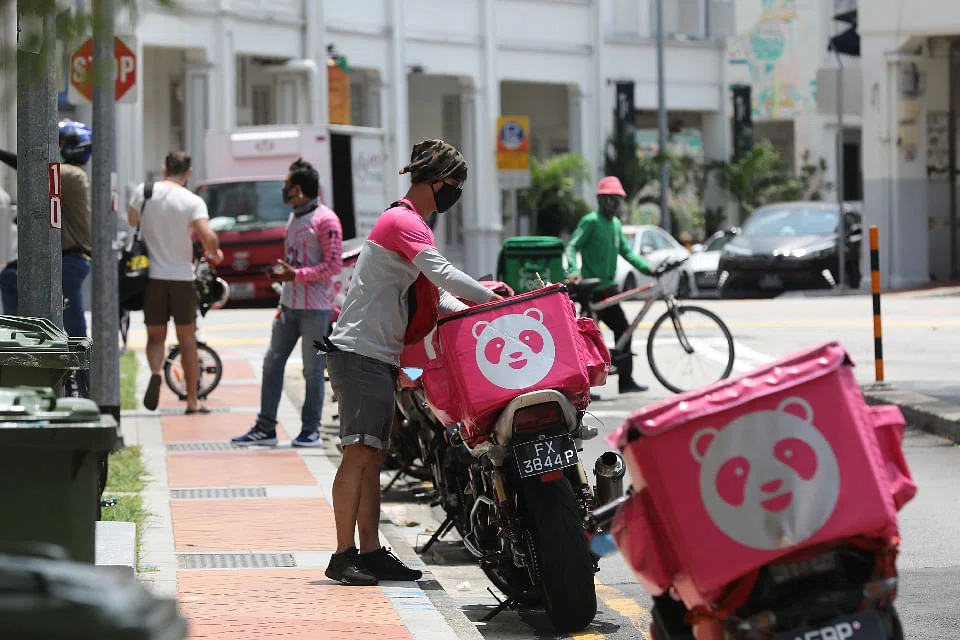
A foodpanda spokesperson said: "The reality is the bulk of our riders are on the platform for a brief period of time as a supplemental gig... Riders choose when and how much to work, and earn as much as they want to."
Grab said that it has been engaging NTUC and MOM on gig worker protection. Gojek Singapore's general manager Lien Choong Luen did not address BT's queries directly, but said that the company is engaging with the government.
ComfortDelGro and Lalamove did not respond to requests for comment.
The developments in Singapore come as a Dutch court ruled this week that Uber drivers are employees, not contractors. The UK and the US recently saw similar legal developments.
READ MORE: Grab posts higher revenue but wider losses in Q2, faces speedbumps