

Grab-Uber deal: CCCS' findings blasted
Verdict was expected, but some question basis for the decision and panel's weak stand on subsidy controls
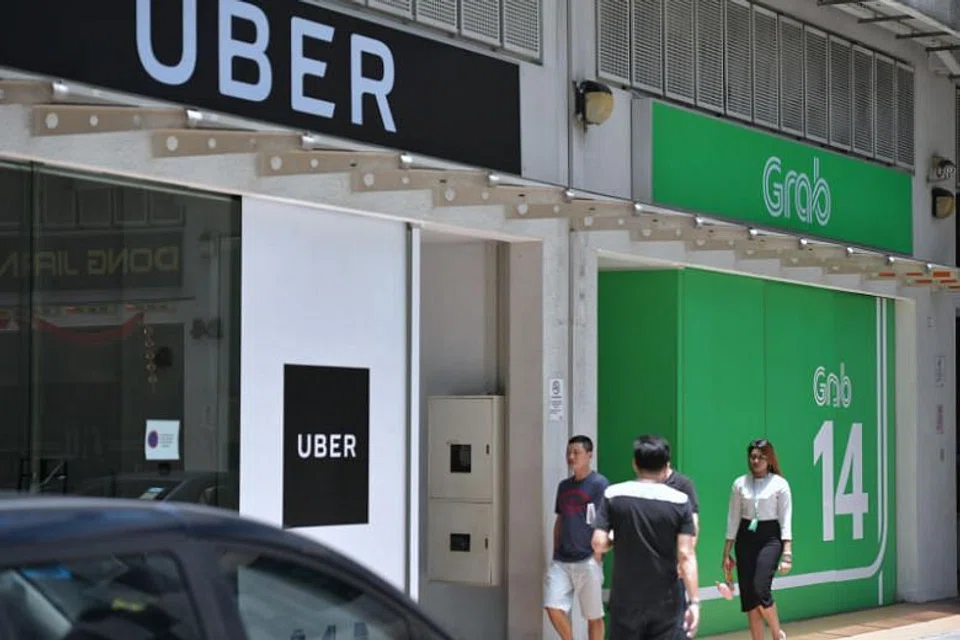
THE Grab-Uber merger was declared an infringement of the competition act by Singapore's competition authority on Thursday. It was a verdict that did not come as a surprise - but the justification for it floored many, including of course, Grab.
Lee Der-Horng, director of the NUS-LTA Transport Research Centre, was among the more critical observers. He told The Business Times: "It really is an amusement to me. I could not help but laugh at the provisional findings by the Competition and Consumer Commission of Singapore (CCCS), which are mostly based on assumptions and speculation."
He cited CCCS' chief finding which stated "Uber would not have left the Singapore market in the near to medium term in the absence of the transaction" and that "Uber had entered into an agreement to collaborate with ComfortDelGro with the introduction of UberFlash to compete with Grab, and the collaboration was only withdrawn after the transaction".
Entry barriers
Prof Lee said: "Given Uber's nature as a global company and that Uber is not a rookie, it must have made a very careful evaluation beforehand and not a random decision (to merge with Grab). Furthermore, Uber's former collaboration with ComfortDelGro showed that Uber was trying to find a way to stay relevant in the Singapore market."
He also highlighted CCCS' finding that taxi-booking services pose an "insufficient competitive constraint" to Grab and Uber with a market share of less than 15 per cent, and barriers to entry and expansion in the ridehailing sector are high due to "strong network effects" that are perpetuated by Grab imposing exclusivity obligations on taxi and car rental partners.
CCCS had said in its statement: "Without any intervention from CCCS, it could continue to hamper the ability of potential competitors to access drivers and vehicles."
To that, Prof Lee said: "It's true that taxi-booking services pose insufficient competition, but this is due to the taxi companies' insufficient actions in improving their booking services. Yes, part of the private-hire car services' success is due to the network effects they've created. But isn't this a good example of innovation that any business should pursue?"
Observers also pointed out that CCCS' response could be a knee-jerk reaction and reflects a desire on its part to assert its regulatory power, when Grab and Uber announced their merger in March without having formally informed CCCS.
Thio Shen Yi, joint managing partner at TSMP Law Corporation, told BT: "What CCCS seemed most concerned about was that the parties consummated the deal without getting an indication from CCCS on its views of the anti-competitive effects of the transaction. That seems risky, though it may have been a calculated risk."
Mr Thio added: "CCCS probably doesn't want to encourage a shoot-first-and-ask-questions-later approach."
Li Jianggan, chief of business consultancy firm Momentum Works and former Asian head of Easy Taxi, believes however that Grab and Uber made a "rational decision" to proceed with the merger without obtaining approval from CCCS. This is because the parties would have risked not being able to complete the deal given that CCCS would need time to assess the transaction, he said. "Not fait accompli, it is easier to remedy the situation than not be able to do the deal at all."
Subsidy war
Observers noted that CCCS had missed the mark on what ought to be an important consideration in its evaluation of the ridehailing space: subsidy controls. In its statement, CCCS had claimed that any new entrant would likely have to incur a significant amount of upfront capital in order to attract drivers and riders through subsidies such as driver incentives and rider promotions.
CCCS had said: "In this regard, potential new entrants have provided feedback to CCCS that without any intervention from CCCS, it would be difficult to attain a sufficient network of drivers and riders to provide a satisfactory product and experience to both drivers and riders so as to compete effectively against Grab."
Prof Lee rebutted that incentives and promotions are "not must-haves" in a private-hire car business. "These schemes existed because Grab and Uber had both wanted to win market share in terms of riders and drivers. The existence of incentives should not be considered as a norm in this industry. CCCS' consideration is therefore ill-rooted."
Mr Li added that while CCCS had proposed to stop Uber from selling Lion City Rentals to Grab without CCCS' approval and to force Grab to end all exclusivity obligations with its partners and drivers, it had not thought hard enough about imposing subsidy controls, which could have and will deter a "subsidy war".
He said: "What CCCS could have done before the merger is disallow subsidies that artificially make rides cheaper.
"That would have allowed players to compete on services and efficiency, and given investors the peace of mind" that they no longer need to have the mindset of "killing off the competition or be killed."
Notably, some observers were receptive to CCCS' decision. Terence Fan, assistant professor at Singapore Management University, said CCCS' requests were reasonable and not overly onerous on Grab. "With such a dominant market share already, these measures by themselves should not hinder Grab's growth."
Yang Nan, assistant professor at the National University of Singapore, added: "This is obviously bad news for Grab. But if I may, I urge the press to put consumer welfare first. Punishing a particular company isn't CCCS' goal per se. Protecting consumers, and a competitive environment, is."
Grab, imaginably, was not thrilled by CCCS' decision on Thursday. A company spokesperson said that for one thing, CCCS appeared to have taken a "very narrow approach" in defining competition in the ridehailing sector, to which CCCS replied that actual and potential rivals do not currently pose sufficient competitive constraint on Grab as compared to what Uber did before the merger.
The Grab spokesperson told BT: "This provisional decision and proposed remedies are overreaching and go against Singapore's pro-innovation and pro-business regulations in a free market economy. We will take all appropriate steps to appeal against this decision."






