

Indonesia's startup scene exploding, but exits are another story
The ecosystem can benefit from a tech firm's public listing, while startups have yet to realise the full potential in the B2B space

Jakarta
IN A neighbourhood nestled within South Jakarta, 37-year-old Romana operates a small roadside kiosk selling prepaid mobile credit and phone accessories.
But customers also come to her when they want to pay their electricity bills, transfer money, or even sign up as a driver with Grab.
Romana, who goes by one name, is one of more than 2.6 million agents using a digital platform operated by Indonesian startup Kudo.
Through Kudo's app installed on its agents' mobile phones, Indonesians who lack home internet connections or credit cards can still shop online by visiting an agent. In turn, these agents earn a commission for every transaction they facilitate through the online platform.
In Indonesia, an archipelago known for its immense market size - with a population of 264 million - and rising mobile penetration among middle-class locals like Romana, a potent mix of underdeveloped infrastructure and unique business models driven by technology has created startup battlegrounds in the major areas of ride hailing, food delivery, e-commerce and fintech.
These startups are changing the labour market by empowering a new generation of micro-entrepreneurs. Since becoming a Kudo agent in 2017, Romana's average monthly income has more than tripled to at least 20 million rupiah, or S$1,931.
Kudo was snapped up by Grab in 2017 in a deal reportedly worth about US$100 million. It rebranded to GrabKios earlier this month amid tighter integration with its parent company.
A flurry of trade sales in Indonesia has provided exits for venture capitalists, but the ecosystem has matured to the point where investors are now itching for blockbuster exits in the form of public listings, which have yet to happen.
"While there has been some consolidation, these have largely been mid-cap acquisitions by the Indonesian conglomerates and tech unicorns, such as e-commerce unicorn Tokopedia's acquisition of wedding vendor marketplace Bridestory earlier this year, on which we advised," said Joel Shen, a tech lawyer based in Jakarta.
"What the market needs is some significant exits. The initial public offering (IPO) of a tech unicorn, for example, or a billion-dollar buyout, like Alibaba's acquisition of Lazada, will bolster investor confidence."
Any investor serious about venture deals in South-east Asia would have Indonesia in their strategy, or so the sentiment goes.
The e-Conomy 2019 report by Temasek, Google and Bain revealed that Indonesia's internet economy has bolted ahead of the pack in South-east Asia, growing at an average rate of 49 per cent a year since 2015. It is on track to cross US$130 billion by 2025, from US$40 billion in 2019.
"This means that even a company that posts modest real growth over the next few years is likely to enjoy a healthy multiplier," Mr Shen pointed out.
Even as the need for a whopper exit remains, there's no denying how far the startup scene has come. On the roads of Indonesia, motorcyclists clad in green and black jackets transport passengers, food and parcels as super app rivals Gojek and Grab go head-to-head.
But the decacorns (startups that are worth at least US$10 billion) have gone beyond transportation and are now dabbling in lifestyle offerings and doubling down on financial services, an area many startups are targeting given Indonesia's large unbanked and underbanked population.
Payfazz, which graduated from prestigious Silicon Valley accelerator Y Combinator, ropes in agents to help people without bank accounts to access financial services online with cash.
Digital lender Akulaku has built a virtual marketplace where consumers without a credit card can still shop on instalment. The startup raised US$100 million in a Series D round this year, which saw participation from Alibaba affiliate Ant Financial.
The e-Conomy report noted that these pure-play fintechs have successfully grown their user base by addressing pain points in access, value and transparency, but face high customer acquisition costs.
"It remains to be seen whether they can generate an even higher lifetime value to be financially sustainable," said the report, referring to a metric that captures the total revenue a business can expect from a customer over the whole period of their relationship.
Industry observers' hopes for a tech IPO might materialise in the more mature field of e-commerce, where the battle for dominance has intensified.
Homebred unicorns Tokopedia and Bukalapak (another Indonesian e-commerce giant) have become household names, but are also facing pressure from regional rivals Shopee and Lazada. The two Singapore-based firms are pumping in money and resources into user engagement through gamification and live-streaming features.
Category-specific marketplaces have emerged as well, such as beauty e-commerce startup Sociolla, backed by Singapore state-owned investment firm Temasek.
But Indonesia's shoppers are more than those who browse online. As the startup scene continues to evolve, "new retail" is a term that often crosses the lips of venture capitalists these days. It emphasises new customer and merchant experiences through methods such as automation and data collection for customer profiles.
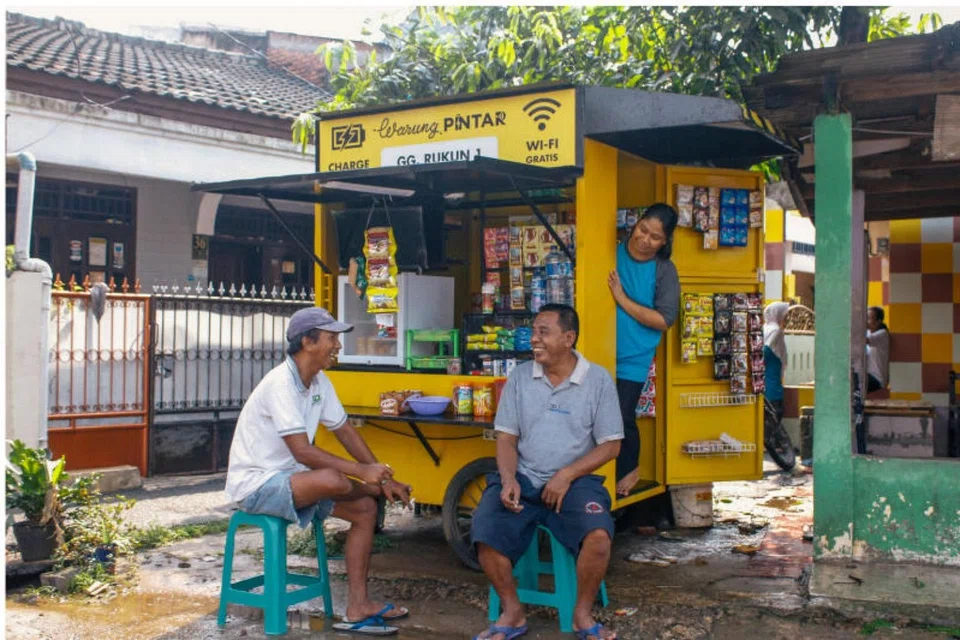
Startup Warung Pintar, which was spun out of venture capital firm East Ventures, aims to revamp traditional road-side kiosks, called warung. It provides vendors with a bright yellow "smart kiosk" decked out with a digital point-of-sales, an LCD screen for displays, free Wi-Fi and charging stations for customers, and more.
"Indonesia's ecosystem has not been efficient for a long time, so many breeds of business models uniquely only exist, or have just newly developed here," said Melisa Irene, a partner at East Ventures.
"Warung Pintar is only possible for a country where more than 70 per cent of retail business is general trade, versus most countries that have modern retail. It also captures a uniquely Indonesian culture that emphasises community, and is based on trust."
Hanno Stegmann, partner and director at BCG Digital Ventures, believes that there is a massively untapped opportunity in Indonesia's business-to-business (B2B) space.
Sectors that he is bullish about include precision farming, construction tech, B2B logistics, inventory management and warehousing, and B2B financing and capital management.
"It is quite a common development we have seen in many markets that startups tackle B2C (business-to-consumer) opportunities first. Frictions are more obvious and often VC money is leaning stronger towards consumer plays as valuations can be higher in the beginning," Mr Stegmann said.
"What a lot of entrepreneurs have not looked at closely enough in my view is the B2B opportunity - here, frictions are more complex (as deep industry knowledge is required), solutions are less obvious, and given that labour costs are still very low in Indonesia on a global benchmark, it is less obvious to solve problems through technology and new business models," he added.
"But if you take a step back and have a long-term perspective, which every entrepreneur should do, because building a startup is a marathon and not a sprint, this will change."
TRENDING NOW

Two Singapore-listed palm oil firms named in Greenpeace report on Indonesian plantation fires

Singapore Airlines flight returns to San Francisco after ‘unruly’ passenger incident

Singapore looking into which companies responsible for haze-causing fires: PM Wong

Deluge IPO 3.86 times subscribed ahead of SGX debut

