

Innovation centre to develop Singapore as base for advanced manufacturers

Singapore
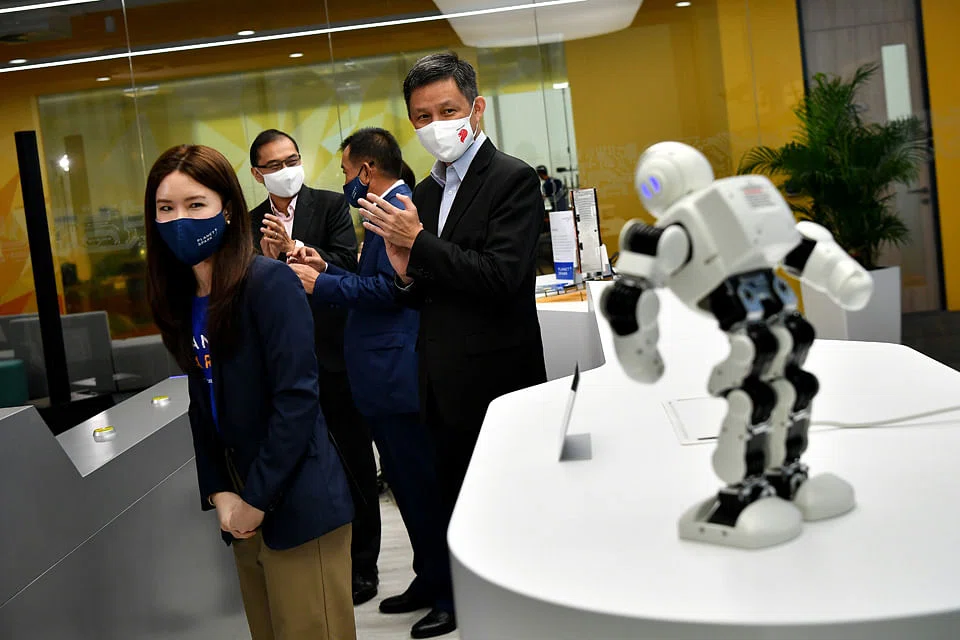
AN innovation centre aimed at boosting the competitiveness of Singapore's electronics and advanced manufacturing sector was launched on Tuesday at Changi Business Park.
The PlanetSpark Innovation Centre plans to nurture Singapore-grown hardware technology startups in the artificial intelligence (AI) and Internet of Things (IoT) sectors.
The centre was developed by mainboard-listed electronics components distributor Excelpoint Technology, in a two-year collaboration with Enterprise Singapore.
Both parties will pump in an initial investment of S$5 million to grow more than 30 startups over the next three years, said PlanetSpark's managing director Phuay Li Ying.
Through PlanetSpark, companies can accelerate their product development journey and deliver a proof-of-concept within six months. Startups pay S$20,000 to participate in the accelerator programme, with Enterprise Singapore subsidising up to 70 per cent of the fee.
The centre will also connect startups to a network of key semiconductor partners and manufacturers such as Analog Devices, Xilinx, Qualcomm and NXP for product development and commercialisation.
PlanetSpark's panel of mentors from the private and public sectors will share their expertise and experience with companies.
The centre will also establish partnerships with venture capital firms, such as SGInnovate and IncuVest, to provide funding to grow high-potential startups.
The opening of PlanetSpark complements the government's efforts to grow the electronics industry and develop Singapore as a resilient base for advanced manufacturers in the region, said Minister for Trade and Industry Chan Chun Sing, the guest of honour at the opening ceremony.
"As a global trading hub for electronics components, Singapore is a key node in the global supply chain for products ranging from semiconductors, storage and memory products to microelectromechanical systems," he said.
In 2019, Singapore exported more than US$84 billion of electronic components, representing about 10 per cent of global electronics exports.
Mr Chan said the nature of manufacturing is undergoing a transformative change, propelled by advancements in AI and IoT, and huge amounts of computational power.
The global IoT industry, which was valued at US$151 billion in 2018, is forecasted to grow to US$1.6 trillion by 2025. Furthermore, overall IoT adoption within Asean is expected to be even greater than global averages due to the growth of "smart cities" and Industry 4.0 efforts.
"It is not enough just to try and play the arbitrage game," said Mr Chan, referring to how players in the electronics industry started out by "buying cheap and selling high" to make a margin.
"Nor is it enough to just produce things for other people. If we do not have our own products, intellectual property and value-added services, it will be very difficult for us to survive this harsh competition."
The minister added that the government is also looking to boost local production to strengthen the country's supply chain across its portfolio of needs.
Singapore is also in a good position to capture opportunities as companies rethink their global supply chains, though it must keep pace with innovation, he said.
The hardware industry is a challenging one to break into because of the long gestation period needed for research and development, said PlanetSpark's Ms Phuay.
The innovation centre will help bridge this gap to allow more startups to thrive in the fast-paced and competitive industry, she said.
Five startups are currently housed under PlanetSpark's programme: spacetech startup NuSpace; thermal sensing solutions firm Nexwah Technology; facial recognition startup Seventh Sense; Excelpoint-invested CLOPTech, which is developing wireless connectivity solutions; and Meridian Innovation, a developer of thermal imaging solutions.
CLOPTech's founder and chief executive Albert Chai told The Business Times that PlanetSpark differs from other hardware accelerators because of its middleware technology.
This customised system integration solution - akin to a "bridge" - is a critical link in determining the scalability and interoperability of an IoT solution. PlanetSpark's middleware is powered by the technology stacks of Qualcomm and Xilinx, Excelpoint's long-time partners.






