Investors see unpolished gems in Malaysia's startup ecosystem
The country has flown under the radar in venture capital deals, but new opportunities are surfacing

Singapore
AGRITECH, infrastructure and Islamic finance - these are some sectors that could draw more venture deals to Malaysia's startup ecosystem, as interest grows from both domestic and global investors.
Malaysia has produced many of South-east Asia's notable entrepreneurs, but its startup scene is often overshadowed by regional peers, such as Indonesia, Singapore and Vietnam.
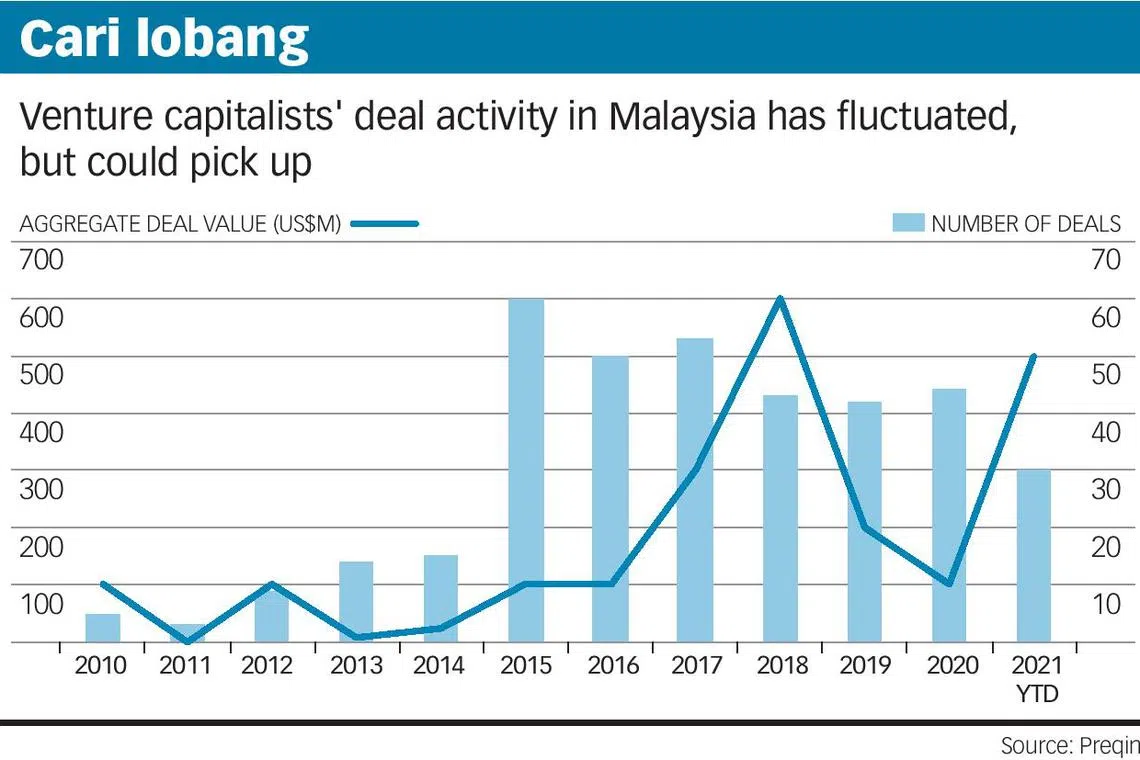
While venture deal volumes picked up in Malaysia from 2015, its growth trajectory has been uneven, according to data from research firm Preqin (see chart).
There are a few reasons behind this. One is the perception that Malaysia - like Thailand and the Philippines - has "existing family business conglomerates that may crowd out new ventures", said Ku Kay-Mok, managing partner of Gobi South-east Asia, which has backed about 20 Malaysian startups.
The mid-sized nature of the country's domestic market has also meant less venture capital interest, as opposed to Indonesia.
In addition, political turmoil has impacted how some foreign investors view Malaysia's startup ecosystem.
"The fluid Malaysian political scene in the last few elections lessened confidence in the Malaysian government being able to orchestrate the digital transformation of the economy and growing the tech ecosystem," said a venture capitalist, who requested anonymity.
But there are also factors that make Malaysia a favourable place for deal-hunting: the availability of tech talent, cost advantages relative to Singapore, a sizeable domestic market and homegrown expertise in sectors such as agriculture and manufacturing.
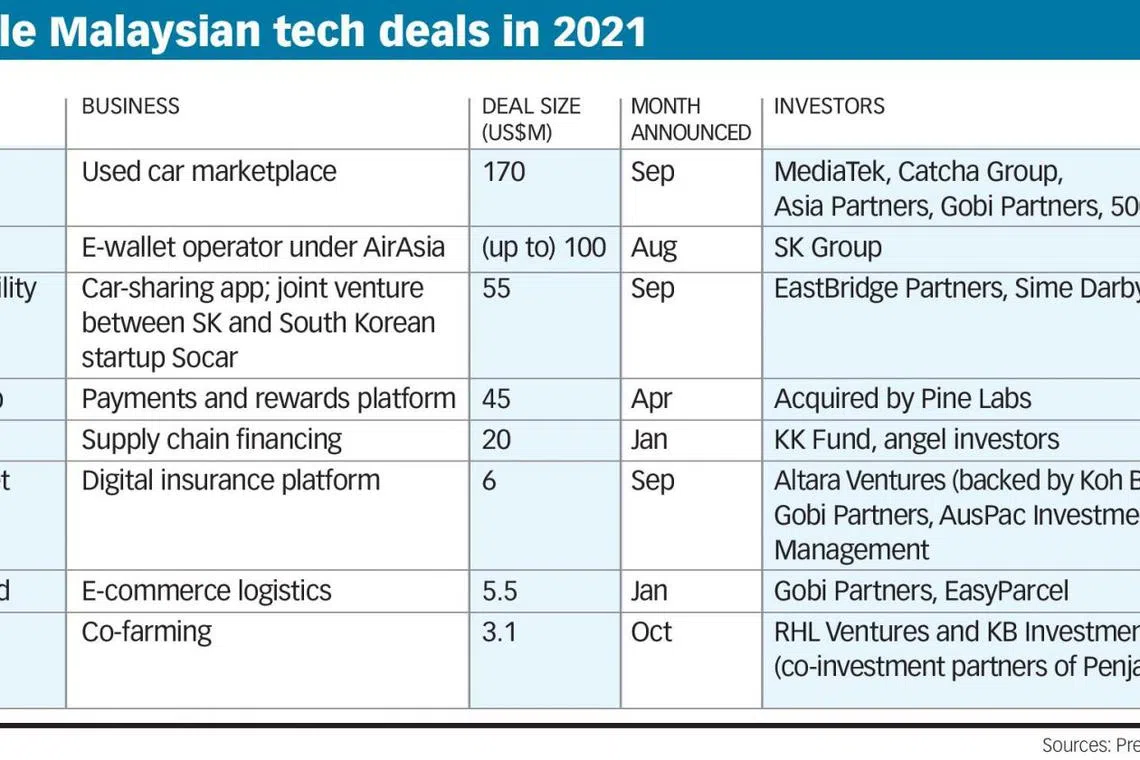
There are strategic sectors where Malaysia's startups stand out, investors told The Business Times (BT). Rachel Lau, managing partner at Malaysia-based RHL Ventures, cites agritech and foodtech as fresh opportunities.
For instance, RHL recently backed Fefifo, a startup that specialises in "co-farming", through which smallholder farmers can rent ready-to-farm greenhouses or open farm space with managed farm services, accommodation and other shared facilities. Fefifo has piloted the concept in Perak, with plans for expansion.
Lau said: "There are young agriculture graduates who want to go into farming. Food security is a very big thing, especially with the pandemic situation, so it's about investing in the right people." Malaysia is also equipped with land and labour resources for such startups to thrive, she added.
Ku, too, is bullish on Malaysia's agritech startups. "The country is already well-known for durian, but with the shift to alternative proteins and other health food products, Malaysia could emulate the Netherlands, which is a smaller country yet a global agriculture export powerhouse," he said.
He cites construction tech as another promising sector: The relocation of the Indonesian capital from Jakarta to Kalimantan could provide good spin-off opportunities for smart infrastructure development in East Malaysia.
"This is in line with the move to a circular economy, where construction tech can be deployed to make the building process more environmentally friendly, and make buildings smarter in terms of energy usage and waste management," he said.
Islamic finance is also a bright spot in the Malaysian market, said Khailee Ng, managing partner at 500 Global, as startups in this sector can also target Indonesia and the Middle East.
"Actually, there are plenty of seed opportunities in Malaysia," said Ng, who previously co-founded two Malaysian startups, Says.com and GroupsMore.
Part of the problem has also just been the lack of good data and coverage of the growth of Malaysia's startup ecosystem, he added.
500 Global has over 40 portfolio startups in Malaysia. A number of them have gone on to attract global venture funding, such as drone tech startup Aerodyne Ventures and used car marketplace Carsome. The latter also recently became Malaysia's first unicorn.
The possibility of more homegrown unicorns has stirred interest not just from foreign investors, but domestic ones as well. Corporate venture activity is picking up in Malaysia. For instance, in June 2020, energy giant Petronas made its first venture capital investment, via Petronas Ventures, into Braintree Technologies, an agritech startup developing robots for farm automation.
Ng said: "We've had different corporations and family-owned businesses invest in our fund and coinvest in startups as well. So we're seeing a lot of momentum."
Being unable to travel has certainly encouraged domestic investors, such as family conglomerates, to take a closer look at tech investments, said Lau of RHL.
"If you're stuck here and your kids keep telling you about Spotify and HappyFresh, then you're like okay, what is this? They're being forced to learn these things," she said, citing the music streaming service and grocery delivery service. The pandemic has also compelled old-school entrepreneurs to think about how to catch up digitally.
Malaysia-based startup founders BT spoke to reckon that the country can actually be a good test market, even though it is not widely viewed as such.
David Chmelar, co-founder of e-commerce startup iPrice, chose Malaysia as the headquarters for his startup mainly due to the relatively lower costs than Singapore and the availability of talent, even though iPrice's biggest market is Indonesia.
"It was (about) cost combined with bringing in international talent. We have centralised operations; we bring pretty much all our team members to one location and that's impossible in Indonesia. They are very strict on international visas, it's a very tedious process," he said.
Kamarul Muhamed, chief executive of Aerodyne, echoes a similar sentiment: "I do have the option of doing this in Japan or even Singapore... But I have stayed here, because we have good diversity in our talent pool; I can get talent quite easily. And it's also a thriving ecosystem."
Malaysia's loss of good startup deals to other countries has been a "wake-up call" for the country, reckoned Kamarul.
"I've been making a lot of noise - Malaysia needs to be a tech powerhouse; we need to do the right thing, we need to invest more to provide a thriving ecosystem. Funding needs to be there."
The Malaysian government has been stepping up efforts. Last year, it launched a fund-matching programme, Penjana Kapital, with a RM1.2 billion (S$389.5 million) target.
Half of the capital, or RM600 million, comes from selected domestic and foreign investors. The Malaysian government matches the other half. Participating investors have since poured in more capital than the target, bringing the total fund size to RM1.57 billion.
Views have been mixed about whether Penjana can make a dent on the startup scene, with previous media reports highlighting concerns about its opaque structure and whether it can be well-executed.
RHL is a participant in Penjana, together with South Korea's KB Investment. Addressing the reports, Lau said: "As with every new initiative and innovation that takes place, there will be plenty of naysayers... (Penjana) is determined to help Malaysia grow its digital ecosystem and it has done a great job in attracting foreign capital."
As investors watch how the Malaysian government's efforts pan out, those on the ground are confident about the fundamentals of the country's startups - it just needs more polishing.
Carsome chief executive Eric Cheng reckons that streamlining and simplifying the process to apply for government-sponsored grants would be useful for startups. The private sector also has a role to play, and more partnerships can take Malaysian startups "to the next level", he said.
"The market offers outstanding fertile ground for startups, and people need to understand this. Malaysia's consumer base is strong, it has excellent cost advantages, talent is outstanding and people are highly motivated," said Cheng.
As he sees it, "Malaysia is easy to overlook, but should not be".
- Garage is BT's startup vertical. Read more news, analyses and opinions at bt.sg/garage