

Old money, young talent a potent mix to take Singapore's deep-tech scene forward: panellists
To draw young talent, startups need to give them "something meaningful" to work towards

Sharanya Pillai
Singapore
SINGAPORE'S prominent families may have made their money in old-school sectors, but they are ready to back the new-age, deep-tech kids on the block, said panellists at a deep tech investing forum organised by SGInnovate on Wednesday.
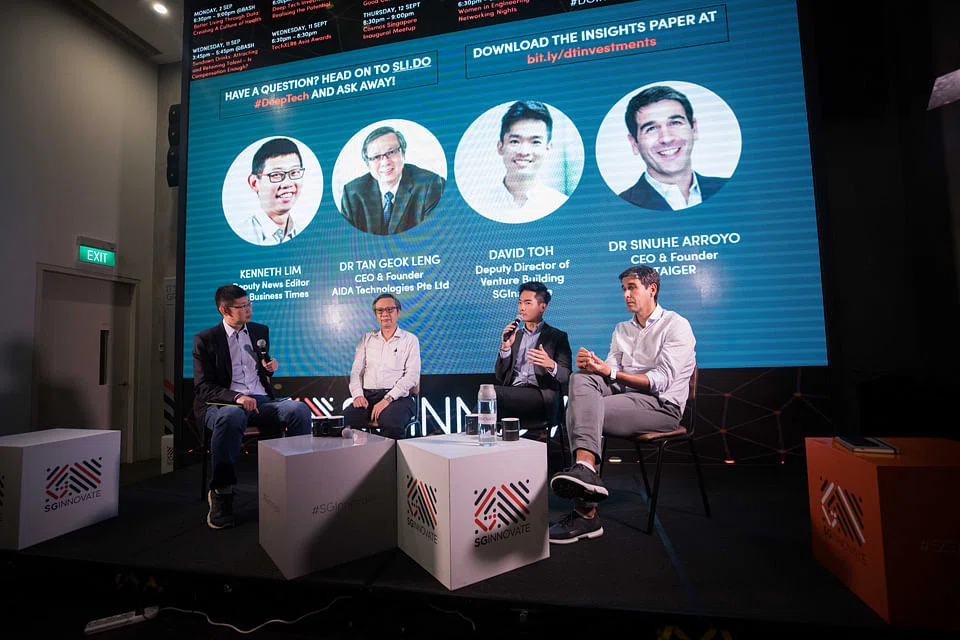
Moderated by The Business Times' deputy news editor Kenneth Lim, the panel featured deep tech entrepreneurs Dr Sinuhe Arroyo, chief executive of AI startup TAIGER; Dr Tan Geok Leng, chief executive of startup AIDA Technologies and David Toh, deputy director of venture building at SGInnovate.
"Increasingly, and rather interestingly, we have family offices (and) individuals who have made their money through property, construction or brick-and-mortar businesses coming to us, because they have already acknowledged that technology will change the way things are done," noted Mr Toh.
He was responding to a comment by an audience member that business families here may be more hesitant to invest in deep tech startups, contributing to the shortage of funding in the deep-tech ecosystem.
Mr Toh added: "(The families) see their own industries being disrupted and they want to be part of it. They are also concerned by the fact that if I only do what I do now, then I will lose out to my competitors. We do have family offices... coming to us who have never had a mandate to invest in technology but increasingly are more excited.
More family offices and even institutional investors seem to be putting money into deep-tech, agreed Dr Arroyo of AI startup TAIGER.
"The hardest part when you are trying to close a round is not in trying to find money, but in finding the lead investor," he said, but added that he expects the situation to improve as Singapore's deep-tech scene matures.
Besides attracting "old money", bringing in young talent is another pertinent challenge for the ecosystem, Dr Tan of AIDA Technologies said. Deep-tech startups not only require leadership with deep technical expertise, but also someone with business acumen.
"I think it will be very difficult to try and convert a scientist to an entrepreneur. The intersection between a good scientist and a good entrepreneur is very small... Maybe a better model is to marry a scientist CTO (chief technology officer) and entrepreneur CEO," he said, citing US tech giant Apple as an example for startups here to emulate.
But to attract young people to serve in either capacity, startups will need to give them "something meaningful" to work towards, instead of just a "badge of honour" that they could gain by landing prestigious roles in Facebook or Google, noted Dr Arroyo.
Mr Toh concurred: "Nowadays to engage the younger generation, they need to have this sense of purpose as to why they are in the company, what impact they (have) and who are they working alongside.
"That is very different from my parents' generation... For us, when we invest in very early-stage deep-tech companies, what we also try to do is to make them as attractive as possible to the talent," he added.
TRENDING NOW

Indonesia begins cutting natural gas exports to Singapore from Oct 24: reports
Singapore’s central gas buyer affirms Indonesia’s role as ‘important partner’ amid export review warning
KKR founders among investors buying 42% of Peter Lim’s Valencia; club valued at US$1.4 billion

NEA issues notices to 10 Singapore-based companies, including Wilmar and APP, over haze

