Over 1,000 startups founded by alumni of South-east Asian tech giants: Report
 Add BT as a preferred source
THE alumni of South-east Asia's first generation tech platforms - such as Lazada, Sea and Grab - have gone on to create and lead over 1,000 startups in the region.
This was one of several findings in a report released on Monday by consultancy Bain & Co and the Tech For Good Institute (TFGI), a new think-tank by Grab focused on South-east Asia's digital economy.
The first wave of tech platforms in South-east Asia have employed more than 120,000 employees, both past and current, since their inception, the report found. The platforms included in the analysis are e-commerce players Lazada, Zalora, Tokopedia and Bukalapak; e-wallet operator Ovo and diversified tech companies Sea, Grab and Gojek.
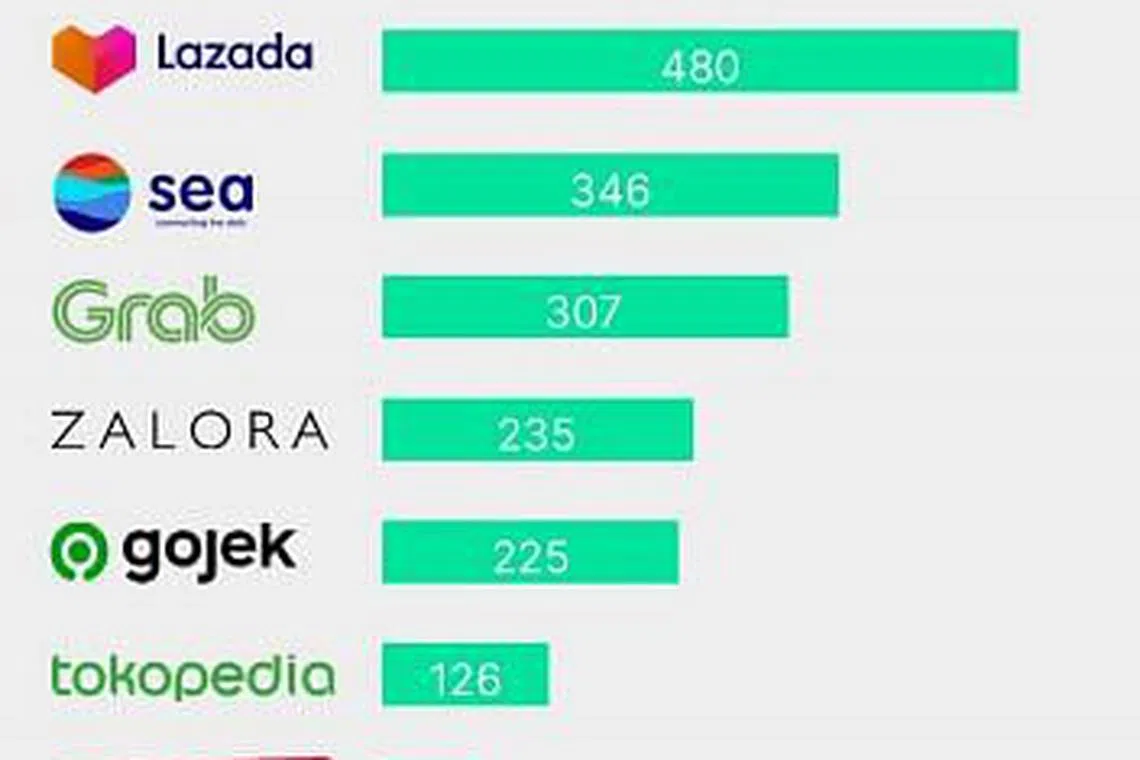
Lazada tops the chart (see below) with 480 alumni who are now founders or chief executives of startups, followed by Sea and Grab with 346 and 307 respectively. More domestically-focused companies, such as Bukalapak and Ovo, also have over 50 alumni each moving on to their own startups.
Such second-generation startups include investment platform Endowus and cybersecurity startup Horangi, both founded by former Grab executives. The report consolidated the data from LinkedIn and news outlet Tech in Asia.
Amid the proliferation of second-generation startups, South-east Asia's digital ecosystem still has plenty of room for growth, said Florian Hoppe, Bain's head of the Asia-Pacific digital practice, at the launch of TFGI on Monday.
For instance, e-commerce contributed to only 8 per cent of total retail sales in South-east Asia last year, as opposed to 17 per cent in the US and 27 per cent in China.
"It is not only about breadth in reaching many (consumers), but also about depth of engagement and activity level," said Mr Hoppe. Another big challenge is in balancing the growth of tech giants with regulatory and social issues, an area where he reckons South-east Asia needs its "own playbook".
"Platforms benefit from scale and aggregating consumer demand. Ensuring a fair and level playing field and access for smaller players remains important. Consumer protection is critical... Data privacy is another one," he said.
The hot topic of platform worker benefits also surfaced in the report and at the launch event, which was attended by Minister for Communications and Information Josephine Teo.
In her speech, Mrs Teo reiterated the government's concerns about the welfare of platform workers, who are currently treated as independent contractors and not employees.
"They are, for all intents and purposes, just like employees. They lack basic protections like workplace injury compensation, union representation and employer CPF. In time to come, we worry that they will find it harder to afford housing, healthcare and eventually retirement. To be truly inclusive, we must address these issues to give workers more secure futures," she said.
The MOM is studying the matter and will take a consultative approach, and public-private partnerships will be key to untangling complex issues that digital developments present, Mrs Teo added.
As announced last month the newly set-up advisory committee on platform workers will be looking into how to strengthen labour protections for these workers over the next year. This may involve legislative changes.
Decoding Asia newsletter: your guide to navigating Asia in a new global order. Sign up here to get Decoding Asia newsletter. Delivered to your inbox. Free.
Copyright SPH Media. All rights reserved.