

Record high levels of undeployed capital, demand for exits seen to drive continued momentum for venture capital deals
Lower interest rates and improved investor sentiment towards the asset class, among others, point towards a rosier Q1 2025


DEALS in the venture capital (VC) space are expected to continue to gain momentum in 2025, driven by record high levels of undeployed capital, demand for exits by limited partners, tempered valuation expectations, and dwindling cash runways for portfolio companies.
Ang Lip Kian, a principal at the mergers and acquisitions (M&A) and private equity practice at law firm Baker McKenzie Wong & Leow in Singapore, noted that there has been an increase in fund investment as well as exit discussions heading into the end of 2024.
“The momentum appears to have carried over into the first quarter of 2025 despite the ongoing macroeconomic and geopolitical uncertainty,” he said.
VC firms have been stepping it up since the fourth quarter of 2024, with Square Peg reporting six exits and returns of over US$270 million for its investors. These exits were a variety of trade sales and public listings, including the privatisation of PropertyGuru.
“The next 12 months, we see activity picking up; we can see a number of follow-ons coming from our portfolio companies and more exits in the region,” said Tushar Roy, partner at VC firm Square Peg.
These deals will provide more proof that the region’s startups are still worth investing in, according to Roy.
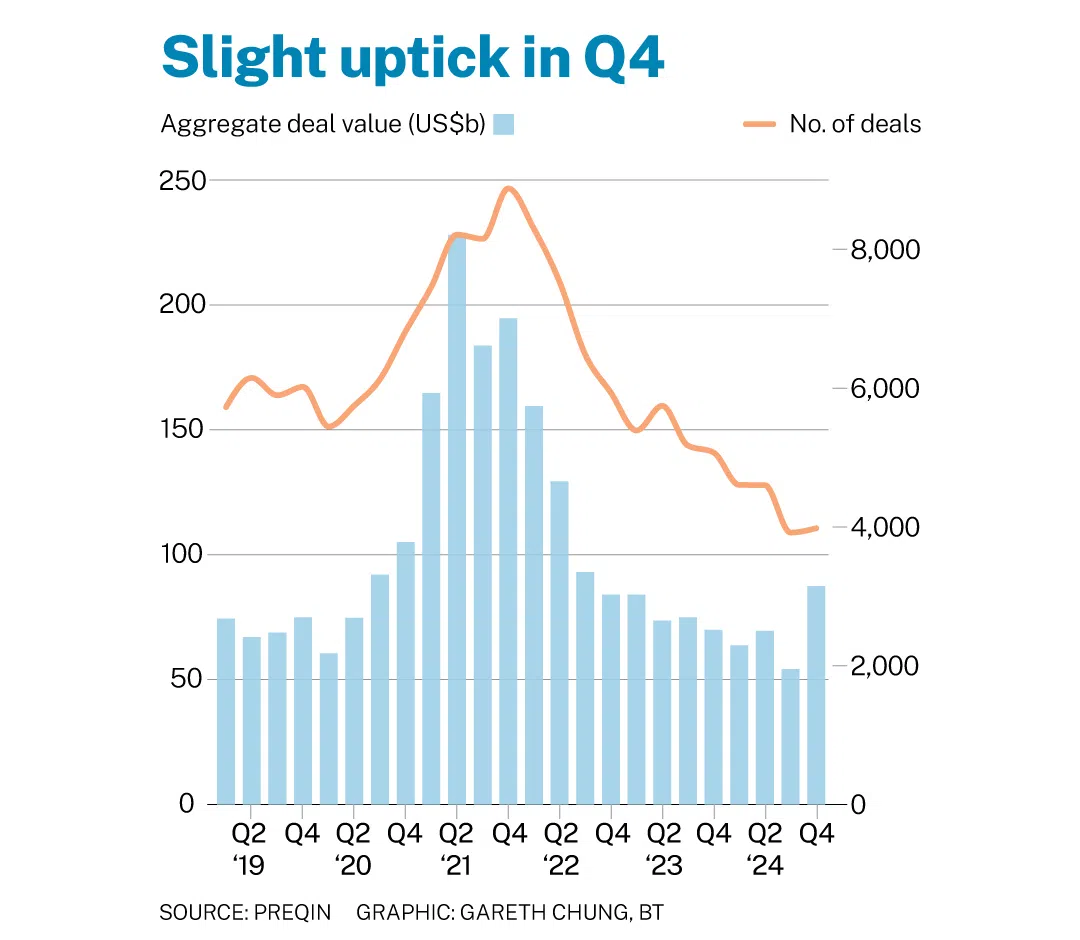
With numbers still being finalised, market watchers are split on whether there was indeed an uptick in VC deals in Q4 2024.
Either way, lower interest rates and improved investor sentiment towards the VC asset class point towards a rosier Q1 2025. Plus, there is over US$500 billion in VC dry powder, noted Angela Lai, head of performance and valuations, research insights at data platform Preqin.
“Capital is not currently a limiting factor even though new fundraising has been slow,” she said.
Gao Kaidi, senior analyst for venture capital at data platform PitchBook, noted that there is a lag in private market data reporting, and deal counts for Q4 2024 are expected to tick up as more data is gathered.
“However, we don’t expect to see a significant jump in deal value, because large deals that make up the bulk of quarterly deal value tend to be disclosed quicker than smaller deals,” she said.
Market watchers believe deals are likely to concentrate on sectors such as artificial intelligence, healthcare and cleantech. Besides having relatively more investment activity, these sectors are also likely to fetch higher valuations, noted Lai.
But the recent eFishery fiasco has led to caution over deploying capital into Indonesia.
“Many investors have become cautious about deploying capital to Indonesia, the largest market in the region, due to considerations including concerns over fraud, a sluggish exit landscape, and thin liquidity from the local exchange, as well as high valuations,” said Gao.
Exits remain soft for South-east Asia. Square Peg, for example, saw most of their exits outside of South-east Asia; the majority of these were via the secondary market or trade sales, instead of public listings.
PitchBook data shows that US$520.4 million was generated from exits in the region in 2024, below the 2023 level of US$772.7 million.
With 2023 already considered a slow year, market watchers see that exits remain a key challenge for South-east Asia.
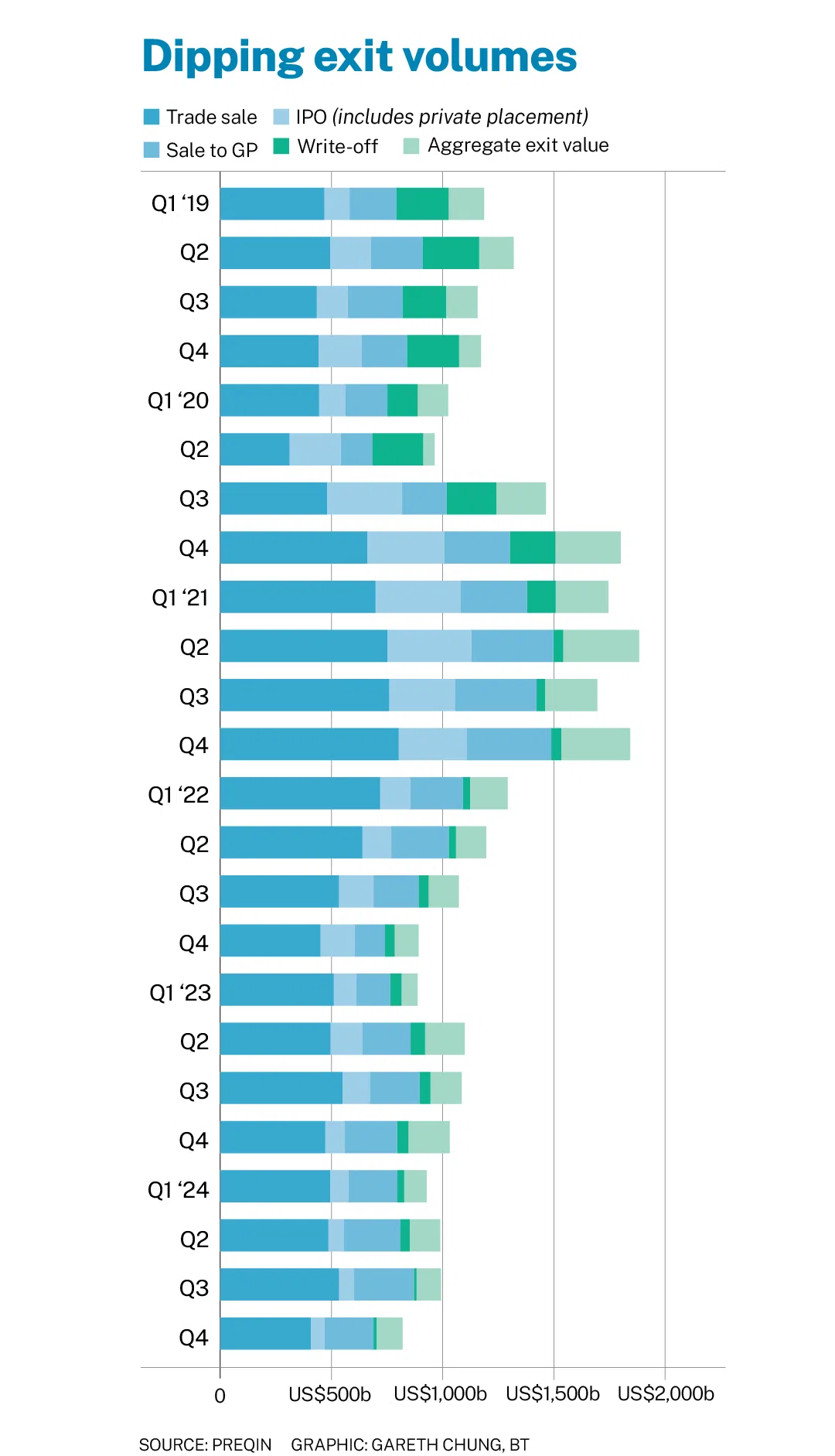
Without large exits, capital remains locked into later-stage startups, which prohibits limited partners (LPs) from recycling capital into new funds. Square Peg’s Roy noted that the distribution-to-paid in capital ratio – or how much investors are getting back from their investments – remains a key metric.
“South-east Asia’s VC ecosystem as a whole doesn’t have a strong record of return generation, so LPs will likely remain cautious and highly selective in 2025, unless we see material changes on the exit front,” said PitchBook’s Gao.
There is hope that exits will pick up towards the end of 2025, with fund managers expecting improvement to the exit environment.
“The risk is that if the improvement does not happen again this year then we could have a new wave of casualties in VCs – especially where there are more pressing needs for new funding,” said Preqin’s Lai.
The market is paying close attention to unicorns in the region, especially those that have lasted longer than the average VC fund life. Successful exits that generate strong returns will help boost confidence in the region’s VC landscape.
“With a lacklustre exit landscape and prolonged liquidity constraints, we expect to see VC managers pushing for liquidity events, including public listings, M&As, and creative strategies like secondaries,” said Gao.
TRENDING NOW

Once staunchly pro-China, Malaysian Chinese businesses are now distancing themselves from Beijing

Grab CEO’s wife Chloe Tong on life with Anthony Tan and finding her purpose

Could stablecoins be the future of money?

ST Engineering opens tech-focused aircraft maintenance facility in Changi; to create over 500 jobs

