

Self-driving startup Wayve raises US$1.5 billion for robotaxi wars
The UK capital has emerged as a testing ground for self-driving car companies globally
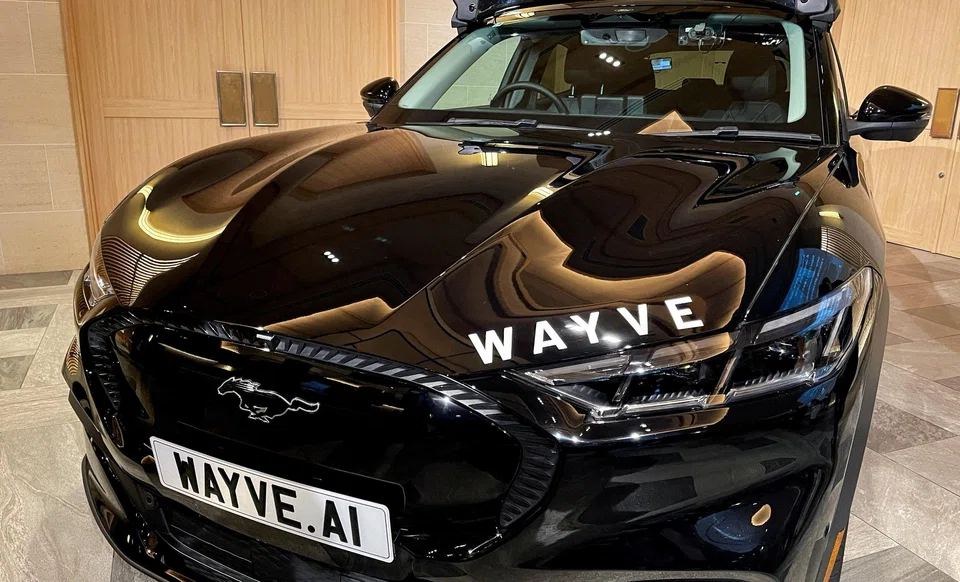
[LONDON] Wayve, the UK autonomous driving software startup, has raised US$1.5 billion in funding at an US$8.6 billion valuation as it prepares to go up against Chinese and US rivals to roll out self-driving taxis.
The funding comprises US$1.2 billion from lead investors Eclipse Ventures, Balderton Capital and SoftBank Vision Fund 2, with participation from Ontario Teachers’ Pension Plan, Baillie Gifford and the British Business Bank among others, Wayve said. Existing backers Microsoft, Nvidia and ride-hail giant Uber Technologies also invested.
Uber committed an additional US$300 million tranche, contingent on Wayve hitting certain milestones, to launch self-driving taxis running on the startup’s software, starting in London this year.
The UK capital has emerged as a testing ground for self-driving car companies globally, with California’s Waymo set to roll out a commercial robotaxi service in the city later this year, and both Uber and its competitor Lyft launching trials in partnership with Chinese tech company Baidu. Though the city is not an obvious place to test autonomous vehicles, thanks to poor weather and plentiful narrow roads, the trials follow the UK government easing of the rules on self-driving cars and buses operating on public streets.
Wayve will be hoping to benefit from the home advantage, and the fact that it mostly aims to deploy its software with partners rather than managing large, expensive fleets of its own vehicles. Its financial backers include carmakers Mercedes-Benz Group, Nissan Motor and Stellantis. Still, it has less financial muscle than some of its rivals, with Waymo raising US$16 billion earlier in February.
The company was founded in 2017 by two machine learning PhD students at Cambridge University, and offers software to enable cars to learn, perceive, understand and navigate complex real-world environments. Rather than relying on traditional rule-based software or pre-mapped routes, Wayve’s system is designed to generalise across cities and vehicle types without first needing to create detailed maps.
Over the past year, Wayve has conducted driving tests in more than 500 cities across Europe, North America and Japan without city-specific fine-tuning before deployment.
The company has partnered with Nissan to develop the next iteration of the Japanese carmaker’s ProPilot driver assistance system to roll out in 2027. These will be the first vehicles available for consumer purchase to feature Wayve’s AI technology.
“If proved safe and reliable, Wayve’s end-to-end AI could give the startup a strategic edge over larger AV rivals, thanks to its higher flexibility and lower costs,” according to a Bloomberg Intelligence report.


Self-driving taxis are set to arrive in other European cities this year, after Estonian ride-hailing company Bolt partnered with Chinese artificial intelligence firm Pony.AI and Stellantis. BLOOMBERG
Decoding Asia newsletter: your guide to navigating Asia in a new global order. Sign up here to get Decoding Asia newsletter. Delivered to your inbox. Free.
Share with us your feedback on BT's products and services
TRENDING NOW

Once staunchly pro-China, Malaysian Chinese businesses are now distancing themselves from Beijing

Looking beyond looming CEO succession, should UOB potentially pursue a transformative merger?

Could stablecoins be the future of money?

Grab CEO’s wife Chloe Tong on life with Anthony Tan and finding her purpose

