Semiconductor unicorn Silicon Box vows to avoid geopolitical mire

Company will reject state-linked funds and base manufacturing on more neutral ground, says CEO
Claudia Chong
Published Thu, Apr 25, 2024 · 09:22 PM
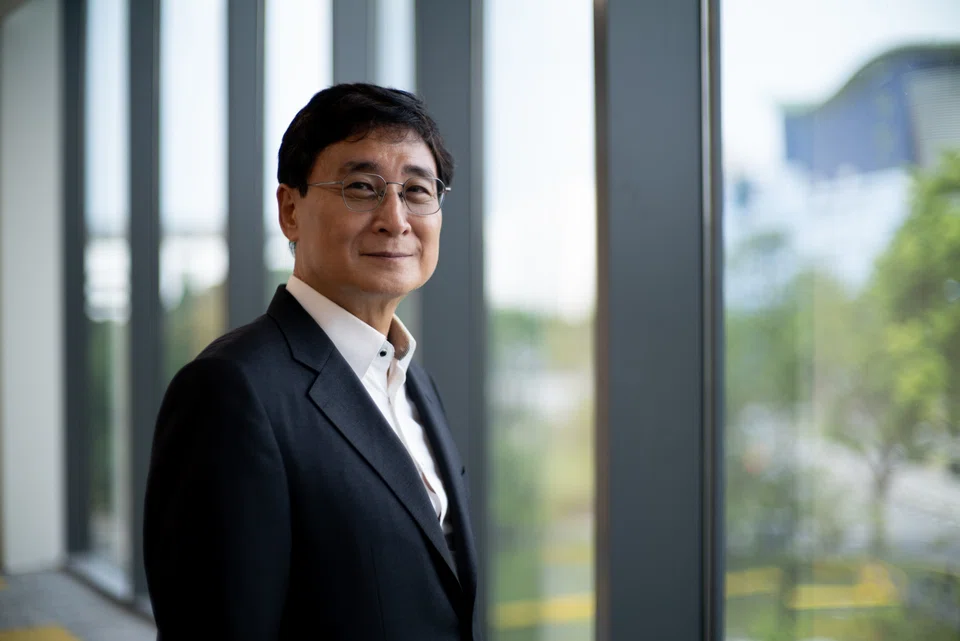
    • Han Byung Joon started Silicon Box in 2021, together with industry veterans Sehat Sutardja and Dai Weili.
    • Han Byung Joon started Silicon Box in 2021, together with industry veterans Sehat Sutardja and Dai Weili. PHOTO: SILICON BOX

    SINGAPORE’S latest tech unicorn Silicon Box, which pushed past a US$1 billion valuation after a US$200 million funding this year, intends to steer clear of the geopolitical tug of war that has jolted the global semiconductor industry.

    The company’s efforts to remain neutral have influenced many early decisions – from its manufacturing bases to its sources of funding, CEO Han Byung Joon told The Business Times.

    “The tension is going on, which is unfortunate. But we have to learn how to live with it,” said Dr Han of US-China relations.

    “The tension will continue, spreading as a disease to multiple areas,” he said, adding that Europe was likely to be next.

    Countries are jostling to bring more of the world’s semiconductor supply chain under their control as the technology grows in importance, powering everyday devices and shaping next-generation electric vehicles and artificial intelligence.

    The US has been tightening export controls while nations such as Japan and China are upping the pressure to localise supply chains, creating a tricky environment for players like Silicon Box.

    The company has so far decided to base manufacturing in Singapore and Italy, perceived as neutral grounds and nodes for top tech talent and research. Its US$2 billion 750,000-square-foot facility in Singapore has started production for early customers.

    The global chips boom helped propel Silicon Box to a billion-dollar valuation less than three years after its founding, before it had even gone to mass production.

    Dr Han said Silicon Box was fortunate to clinch strategic investors even amid the funding cooldown, though it has had to tread carefully.

    “With every investor, I categorically reject any funds related to any political or government-related fund,” said Dr Han.

    “I’ll remain that way… I’m not going to have any one of them in my shareholder portfolio as an investor. I’m building the company to be geopolitically very free and neutral.”

    That said, governments’ eagerness to attract semiconductor investments could act as a tailwind for such up-and-coming companies.

    In March, Silicon Box announced a partnership with the Italian government to invest up to 3.2 billion euros (S$4.7 billion) in a new facility estimated to create 1,600 jobs.

    The factory brings the company closer to Europe’s semiconductor wafer fabrication clusters in Italy, Germany and France.

    Companies like TSMC have expanded to Europe, Dr Han said. “But after they do all this wafer manufacturing, they still have to ship back to Asia,” he pointed out.

    “So I have to be there first… in the territory,” he said of Silicon Box, which handles the next step in the supply chain.

    ‘Jumping into chiplets’

    Semiconductor manufacturing typically involves a stepwise process comprising chip design, fabrication, and testing and assembly. Nvidia and Qualcomm, for instance, are known as “fabless” companies that excel at design.

    Companies engage Silicon Box for the final step, involving assembly and packaging. The startup specialises in advanced chiplet packaging, an emerging business as more companies adopt chiplet technology.

    Traditional semiconductor manufacturing focuses on building an entire system with all or most components on just a single chip. Apple’s M3 chip, which powers its MacBooks, is one such “system on a chip”.

    The chiplet concept, on the other hand, breaks up this system-on-chip approach into its many parts. Each chiplet is designed for a particular function, such as memory or graphics processing, then mixed and matched like Lego blocks to form a package tailored for specific uses. This gives more flexibility and efficiency in design.

    “Everybody’s jumping into chiplets,” said Dr Han. The glaring issue was the lack of capacity for advanced chiplet packaging – a gap Silicon Box is aiming to address.

    Its target customers include those in the automotive, high-performance computing, and mobile industries. It has clients in markets including the US, Europe, Korea and Taiwan.

    Silicon Box’s manufacturing facility in Singapore will cost US$2 billion when it is fully fitted out. PHOTO: SILICON BOX

    Industry veterans

    Silicon Box’s founders have attracted considerable investor interest.

    Dr Han started the company after 20 years at Stats ChipPac, a semiconductor assembly and test provider once backed by Temasek. He was CEO and formerly chief technology officer of the group, which was listed on the Singapore Exchange and privatised in 2015 in a S$1.03 billion deal.

    His co-founders Sehat Sutardja and Dai Weili are meanwhile notable names in the semiconductor industry, having founded Marvell Technology – an American chipmaker now worth US$56 billion – in 1995, but later getting ousted from its management team in 2016 in a shock move.

    The ouster followed internal and external investigations in Marvell for certain business practices, and happened shortly after an activist investor took a 6.7 per cent stake in the company.

    An internal accounting probe in 2016 found no evidence of fraud, but flagged certain issues including some premature booking of revenue and undue pressure on sales personnel.

    The founding of Silicon Box marked Dr Sutardja and Dai’s return to the chips business.

    The deep experience of the founders and their pioneering insights on chiplet technology convinced investors to come onboard, said Dr Han. Dr Sutardja and Dr Han combined have more than 800 US patents, Silicon Box has said.

    Staying founder-owned

    Singapore-based family office Praesidium Capital invested US$100 million in Silicon Box’s Series B round, analysis by data platform Alternatives.pe showed. Praesidium Capital’s two directors are members of the Widjaja family, the wealthy family behind Indonesia’s Sinar Mas conglomerate, regulatory filings indicated.

    Silicon Box’s other backers include Intel Capital, US hedge fund Maverick Capital, and the venture arms of Taiwanese chipmaker UMC and Japanese electronics group TDK.

    Silicon Box remains majority founder-owned even after the Series B round, said Dr Han. The company has been thinking hard about whether to grow faster, or control its growth.

    “Considering that this company is not even three years old, we have been going really, really fast,” he said. The company employs 250 staff in Singapore, and is hiring more.

    But Dr Han is cognisant of the development cycles in various industries that may drag out demand over years, despite the initial overwhelming enthusiasm.

    “Being in the industry for 30, 40 years, I could have a gut feeling that this is growing,” he said. “But nonetheless I won’t have the full throttle of acceleration, because you can easily make mistakes if you are going too fast.”