Agri-food sector wants support for training and new technologies
Players say environment that brings down operating cost for local farmers important for business sustainability

Singapore
SOME farmers are hoping for more support for training and co-creation of agricultural technologies in the upcoming S$60 million Agri-Food Cluster Transformation Fund.
But beyond ad hoc financial support, steps must also be taken to engineer an environment that brings down the operating cost for local farmers, industry players said.
Achieving business sustainability has been a drawn-out battle for the local sector, which has to compete against imports from countries such as Malaysia, where the cost of labour is significantly lower.
These farmers now also have to overcome the effects of climate change on global food production.
As part of its sustainability efforts, the Singapore government is setting aside S$60 million for a new fund aimed at helping farmers adopt technology.
"We harnessed technology to overcome our water and land constraints, and will do the same for climate change," Deputy Prime Minister Heng Swee Keat said on Feb 16.
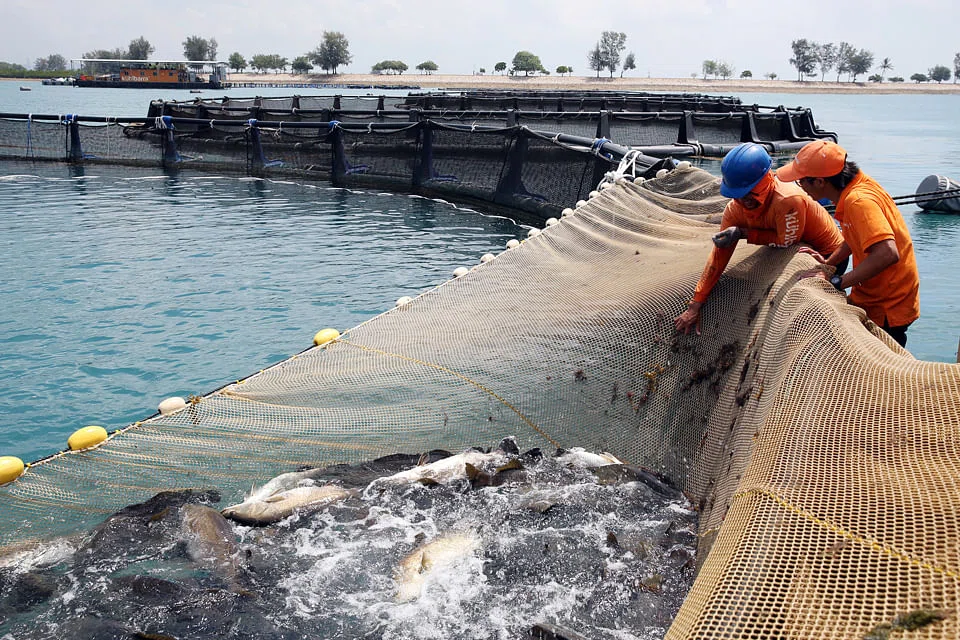
Tan Ying Quan, the head of people and partnerships at fish farming group Barramundi Asia, said he hopes to see more financial support for various stakeholders to collaborate together on farming technologies.
"For our sector to be valuable, we should be part of the value creation process and co-create solutions. There is an opportunity to build customised solutions instead of buying off-the-shelf technology. This also gives farms the chance to own their own intellectual property," Mr Tan said.
The new S$60 million fund, more details of which will be announced at a later date, will replace the Agriculture Productivity Fund (APF) launched in 2014. As at end November 2020, S$42.6 million has been committed from the APF to help 118 companies.
Mr Tan believes that while the APF has uplifted the industry, the new upcoming fund could do more to highlight specific themes such as sustainability. This could make local products more competitive for the export market, from a branding perspective, he said.
Meanwhile, the farming scene in Singapore is still lacking in the expertise needed in adopting, customising and implementing technology.
Funds could be allocated to training farmers in these aspects, said Darren Ho, managing director of Petalicious Farm. Especially crucial is the need to understand what is known as the "gestation period" - where results are not immediate even if the farmers have to absorb the cost of using tech.
Mr Ho emphasised that the focus of the new fund must be on the efficiency of food production rather than the overall output volume. This comes as farmers struggle over high operating costs in Singapore.
Lionel Wong, the founding director of Upgrown Farming, agreed. "A major issue to address would definitely be how to make the Singapore business model commercially viable. If labour and electricity costs remain the same, then we will always be handicapped especially when compared to imports," he said.
Singapore has a "30 by 30" food security goal, where it aims to produce 30 per cent of its nutritional needs locally by 2030.
Mr Wong pointed out that grants have mostly been defraying capital expenditure and initial set-up costs.
The industry needs an "ongoing and dynamic" shift towards supporting local farming, he said.
This presents an opportunity for the government to craft creative policies targeted at pressure points such as the cost and availability of labour. Business sustainability will be challenging to achieve in a strictly free market model where there is no strong competitive advantage for local farmers, Mr Wong added.
Kenny Eng, the director and principal consultant of Gardenasia, believes it is critical to have balanced approaches that focus on both the demand and supply of food.
"A holistic agriculture industry and robust ecosystem is important for farmers to be incentivised to grow more food. With our 90 per cent import strategy, it's easier for our farmers to be traders or importers than growers."