

Singapore wealthtech investments up 605% in 4 years amid Asian wealth boom

Claudia Chong
VENTURE funding in wealth management startups in Singapore surged in recent years as companies looked to address gaps in the market neglected by traditional wealth managers.
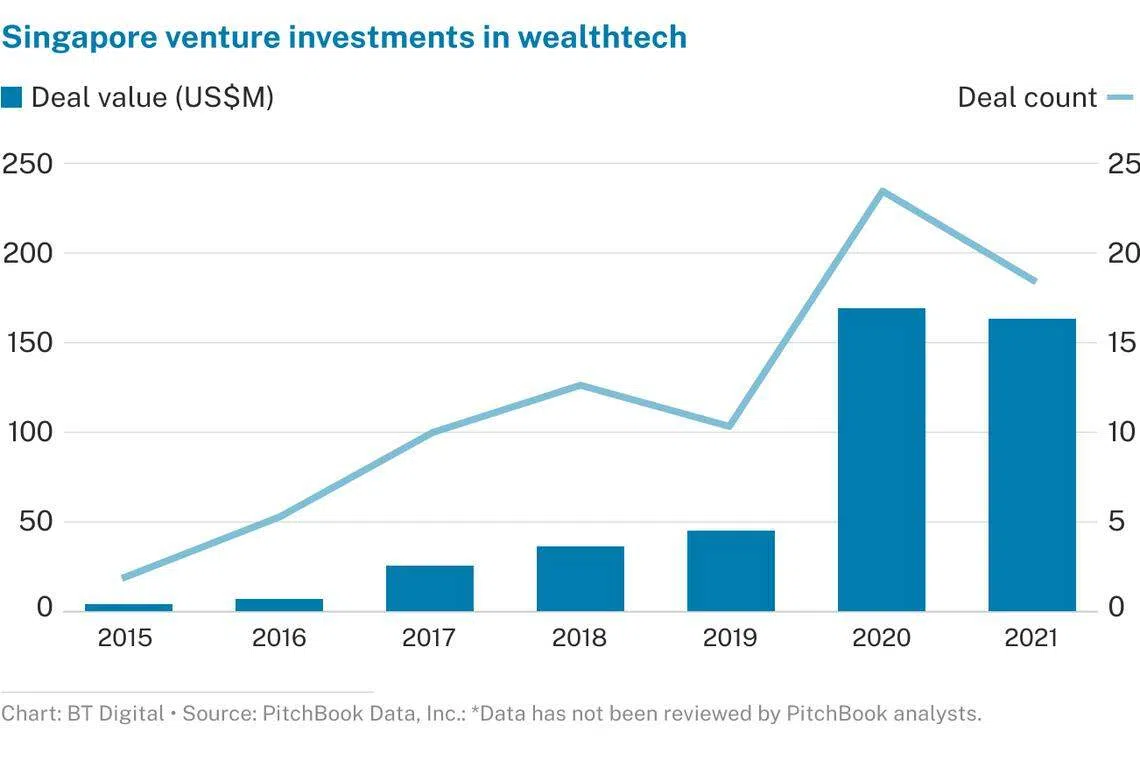
Driven by its financial hub status and growing high net worth population, Singapore recorded a jump in wealthtech investments to US$161 million in 2021 from US$23 million in 2017, according to a report by KPMG and digital wealth manager Endowus.
During this period, Singapore’s share of Asian wealthtech investments grew from 2 per cent to 7 per cent, according to the report, which analysed data from PitchBook. Asian wealthtech funding doubled to US$2.2 billion from US$1.1 billion.
Singapore has been experiencing an inflow of wealth as individuals, particularly wealthy Chinese, flock to the city-state for its attractive regime and perceived political neutrality.
Between 2016 and 2021, the number of high net worth individuals (HNWI) in Singapore grew 126 per cent, and the pool of ultra high net worth individuals (UHNWI) grew 158 per cent, according to Knight Frank’s Wealth Report 2022.
Opportunities in the global wealth management industry are increasing, driven by growing household and entrepreneurial wealth, an intergenerational wealth transfer and underfunded retirement savings. Global wealthtech investments doubled in 2021 to hit a high of US$8.8 billion.
With sustained wealth creation, consulting firm Bain & Co has forecast revenues from wealth management to almost double from US$255 billion to US$509 billion between 2021 and 2030.
Asia, in particular, is riding on the tailwinds of the wealth boom and is set to replace Europe as the world’s second largest wealth hub by 2026.
Online brokerage firms in Indonesia contributed to a significant portion of total Asian wealthtech funding last year. Ajaib raised US$243 million across three rounds, while Bibit and Pluang raised US$95 million and US$55 million respectively.
Still, Asia’s wealth management industry lags other markets such as the UK, giving wealthtech service providers a way to predict upcoming trends.
Mature wealth management markets have evolved, particularly in places like Switzerland, Australia, the UK and US, where the rise in independence in wealth management and advice has taken over, said Endowus chief executive Gregory Van at a media conference on Monday (Sep 12).
“So that’s having wealth managers or wealth advisers not attached to product providers… as well as situations where advisers are fee-only, which is how the 95 per cent plus of the industry is working today in Asia and in Singapore,” he said. “This move is undeniable.”
Investors are also placing greater focus on the total costs of investment and advice. “The days when retail investors would put up with much higher costs than were typically available only to large institutions are fading,” said Joel Teasdel, Dimensional’s head of wealth management (Asia ex-Japan), in an interview published in the report.
The changing demands of consumers, as well as a vast underserved segment, has fuelled a surge in fintech innovations in the last five years. In South-east Asia, interest in digital banks is on the rise, with launches happening in Singapore and acquisition deals being closed in Indonesia.
Samuel Rhee, Endowus’ chairman and chief investment officer, doesn’t see digital banks operating directly in the same space as wealthtech players.
“Wealthtech is another level of sophistication that they haven’t really invested in that well, and if you think about it, it makes sense because a lot of banking services are transactional,” he said at the media conference.
Wealth management, on the other hand, takes a level of trust that is significantly higher. “If you frame it in that way, it’s easy to understand what the role of the digital bank is, which is a channel business and a transactional business,” said Rhee. “A wealth business…is a service-oriented business. It’s a long sales cycle, relationship driven, advice driven and much more sophisticated.”
TRENDING NOW

Indonesia’s coal tycoon Low Tuck Kwong replaced as Bayan Resources president-director

OCBC names Ang Eng Siong as global corporate banking head in rejig of wholesale banking business

Consider lowering homeownership barriers for some non-resident foreigners

DBS opens flagship investment strategy to retail investors with new fund

