

South-east Asia’s private equity investors eye healthcare, energy, digital infrastructure

Sharanya Pillai

PRIVATE equity (PE) investors are sitting on too much dry powder, and 2024 might be the year they find enough confidence to deploy a big scoop of it.
South-east Asia’s PE investors are particularly keen on the healthcare and clean energy sectors, industry watchers and players told The Business Times.
Building optimism in public equities could fuel private markets too, as portfolio managers rebalance.
The region recorded 118 PE deals in 2023 worth US$8 billion, down from US$10.8 billion worth of deals in 2022, according to private markets data provider Preqin. Deal value has only recovered slightly since the onset of the pandemic in 2020, and is still far from the high of 2018.
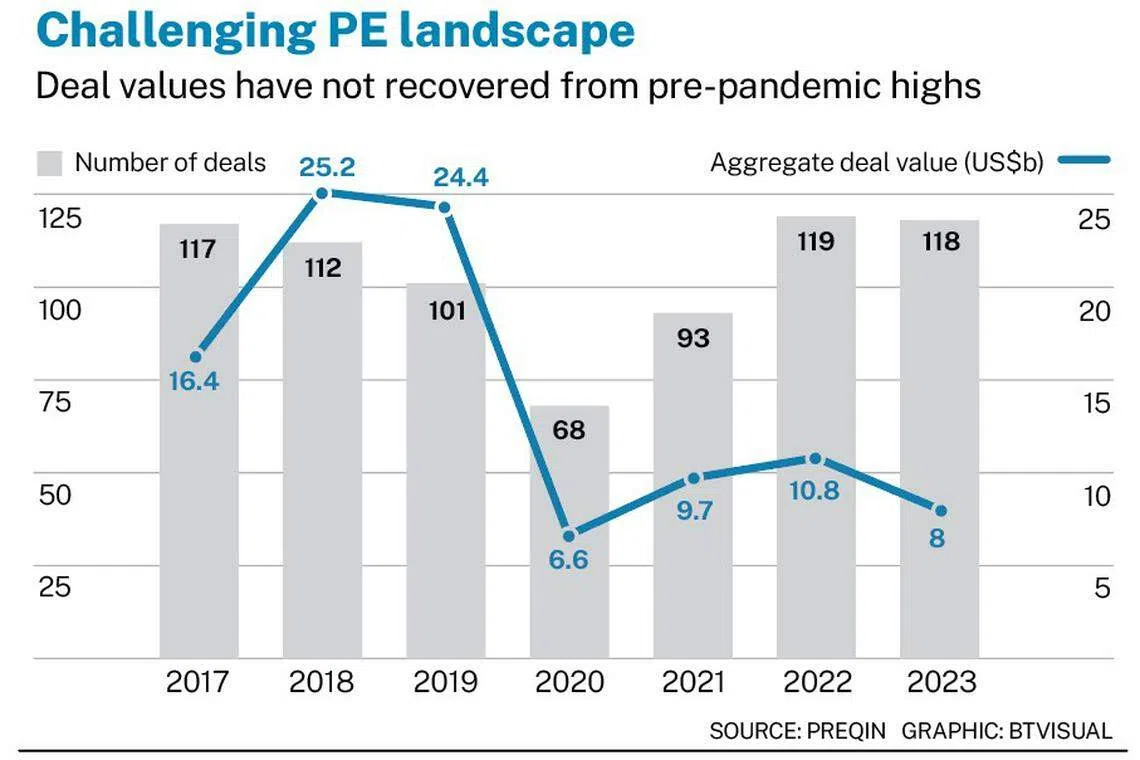
PE deals slowed significantly post-pandemic because of rising interest rates, supply chain challenges, and complicated cost structures, said Luke Pais, Asia-Pacific PE leader at EY.
“Against this backdrop, it was difficult to develop forecasts and price assets. This resulted in a valuation gap,” he explained.
Some institutional investors were hit by the “denominator effect”, said Maurizio Arrigo, global co-head of PE at Pictet Alternative Advisors.
The value of these investors’ public equity portfolios declined more quickly than the value of their PE portfolios, inadvertently giving them greater exposure to PE than they were comfortable with.
“Some institutional investors have quite strict boundaries, such as: PE should not represent more than 8 per cent (of the portfolio). All of a sudden, because of this (decline in public equities), they are at 10 or 12 per cent. So they have to slow down, commit fewer funds.
“Some of them had to sell on the secondary market some parts of their portfolio to reduce their exposure to PE. This was a major phenomenon that happened in 2022 and 2023,” he said.
Deal activity picked up towards the end of 2023, however, and transactions were larger. This could have been because equity markets rallied, and the United States Federal Reserve started to adopt a more dovish stance.
“Entering 2024, we expect a sustained increase in PE investments. Corporates in the region are looking to drive operational efficiency, divest non-core or underperforming businesses and focus on strengthening their core, which is likely to spur deal activity,” said EY’s Pais.
Lee Lay Hong, managing director of private markets investor Flexstone Partners, expects more deals will get done over the next six to nine months.
“Valuations are becoming more reasonable and there are a lot more opportunities where people are more willing to negotiate. Even just 18 months ago, entrepreneurs… were not willing to negotiate, but I think things have changed quite a bit,” she said.
Asean growth story
The primary focus in South-east Asia remains on sectors exposed to the rising middle class and global megatrends, said Andrew Thompson, head of private equity at KPMG Asia-Pacific.
“Notably, the new digital economy and its related physical infrastructure, consumer products, healthcare, education, and financial services have all proven popular sectors with PE,” he said.
The healthcare space is especially of interest, given the region’s rapid population growth and rising demand for chronic care services. There are opportunities to improve hospital infrastructure in Indonesia, Vietnam and the Philippines, said EY’s Pais.
Clean energy is another sector that investors are bullish on, given South-east Asia’s efforts to tackle carbon emissions. Indonesia in November launched a US$20 billion renewables investment plan, under the Just Energy Transition Partnership, while Singapore has laid out plans to import low-carbon electricity from Vietnam.
There is a lot of momentum around the clean energy sector in Asia, said Eric Deram, managing partner of Flexstone Partners. Related segments of interest include battery technology and wastewater treatment.
Another segment to watch is the logistics and data-centre space, which will attract significant investment as digital and physical infrastructure continue to be built out across South-east Asia, said Steven Tran, a partner at law firm Morrison Foerster in Singapore.
With its growth sectors, South-east Asia is an attractive investment destination for PE. “The region has some of the world’s fastest growing economies that are underpinned by compelling demographics: a growing middle class, and a largely young population with more money in the bank and a desire to spend,” said Tran.
“Governments across the region are generally also welcoming of foreign capital to help build the infrastructure that’s needed for growth and development. South-east Asia has become a destination in its own right for capital deployment and will continue to attract PE investors’ attention as we move into 2024.”
Surviving the downcycle
The PE industry has come a long way from its post-2008 boom fuelled by low interest rates. Conditions are a lot tougher now, with investors in PE funds holding back on or cutting their exposure to the asset class.
KPMG’s Thompson noted, however, that PE money tends to be patient money.
“PE investors can generally bide their time until valuation gaps close and better investing conditions return,” he said.
They are also sitting on a huge build-up of committed but undeployed funds, also known as dry powder.
“As the valuation gap narrows between sellers, who would prefer 2021 pricing, and buyers, who are willing to pay current lower valuations, we expect a significant increase in fund deployment in the late stages of 2024 and into 2025,” said Thompson.
This challenging period for PE could be what separates the wheat from the chaff, as opposed to the boom days when all players were doing well.
“Everybody was a good student, because the exams were easy to pass,” said Arrigo of Pictet. “But now that exams are much more difficult, this is when we are going to see the difference between the managers that really bring a value-add – because they know the sector very well – and the others.”






