

GoPizza serves pizza with AI and robotics. But is it a flash in the pan?
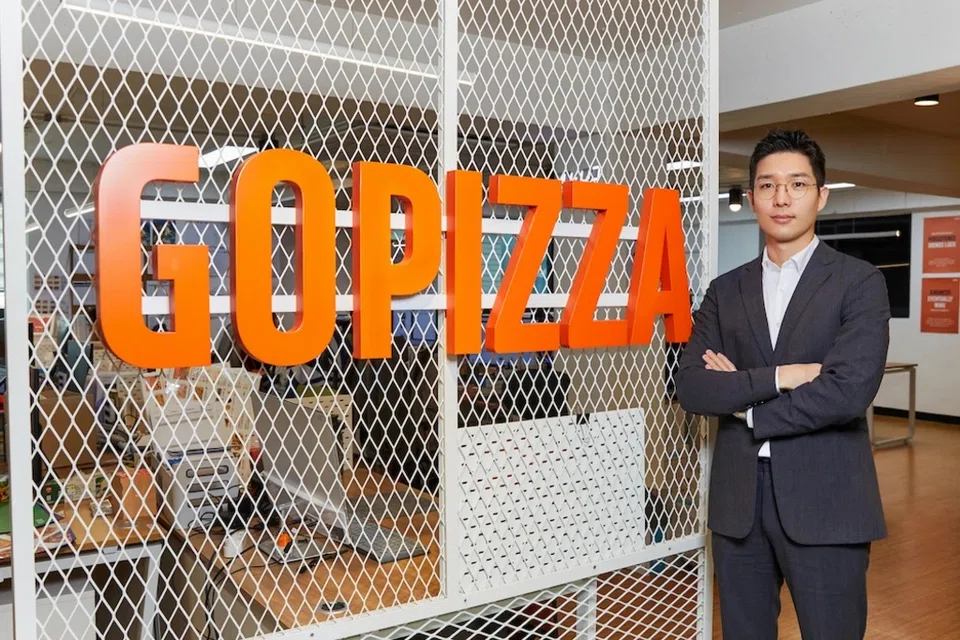
GOPIZZA founder and chief executive Jay Lim is no foodie, but he is on a mission to make pizza more accessible.
Lim, who attended university in Singapore, recalls paying S$20 to S$30 for a buy one, get one free pizza, which he found “illogical.” Apart from waiting over an hour for your order to be delivered, “you’re sure to have leftovers,” he says.
Now, he owns the third-largest pizza chain in Singapore by store count. Demand for its pizzas is driven by trends including an increase in single-person households, rising cost of living, and a post-pandemic labour crunch, Lim said.
GoPizza started out in South Korea as a single food truck in 2016. Eight years later, it has 200 stores in seven markets in Asia and plans to add another 100 by June. Existing stores include 130 in South Korea, 47 in India and 26 in Singapore. It also has outlets in Japan, Indonesia, Thailand and Malaysia.
In December 2023 alone, GoPizza opened six new stores in Singapore.
The company, which Lim says has raised US$50 million from investors to date, sold more than US$37 million worth of pizza at its outlets and franchise stores in 2023.
GoPizza is also backed by some of South Korea’s biggest conglomerates. GS Venture is the corporate venture arm of GS Group, which owns around 17,000 GS25 convenience stores in the country as at June 2023. CJ Investment, whose parent firm CJ Group is a leading distributor and manufacturer of beverages and frozen food, is also an investor.
Lim shares that GoPizza’s valuation is an estimated US$150 million.
Making pizzas efficiently
Rectangular in shape and at about 27 cm long and 17 cm wide (roughly 11 inches by 7 inches), GoPizzas are the “perfect size” for an individual portion, Lim says. They are also slightly heftier than a 7-inch personal pizza from Domino’s.
In Singapore, GoPizza’s prices range from S$7 for a standard pizza to S$12 for one with premium toppings. It could take between five to seven minutes on average to serve the pizzas, making them suitable for takeaways.
That’s slightly cheaper than what Domino’s charges for its personal pizza, which is priced between S$12.90 to S$15.90. Pizza Hut’s personal pan pizzas, meanwhile, cost S$12.10 to S$16.65 and are smaller at 6-inches wide.
However, GoPizza does not see chains such as Pizza Hut and Domino’s as its main rivals in Singapore. Instead, it competes against fast-food giants that offer a similar price point and value such as Subway, McDonald’s, and KFC, Lim says.
GoPizza uses patented ovens designed to bake its pizzas in under five minutes – half the time that it would normally take on conventional ovens.
A specially formulated “par-baked” or partially baked dough eliminates the need for any kneading. Robots sprinkle condiments and drizzle sauces with precision, leaving humans to do the unexacting tasks of topping the pizzas and placing them in the oven.
The company also taps AI to monitor the topping process, ensuring that ingredients are placed accurately and consistently. It also uses facial recognition tech to help supervise stores and to identify if any of its employees are incorrectly making a pizza.
How does this process affect the taste of GoPizza’s products? Its pizzas are certainly not designed to match those kneaded by a skilled human or baked in wood-fired ovens. Artisanal pizza is “not where we are – that’s not our market,” Lim said.
Scaling in a hypercompetitive market
Countless F&B tech players including a glut of coffee-tech players have flocked to Singapore, hoping to make a mark in the world’s most expensive city.
Jianggan Li, founder and CEO of venture builder Momentum Works, notes that operating in highly competitive markets despite their higher costs makes sense because of existing consumer demand.
He believes there is “a lot of room” to apply tech innovations in other fast-food categories, particularly grab-and-go concepts. As such, he expects competition in GoPizza’s category to intensify as more operators turn to tech to differentiate themselves or streamline their operations.
Competing value-for-money chains such as EatPizza, which is also based in South Korea, have sprung up, selling pizzas that are similar in price, shape, and size.
EatPizza, which has over 100 stores in its home market, made a buzz in Singapore when it opened its first store in January.
The company shares several similarities with its rival: EatPizza also offers flavours ranging from classic to Korean style, and it has a baking process that can serve up pizzas for one in under five minutes.
As far as F&B tech firms go, however, China-headquartered Luckin Coffee is a standout for Momentum Works’ Li. The coffee chain uses tech in everything, from its ordering system and payments process to product development and user acquisition and retention.
In comparison, GoPizza uses tech mostly to optimise its operations, so there’s room to apply it in areas like loyalty programmes or to provide personalised menu recommendations based on a customer’s order history.
Given the growing competition and similar offerings from other players, can GoPizza build a sustainable business in Singapore?
Lim says he’s confident not just in GoPizza’s position in the city-state but also in its product – the dough mixture and the manufacturing process it has refined over years of R&D.
He pointed out that “it’s very difficult to have that superior and consistent quality with low production costs” when mass producing dough, but GoPizza has achieved that.
As fast as Flash Coffee?
GoPizza’s blistering pace of store openings brings to mind Flash Coffee, the chain that filed for a voluntary winding up in Singapore and shut down its 11 stores in the city-state in October 2023 to focus on its “most promising markets.”
In 2021, Flash Coffee was opening three stores a week in Asia Pacific, with plans to triple that rate to achieve its target of opening 300 outlets that same year.
Flash Coffee’s speedy expansion, however, was just one of the many reasons for its eventual retreat from Singapore.
An analysis from Momentum Works attributed Flash Coffee’s exit to its inadequate use of tech to differentiate itself from competitors as well as the lack of a well-defined value proposition and F&B experience among its founding members.
While Lim has no F&B background, he does not see it as a hindrance. Instead, he says this helped him come up with “random ideas” to solve problems such as how to pre-make dough or bake pizzas faster.
“If I were a chef, I would have [thought] that it wasn’t possible,” he adds.
Breaking even in six months
With the technology it has developed, GoPizza outlets can operate at a fraction of the real estate footprint as well as labour and rental costs of larger stores, Lim says.
In Singapore and South Korea, many of GoPizza’s shops are situated within convenience stores, petrol stations, and cinemas. They are also compact at 50 square feet – just slightly larger than the size of a king-sized bed – and manned by two employees.
A GoPizza outlet located in a Caltex petrol station in Singapore / Photo credit: GoPizza
With its “shop in shop” strategy, the company “can immediately absorb their traffic,” reducing investment costs and operating expenses, Lim explains.
According to the CEO, close to 40 per cent of GoPizza’s 26 stores in Singapore broke even on an Ebitda basis in their first six months of operations.
A franchise store located in a regional mall in Singapore, for instance, makes S$5,000 to S$6,000 (US$3,700 to (US$4,400) in sales a day – a feat made possible by its high degree of automation, Lim says.
GoPizza also operates bigger outlets, with store sizes averaging 200 square feet and 500 square feet in Singapore and South Korea, respectively. In markets such as India, where labour and rental are relatively more affordable, GoPizza has more spacious stores.
Enough runway for “at least three years”
By the second quarter of this year, GoPizza plans to set up a hundred more 50 square feet stores in convenience stores across South Korea via a partnership.
Lim declined to share the name of its partner or where those stores would be located before the official announcement. But he attributed GoPizza’s ability to launch so many stores in one go because of their compact size.
He expects the company to become EBITDA positive from this year, stressing that the firm is “funded enough” – it has enough runway “for at least three years.”
A “huge upgrade” in its dough this year will make its pizzas more suitable for deliveries and takeaways, the CEO shares.
The goal, he tells Tech in Asia, is to build a pizza company that would be recognised anywhere in the world, including the US.
“We do want to go to the US, but up until last year, we felt we were not ready,” Lim says. “But now that we’re gearing up for profitability and all the countries are stabilised … maybe it’s time.” TECH IN ASIA






