
Mirxes posts US$58 million operating loss, US$24 million revenue
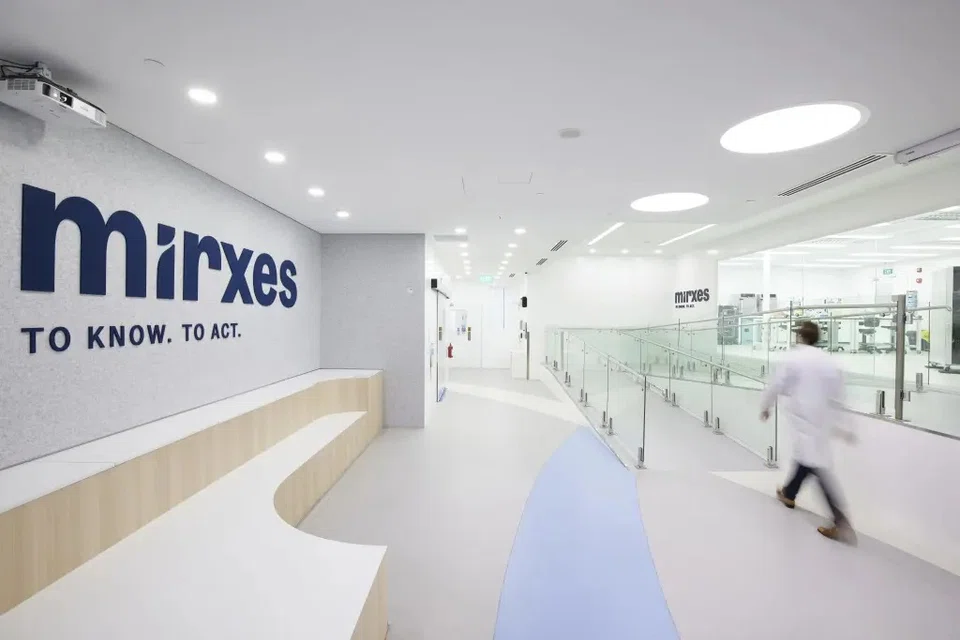
SINGAPORE biotech firm Mirxes reported a 36.2 per cent year-on-year revenue growth to US$24.2 million in 2023, according to its April filing with the Hong Kong Stock Exchange. This comes ahead of the company’s anticipated initial public offering (IPO) in Hong Kong within the next six months.
However, total losses for the year reached US$70.4 million – a 21.8 per cent jump from 2022. Its operating losses, meanwhile, increased 24.4 per cent to US$58.7 million.
According to the filing, Mirxes attributed the increased losses primarily to higher spending on research and development, which grew 22.3 per cent year on year, to US$22.6 million. A 20 per cent jump in general and administrative expenses also contributed to the higher losses.
Meanwhile, its cash and cash equivalents declined in 2023 to US$14 million from US$19.8 million the year before.
The firm announced its intention to list in Hong Kong last July. In an e-mail interview with Tech in Asia, the company says that an IPO is “a routine fundraising event for biotech companies” and is “not an exit event”.
The company’s latest prospectus also indicates that Mirxes took out a loan for US$25 million in April 2024 and received loans of S$1 million (US$740,000) and US$2 million from co-founder and CEO Zhou Lihan in March 2024.
Responding to inquiries from Tech in Asia, the company says that it chose to take out short-term loans to speed up its path to an IPO.
Mirxes also reported a decrease in total assets and higher liabilities for 2023. However, current assets still exceeded current liabilities in 2023, a pattern that continued to 2024 as at the end of February.
Considering this, Mirxes says that its directors believe that the company has enough working capital to cover at least 125 per cent of its costs for at least the next 12 months from the April filing.
Shuffling revenue mix
Mirxes develops test kits for the early detection of cancer and other diseases. It was spun out of Singapore’s Agency of Science, Technology, and Research in 2014 to commercialise its products and make them more accessible.
Approximately 72 per cent of the company’s revenue is generated from its early detection and precision multi-omics segment, which consists of the GastroClear and LungClear products. The former remains Mirxes’ core product, which is used to detect gastric cancer early.
The company has raised about US$167 million in disclosed funding to date, according to Tech in Asia data. In 2022, it participated in the US$4.5 million funding round of Vietnamese healthtech startup Med247.
Last year, Mirxes indicated its interest in a separate listing in Singapore but still opted to list in Hong Kong first to have a better “fighting chance”.
The company tells Tech in Asia that it made “strategic investments” in its early detection arm in 2022 and 2023 in anticipation of a decline in revenue from its infectious disease unit after the pandemic.
The latter segment – which is mainly carried by its Covid-19 diagnostic test kit Fortitude – contributed just 27.7 per cent of the company’s total 2023 revenue. In 2022, this unit was Mirxes’ main revenue generator, pulling in 42.2 per cent of the total figure that year.
Strategic push into China
Mirxes explains that the decrease in cash and cash equivalents was due to an increase in operating costs as well as in trade and other payables, which refer to expenses incurred from third parties. This took place after the firm raised US$50 million in series D funding in July last year.
The capital was used to support the completion of a GastroClear trial in China, as well as for other initiatives geared towards driving product adoption across South-east Asian markets. Mirxes also invested in obtaining the Breakthrough Device designation from the US Food and Drug Administration in 2023.
In its latest filing, the company noted that it currently operates two diagnostics manufacturing facilities, one located in Singapore and the other in China.
According to Mirxes, the completion of its GastroClear trial in China will expedite its approval and sales in the country, a market with an estimated 600 million people eligible for stomach cancer screening. The Singapore-based company says that it spent 15 per cent less than other US firms for the trial, who typically invest around US$200 million for similar procedures. TECH IN ASIA
TRENDING NOW
Three ex-employees of Envy group join Ng Yu Zhi in bankruptcy
He built the Vingroup empire. Now South-east Asia’s richest man is handing some key roles to his sons
Grab CEO’s wife Chloe Tong on life with Anthony Tan and finding her purpose
Incidence of civil servants buying property near unannounced MRT stations ‘a concern’, but may not establish misconduct: PSD



