

MoneyHero’s US$8 million gambit: Bold move or blunder?

FOR years, personal finance platform MoneyHero Group and rival MoneySmart operated in the same markets, even as other competitors came and went.
Then, last month, Nasdaq-listed MoneyHero made a controversial US$8 million non-binding offer to wholly purchase Singapore-headquartered MoneySmart.
Aside from being perceived as a lowball offer – given MoneySmart’s financial performance in 2023 – the way it was presented also raised a few eyebrows.
Millions of users visit MoneyHero and MoneySmart each year to find deals on credit cards, insurance products, and personal loans. The two firms work with the same banks and insurance companies, whose products they peddle.
They also butt heads in Singapore and Hong Kong, MoneyHero’s two largest markets where it operates the SingSaver and MoneyHero brands, respectively.
Highly unusual
MoneyHero’s approach was highly unusual as far as M&A strategies go, said Joel Shen, partner at law firm Withersworldwide.
Shen, who has advised companies on M&As of tech businesses and assets, tells Tech in Asia that the M&A process for a privately held company typically begins with a prospective buyer canvassing support from its key shareholders.
The process would also involve bringing shareholders of the target company around the table together with its board of directors. Such conversations would also involve discussions on what a reasonable price would be.
Forcing an answer from the target company through a public press release, in the manner MoneyHero did, is not only “very unusual” but risks angering the party, Shen added. It also “doesn’t achieve anything from a legal or deal-making perspective”.
The fact that MoneyHero announced that it had made an offer to buy MoneySmart shares through a press release “suggests to me that no term sheet exists” or that it has expired, Shen noted. Had one been on the table, a public announcement would have been a breach of confidentiality provisions, he added.
To MoneySmart’s knowledge, the offer had not been presented to any of its shareholders prior to MoneyHero’s public statement, Vinod Nair, MoneySmart founder and CEO, tells Tech in Asia in an e-mailed response.
While MoneyHero has “repeatedly approached some of our shareholders and board members with vague proposals, these have lacked substance, clarity, or any viable path forward that aligns with MoneySmart’s strategic priorities”, Nair said.
For instance, in early 2024, MoneyHero board members Kenneth Chan and Derek Fong initiated a call with MoneySmart investor Golden Gate Ventures. While the call had been set up in the context of getting acquainted, the discussion expanded to one about acquiring MoneySmart. Communications were subsequently halted, Nair shares.
The CEO, speaking on behalf of the board, rejected the US$8 million offer in a LinkedIn post published on the same day as MoneyHero’s press release.
MoneyHero could not be reached for comment.
Ruffled feathers
In 2023, MoneySmart was net profitable and reported S$46.9 million in revenue last year, according to its audited Acra filings. Nair declined to reveal profit or revenue projections for 2024.
MoneyHero, in its press statement on Aug 22, said the US$8 million offer for 100 per cent of MoneySmart’s shares “reflected a premium for MoneySmart’s business”.
MoneyHero also said it took into account its competitor’s “recent capital reduction” exercise when arriving at that valuation.
Official filings by MoneySmart’s registered entity in Singapore show that in March, the firm reduced its fully paid-up share capital by about US$11.2 million in total.
It also paid US$2 million to Japanese web group Kakaku.com, an investor in its series B round, to buy over its existing ordinary and preference shares.
According to Nair, while the basis of MoneyHero’s offer seems to have been made on this private share transaction with Kakaku – which was made at “a significant discount” – the transaction is not representative of MoneySmart’s market value or future prospects.
Kakaku, he explains, had expressed interest to immediately divest its holdings in MoneySmart for “internal reasons” and had offered a discounted price for an accelerated sale.
In a 2019 financing round, which has not been publicly disclosed, MoneySmart had a post-money valuation of US$91 million, Nair shares.
“Since then, we have grown significantly with improved margins and achieved profitability – developments that we believe reasonably carry a premium over our last valuation,” he said.
This, Nair adds, was evidenced by a reverse valuation deal that valued the firm at US$161 million in 2023. However, the deal, supposedly with SGX-listed Asia-Pacific Strategic Investments, was called off in July that year.
A “bold” strategy
It was more than MoneyHero’s asking price, however, that ruffled MoneySmart’s feathers.
While there had been “various informal touchpoints and conversations” between the two companies over the past two years, these interactions “never evolved into formal or credible discussions about a potential combination”, Nair added.
In previous conversations, MoneySmart had also expressed its disinterest in pursuing a discussion on consolidation, the CEO said.
On MoneyHero’s end, the public offer – though non-binding – could serve as a “starting point” to initiate further discussions with MoneySmart and its shareholders, a source familiar with MoneyHero said.
A cash component tagged to the offer for US$8 million in MoneyHero shares also provides wiggle room for further revisions that take into account MoneySmart’s full financial health, the source suggested.
Given that both firms had had “on-and-off” discussions regarding a potential deal since 2021, MoneyHero’s initial offer was “not created in a vacuum,” added the source.
In the best case scenario, MoneySmart – if it is interested – could initiate a discussion with MoneyHero. This could trigger a due diligence process that opens up access to private information, the source said.
“You could call it unconventional, or you could call it bold. But it’s open and fair. The information is now available to everyone,” including MoneySmart’s shareholders, who might have “different preferences and investment horizons”, the source added.
Combining strengths
In April, MoneyHero shared a guidance that it would reach over US$100 million in annual revenue and achieve profitability in 2024.
The firm has also been ramping up marketing efforts to acquire more users. On the company’s Q1 2024 earnings call, MoneyHero Group CEO Rohith Murthy said that an “aggressive growth strategy and marketing investment around credit cards” had expanded the company’s user base, drawing new users and those from other platforms.
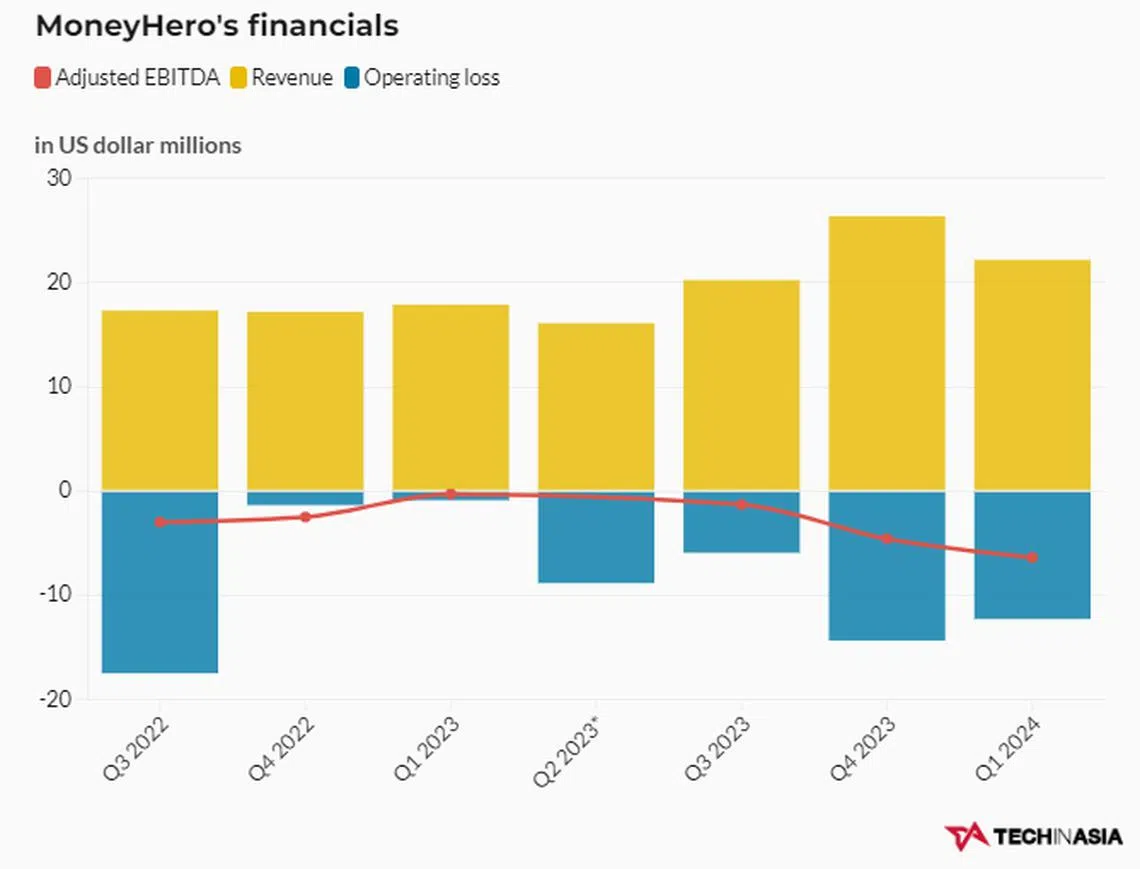
This has come at a cost. In the first quarter of this year, the company’s adjusted Ebitda quarterly losses in Q1 2024 stood at US$6.4 million, from -US$300,000 in the same quarter last year.
Certainly, a merger of the two could be bigger than the sum of its parts. In theory, acquiring a direct competitor could drive cost efficiencies and lower marketing costs at a time when losses are surging. It could also potentially give MoneyHero more leverage to negotiate better rates with financial institutions.
But that would require both firms coming to the drawing board once more – possibly a big ask after MoneyHero’s controversial move. TECH IN ASIA






