Is Grab’s ride-hailing business future-proof?
SINGAPORE-BASED Grab undoubtedly leads South-east Asia’s ride-hailing sector, commanding around 70 per cent market share.
However, competitors are not relenting. There has been a surge of activity in the sector including funding rounds, public listings, and announcements of expansion.
In Vietnam, homegrown players Be Group and GSM are putting pressure on Grab as favoured local alternatives. Be Group raised US$30 million earlier this year, while GSM – led by Vingroup chairman and billionaire Pham Nhat Vuong – is intensifying its focus on expanding its electric vehicle (EV) fleet.
Singapore-based Tada opened for business in the underpenetrated Thailand market, where it sees scope for faster growth.
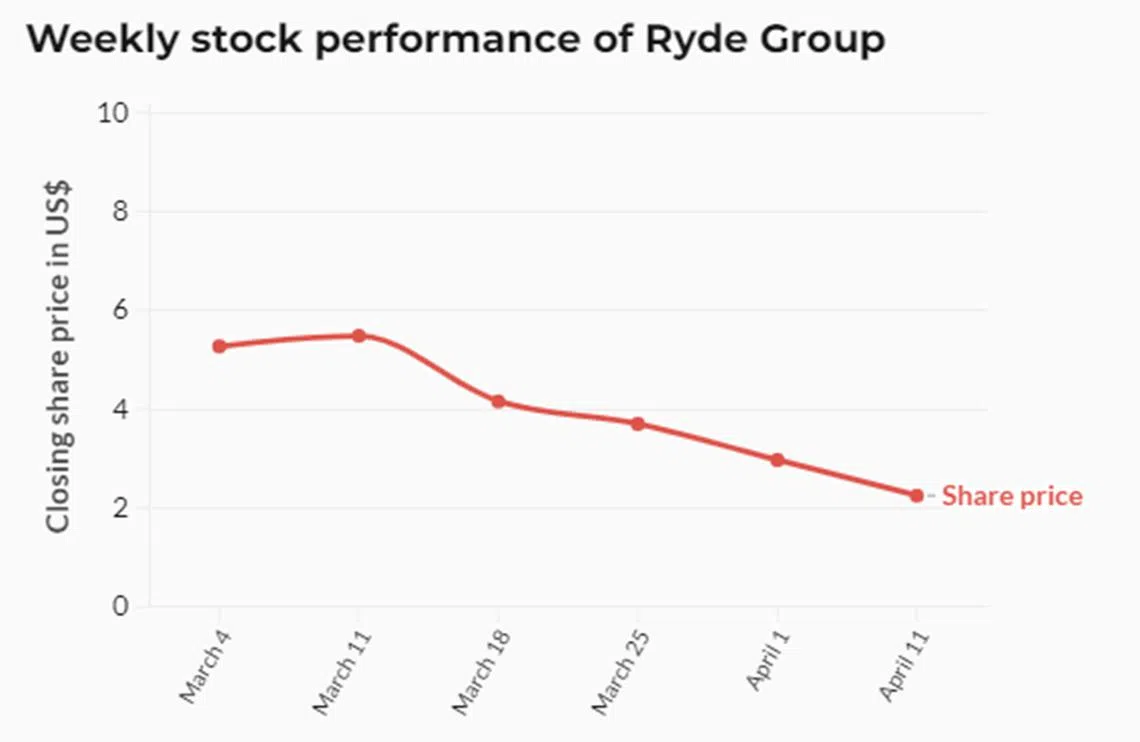
Ryde became the first Singaporean ride-hailing company to debut on the New York Stock Exchange as it sought “greater global recognition … and higher liquidity”.
The ride-hailing sector in South-east Asia is predicted to reach a market size of US$10.5 billion by 2028.
Will these players pose a threat to Grab’s dominance? Or is the Nasdaq-listed company’s pole position safe?
The Grab grip
Launching a ride-hailing business requires dealing with a classic chicken-and-egg situation: To provide the reliability and reach that consumers expect, you need a consistent supply of drivers on your platform. However, attracting these drivers is challenging without a substantial consumer base. As a result, acquiring both sides often requires deep pockets.
This is where Grab stands out, benefiting from a period of low interest rates from 2008 to early 2022. It has secured a total of nearly US$16.5 billion in funding over the years.
The company emerged with its ride-hailing model at a time when capital was more abundant and VC firms poured investments into companies they deemed promising.
That is not the case in today’s environment, with the “era of easy money” over.
Investors won’t shell out capital for another ride-hailing player in the same way they did for Grab “unless there is a compelling change in the way of ride-hailing, for example driverless cars”, Christopher Quek, managing partner of Trive Venture Capital – which holds a 13 per cent stake in Tada’s parent MVLLabs – tells Tech in Asia.
Such tech shifts often present an opportunity for new players to emerge. For example, the rise of livestreaming in ecommerce provided an opening for TikTok Shop to challenge Shopee’s dominant position in Indonesia.
For its part, Grab does not appear to be sitting on its laurels. It continues to roll out new initiatives and invest in its mobility business.
The firm recently introduced a group rides feature in Singapore, enabling passengers to plan a trip together while receiving real-time updates on the status of the ride. This differs from the existing multi-stop rides feature that only allows a single user to coordinate the trip.
The company is also working on a bill-splitting tool so that users do not have to do so manually.
Even as Grab reduced incentive spending across the board – total incentives in 2023 were down by 19 per cent compared to the previous year – it has spent more on its mobility business, the only vertical to see an increase in expenditures.
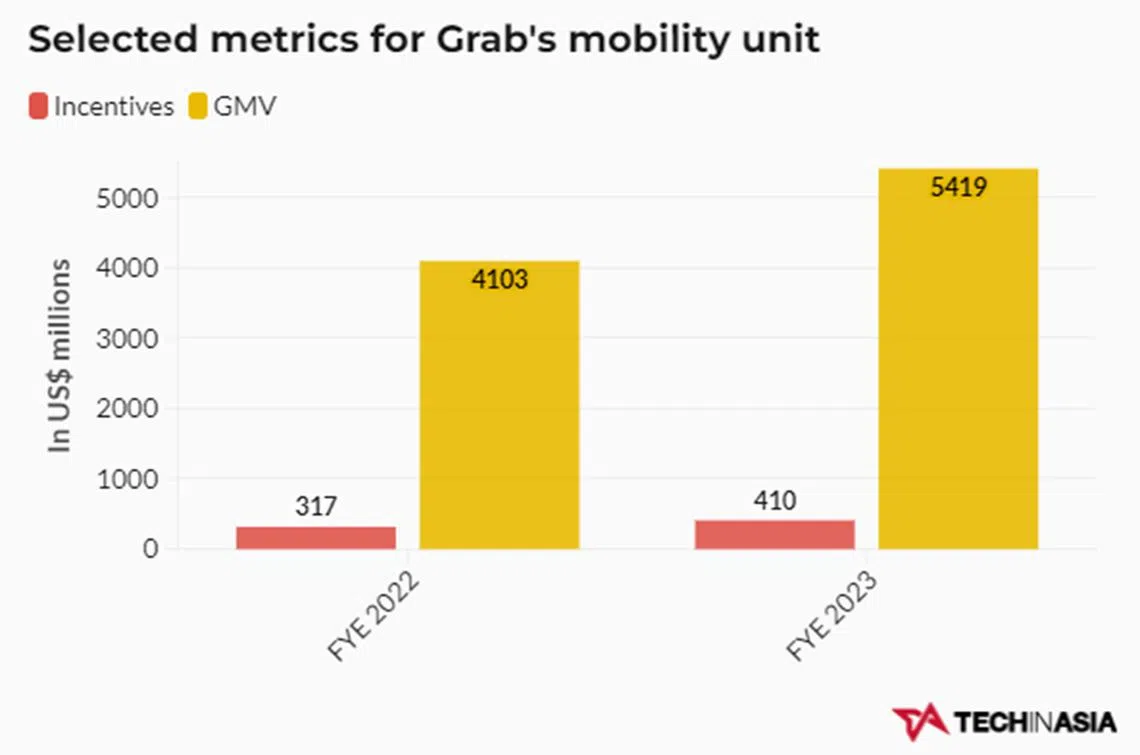
Incentives for the mobility unit, which includes those to drivers and customers, rose 29.5 per cent year on year in 2023.
This investment in its mobility business appears to have been efficient, with year-on-year growth in GMV of 32 per cent outpacing the rate of growth in incentives spent.
Another notable aspect of Grab’s business is its razor-sharp focus on South-east Asia.
It has been clear in its agenda of being the leader in the region and has not sought to dilute its focus. The firm’s localisation strategy has been cited as a factor that helped it beat Uber at its own game in 2018, which ultimately led the US ride-hailing giant to cease operations in South-east Asia.
In comparison, Estonia-based Bolt is present in 45 countries globally, while Tada is actively engaged in acquisition discussions in countries such as South Korea and Taiwan, according to Kay Woo, CEO and founder of MVLLabs.
New commission models
With Grab in a commanding lead, competitors are experimenting with alternate models that will provide more choices to customers and drivers, while not necessarily challenging Grab’s dominance.

High commission rates have been a bone of contention for Grab’s drivers. Protests have emerged, with drivers expressing their grievances over fare cuts and changes to incentive schemes.
In response to such concerns, companies such as Tada and Ryde are offering zero commission rates, allowing drivers to retain full payment for each completed ride. In contrast, Grab charges up to 20 per cent commission.
But operating on a zero-commission model may not be financially viable in the long run. Companies may struggle to cover costs unless they have an alternate way of earning money.
Tada, for example, charges a fixed small platform fee, and drivers are rewarded further when they earn favourable customer reviews. Such initiatives have led to an organic acquisition of drivers with “rides growing at almost 4x in each of the last four years”, Woo said.
GSM also has a fixed salary structure along with a bonus per trip. This approach has helped the platform gain “nearly 20 per cent of the ride-hailing market share in Vietnam” in only seven months of operations, according to Thanh Nguyen, global CEO of GSM.
While this structure brings a sense of security among drivers, it has its own downsides. Driving for GSM is not as flexible as driving for Grab, as drivers do not have the freedom to choose their schedules, according to an analysis by Le Hong Hiep, senior fellow at ISEAS, Yusof Ishak Institute.
The analysis by Hiep mentions that drivers have also expressed concerns about GSM’s rising expectations from them to generate higher revenue and the implementation of more stringent criteria for bonuses.

For its part, Grab may have found a way to address concerns over its commission rates. It has come up with a variable commission structure for Singapore that replaces its previous fixed rate. This will change from trip to trip and would be lower when drivers have to travel farther.
While this arrangement is expected to boost drivers’ willingness to accept longer trips, it may pose challenges for customers taking short rides. Grab has said it will improve the new structure based on feedback.
The EV play
Electric mobility is another area where several ride-hailing firms are lining up their fleets. Grab was one of the first players to experiment with EVs in partnership with automakers in 2019.
In response to a query from Tech in Asia, the company said that in countries where it uses a rental fleet, “a portion of it does consist of EVs”. Specifically, Grab has over 10,000 electric bikes in its fleet in Indonesia, which it says is “the largest EV rental fleet in the country”.
While EVs are on their way to becoming commonplace, they currently come with infrastructure challenges. Without sufficient charging points and a clear government roadmap, drivers may hesitate to transition to EVs.

That said, countries such as Vietnam are seeing green shoots, with founders such as Vingroup’s Vuong pushing for the development of an EV ecosystem. Pham aims to invest US$404 million in a new EV charging venture.
Such initiatives are likely to reap benefits for GSM, the first pure electric taxi company in Vietnam. It is already planning to recruit an additional 20,000 to 30,000 taxi drivers and 15,000 to 20,000 motorbike drivers to its existing fleet of 40,000 electric taxis and bikes, CEO Nguyen said.
According to a Reuters report, GSM had signed an unreported US$419 million deal with VinFast at the end of 2023 for deliveries of 14,600 additional EVs. VinFast is the EV manufacturer owned by Vuong, who is also the founder and chairman of Vingroup and owner of GSM.
Laos-based player Loca is also advocating for an electrification push in a bid to save costs. In Laos, where petrol costs US$7 per 100 kilometres, charging an EV at a Loca station costs US$1.5 for the same distance, its co-founder and CEO Souliyo Vongdala tells Tech in Asia.
The company is already profitable, according to Vongdala. “Critically, our ability to control energy costs through our EV charging network shields us from fluctuations in oil prices,” he added.
For larger companies, however, EVs still form only a small portion of their daily trips. Vietnam’s Be Group says that the figure for its operations is less than 2 per cent.
“At this stage, EVs are only PR focused. Over time, as the total cost of EV ownership goes down and infrastructure improves, the order volumes will rise,” said Roshan Raj, partner at Redseer Strategy Consultants.
Kengo Kurokawa, founder and CEO of research firm Asia Plus, shares similar views. In the Reuters report, he expressed concerns regarding the sustainability of GSM’s ride-hailing business model due to its “high cost structure and the market’s low profitability.” He suggested that GSM primarily serves as an advertising tool for VinFast.
The report noted that while Vingroup agrees profitability for GSM may not be immediate, it anticipates that the firm will hit the milestone “well before 2030.”
Steering towards consolidation
While the new players are vying to get a share of the pie from Grab, no one has yet reached the scale to take the company head on.
Instead, some are rooting for partnerships in a bid to make a country-specific dent in Grab’s operations.

“There is still scope for country-specific niche players to increase the competitive intensity, However, when it comes to seamless connectivity using a single app, Grab is hard to beat,” said Shekhar Jaiswal, an analyst at RHB Banking Group.
Recognising this, Be Group has partnered with GSM in Vietnam, which can be seen as a strategic move against Grab in the country. GSM also expanded into Laos last year, penetrating a market where neither Grab nor Gojek have yet established a presence.
Estonia’s Bolt has not done any significant M&A deal so far, but it is not closing the door on acquisitions. According to founder and CEO Markus Villig, the company has not yet found a business “that meets its high acquisition criteria”.
Not to be outdone, Grab is also in the process of acquiring Trans-Cab, Singapore’s third-largest taxi operator, which will give it control over 2,200 taxis and more than 300 private-hire vehicles.
However, the acquisition is under review by the Competition and Consumer Commission of Singapore. Deal-making has become more challenging for a dominant player such as Grab, due to increased scrutiny from regulators aiming to safeguard competition.
In any case, Trive Venture Capital’s Quek notes that it is unnecessary for smaller ride-hailing providers to aim to take over Grab. “It makes sense to do a follow-the-leader strategy and obtain a sensible market share where it is profitable,” he said. TECH IN ASIA