Carro swaps growth for profitability, as losses fall 92% in FY24
SOMETIMES, you have to go into reverse to make progress.
Used-car marketplace Carro said that it cut its operating losses by 92 per cent to S$9 million in its financial year ended March 2024.
While this came at a cost, with the company posting a year-on-year decline in revenue growth of about 6 per cent to US$781 million, gross profit margins improved from 8 per cent to 12 per cent during the same period.
Carro attributes these results to a focus on “growth on higher-margin revenues” and changes in its “geographical mix”, the company said.
The used-car marketplace sector has been on a roller-coaster ride over the last few years, as rising interest rates have sent investors fleeing. A shortage of new cars also led to more people buying used cars instead, which then created affordability challenges for consumers.
US industry leader Carvana saw its share price decline by 99 per cent between August 2021 and January 2023. However, since that low, interest rates have peaked, and companies such as Carvana have restructured their businesses to make them more efficient. The US-based firm’s shares are now up by over 5,000 per cent, giving the company a market capitalisation of US$52 billion.
Carro, along with its South-east Asian peer Carsome, are both eyeing the possibility of an initial public offering (IPO) in the next couple of years. The latter recently reported that its revenue for the second quarter of 2024 had increased by 9 per cent from the previous quarter, while earnings before interest, taxes, depreciation and amortisation (Ebitda) increased more than three-fold over the same period. Carsome also said its gross margin for Q2 “exceeded 10 per cent”.
Along with its FY2024 results, Carro announced that it had received a strategic investment from Woori Venture Partners, a venture capital subsidiary of Woori Financial Holdings, one of the largest banks in South Korea. Terms of the deal were not disclosed.
Chasing “higher-quality” revenue
While the company sold 11 per cent more vehicles in FY2024 than the year before, Singapore’s contribution to overall sales volumes decreased, a Carro spokesperson said.
Falling car sales in Singapore was a dampener on revenue growth in FY2024. That is because the value of cars in the country is “10 times or more” compared to its other markets, according to the company.
Vehicle ownership is notoriously costly in the city-state, with some estimating that it is the most expensive place in the world to buy a car.
According to the company, while gross profit per vehicle sold in Singapore is generally “much higher” than in other markets, gross profit margins are lower. This means that a reduction in the share of the country’s contribution to revenue would result in overall profit margins going up.
In addition to Singapore, Carro currently operates in Malaysia, Indonesia, Thailand, Taiwan, Japan, and Hong Kong. It entered the last two markets only in the past 12 months.
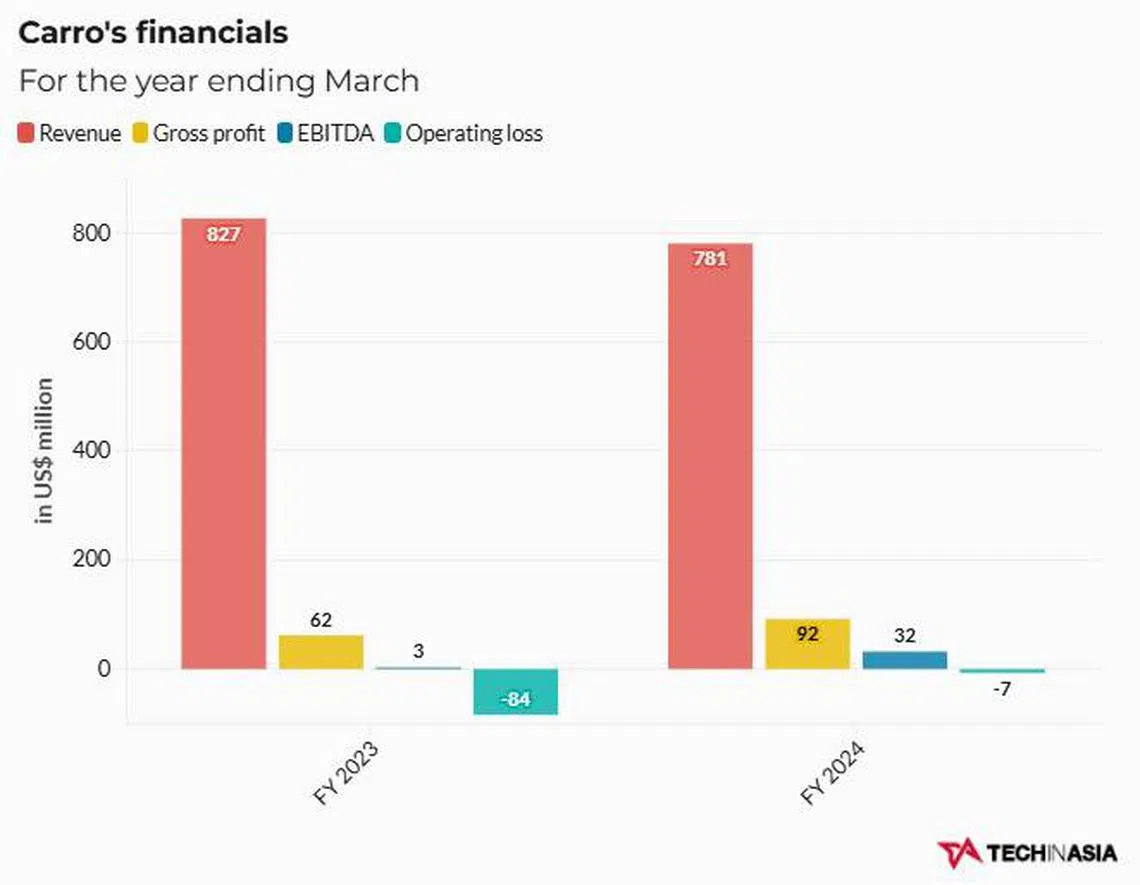
Similarly, improvements were seen further down the bottom line, with Ebitda going up 11 times to S$43 million and operating losses narrowing by 92 per cent to US$7 million.
The company attributed these to its streamlining of operating expenses, which drove an overall improvement in unit economics.
Beyond buying and selling
In recent years, Carro has moved beyond just buying and selling cars. It now offers services such as car financing (via Genie Financial Services), vehicle maintenance and repair, and automotive insurance.

Crediting Carro’s “ecosystem-led” operating model, co-founder and group CEO Aaron Tan said that the company was focused on increasing the profit margin of its business by cross-selling other services with higher margins, as well as those that provide recurring income.
For example, when Carro sells cars to buyers, it can also cross-sell loans to enable them to purchase the vehicles, along with automotive insurance. Subsequently, it can, in theory, resell auto insurance to past buyers when they renew their insurance policies the following year, leading to a continual stream of income.
A company spokesperson said that these initiatives have enabled Carro to “capture a larger wallet of the vehicle ownership life cycle”.
According to the company, ancillary services contributed “about 60 per cent” of its gross profit in FY2024, and they continue to drive earnings growth.
But its overall loan book of US$370 million for the year was up roughly 6 per cent from FY2023. The company said that this was due to it “being prudent” and a desire to ensure “liquidity remains strong”.
Indeed, its non-performing loans (NPL) ratio was “below 0.5 per cent” for FY2024, which the company said “is much better than industry benchmarks”. For comparison, the NPL ratio for the automotive sector in Thailand was around 1.5 per cent.
Meanwhile, rival Carsome said in September that its NPL ratio was “below 2 per cent” for loans made to retail buyers, and “0.1 per cent” for those made to wholesale buyers.
IPO-ready?
With the Woori investment, Carro said it intends to expand further in its existing South-east Asian markets, especially in Indonesia, where Woori “has a strong presence”.
The company also said that this growth is likely to be “mainly organic”, which could mean launching new products or expanding its customer base, although this might be complemented with inorganic growth, such as through mergers and acquisitions.
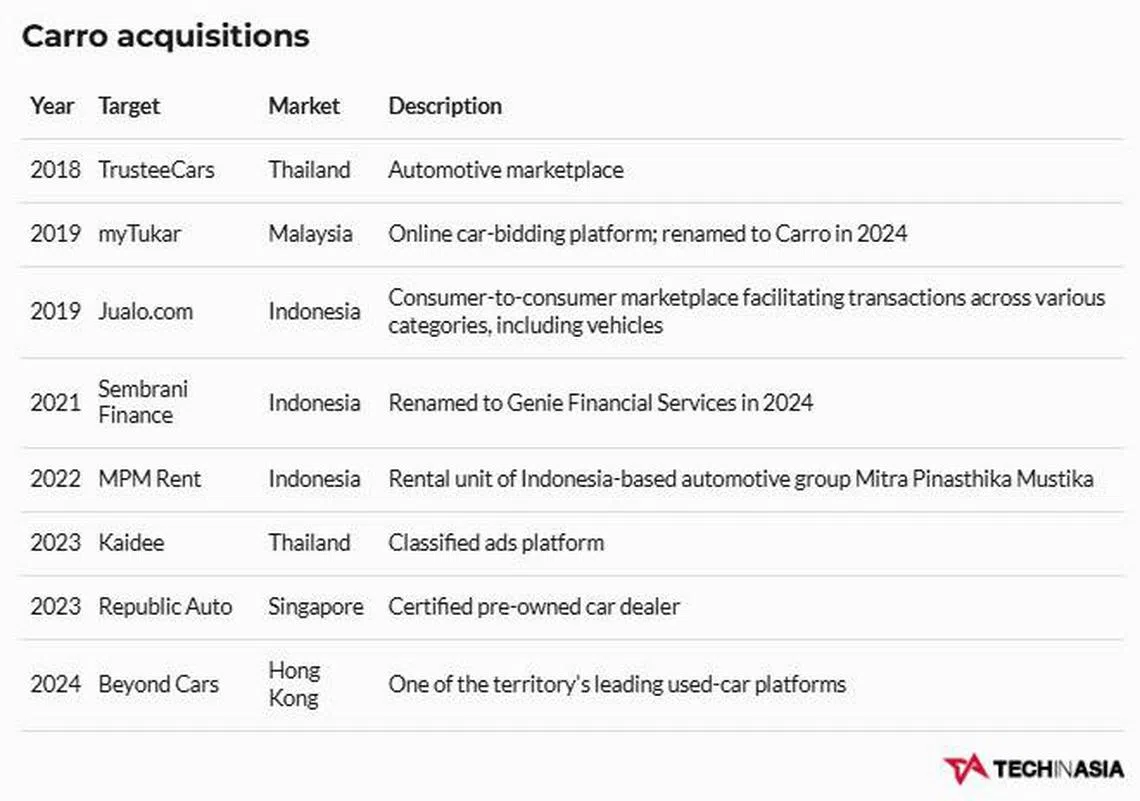
Earlier this year, Carro launched Okai, a jobs platform based in Thailand, officially marking its foray into recruitment services. This came off the back of its acquisition of Kaidee, a Thai classifieds ads company, in 2023. Tan said at the time that he intended to spin off Okai as a separate entity.
In April, Tan shared that while Carro was “ready for an IPO”, any decision to list would depend on the broader macro environment.
Has the company got any closer to a listing since?
Carro said that the IPO environment continues to be “very weak and fragile” and that it will “continue to watch” the market.
When the firm does go public, having positive operating profit would be one factor that investors might view favourably. Given the significant improvement in the metric for FY2024, does it expect to achieve operating profitability in the upcoming financial year?
Carro notes that the macro environment in the second half of its financial year is expected to be “more challenging”, and it is “strategically readjusting” its growth to adapt to this.
“Even if we miss, it will be by design, and we will still be within (a) very close striking distance of positive operating profit,” a company spokesperson said.