
Ijooz squeezes US$2.5 million in net profit in FY 2024

The company aims to list on a US stock exchange by 2027
Summarise
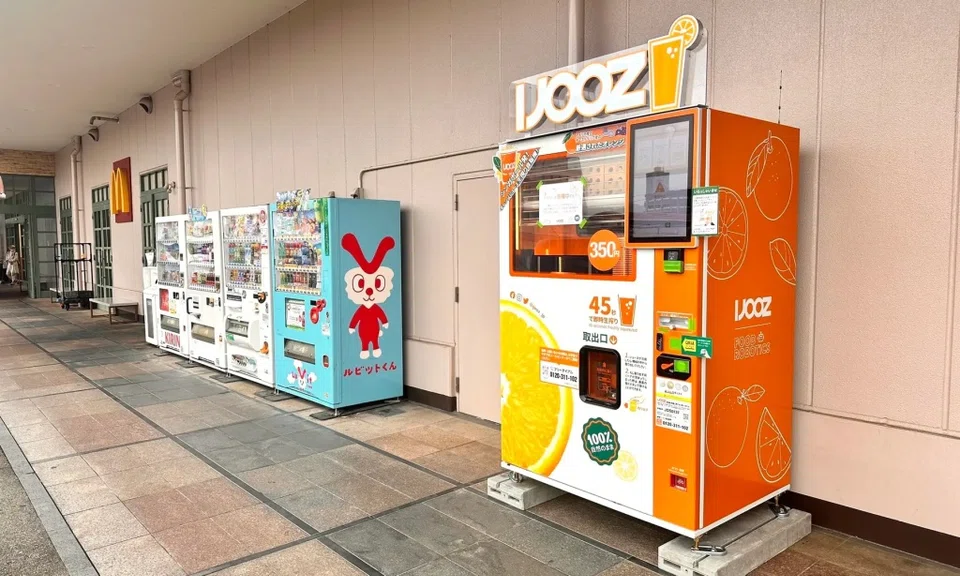
    • Founded in Singapore in 2016, Ijooz’s machines have been deployed to 32 countries worldwide.
    • Founded in Singapore in 2016, Ijooz’s machines have been deployed to 32 countries worldwide. PHOTO: IJOOZ
    Published Mon, Nov 24, 2025 · 10:17 AM

    IN JAPAN, where fresh fruit is considered a luxury item, a single orange can cost US$13.

    It’s no surprise then that Ijooz, a vending machine startup specialising in fresh and affordable orange juice, has become a hit.

    Founded in Singapore in 2016, Ijooz’s machines have been deployed to 32 countries worldwide. These machines dispense cups of freshly squeezed juice, priced at S$2 in Singapore and 350 yen (S$2.91) in Japan. They are equipped with an Internet of Things device that enables the company to remotely monitor when they need replenishing.

    The company launched in Japan in 2023. It ramped up its operations in the market in 2024, when the country was facing an orange juice shortage.

    By November 2024, it had over 400 vending machines in the country. Today, that number has grown to 1,300 machines across high-density areas – such as train stations – in Tokyo, Osaka and Nagoya. That’s almost as many machines as it has in Singapore, where it operates 1,500 machines as at February this year.

    In the 19 months running from June 2023 to December 2024 (FY2024), the company more than doubled its revenue to S$64.6 million, according to its audited financial statements for Ijooz AI.

    During the period, the company changed its financial year-end from May to December. As such, FY2024 spans a longer duration compared with its previous financial year, which ran from June 2022 to May 2023.

    On an annualised basis, revenue for FY2024 stands at US$31.4 million, about 1.6 times its FY2023 figure.

    Ijooz’s ultimate holding company is Ijooz Holdings, and the figures from Ijooz AI’s financial statement may not reflect its global numbers.

    The firm recorded a profit before tax of US$2.5 million in FY2024. Taken on an annualised basis, this figure stood at US$1.6 million, about three times that of FY2023.

    Ijooz did not respond to Tech in Asia’s multiple requests for comment.

    Bringing the juice overseas

    Founded by Bruce Zhang, Ijooz counts IMO Ventures as its only publicly disclosed institutional investor, according to Tracxn.

    As the firm deployed more machines last year, its cost of sales more than doubled to US$31.4 million over the FY2023-FY2024 period. Other operating expenses, which include employee benefit expenses, also roughly doubled to US$15.6 million over the same period.

    In FY2024, a majority of the firm’s revenue came from sales of goods, which contributed US$40.5 million.

    Ijooz does not own all of its vending machines. It also sells and leases them through a franchising model.

    Aside from orange juice vending machines, Ijooz offers a smart-pantry service, catering to offices. Companies can choose to set up refrigerators on premises and choose from over 500 food varieties, and Ijooz monitors inventory using computer vision tech and automatically restocks products when they run low.

    On its website, the firm lists Oracle, Capitaland, and the National University of Singapore among its clients.

    Its financial statement did not break down how much of its sales come from its vending machines and smart pantries.

    Ijooz’s asset turnover ratio, which measures how efficiently a company uses its assets to generate sales, decreased from 2.2 in FY2023 to 1.3 in FY2024. This suggests that its machines were less efficient in generating revenue compared with the year before.

    Still, Zhang said last February that Ijooz plans to eventually operate 5,000 machines in Singapore, including at the void decks of public housing blocks. The founder did not give an estimate as to when the company expects to hit this number.

    As Ijooz’s profit grew, so did its cash flow from operating activities. The latter more than trebled year on year to US$5.8 million in FY2024, after taking into account depreciation of plant and equipment and other assets, both non-cash expenses.

    A 2027 IPO target

    Ijooz aims to list on a US stock exchange by 2027. It also plans to deploy its vending machines in the country, starting with New York this year.

    But amid its expansion, some headwinds remain.

    Ijooz sources oranges from across the globe, including Australia, South Africa and the US. It has also started to source from Egypt as at November last year. Getting supply from multiple countries allows the company to be flexible on costs amid a volatile pricing market.

    However, a global shortage of oranges – due to factors such as severe droughts and labour cost hikes – could raise the cost of procuring the fruit.

    Citrus greening disease, which makes oranges taste bitter, has also shut down orchards in countries such as Brazil, China and the US. Prevention of this disease has raised the cost of production for farmers, further affecting the price of oranges.

    Continued inflation could force Ijooz to increase the price of its juices, though at US$1.50 to US$2.20 per cup, it has some headroom to do so while still being affordable.

    In a January interview, Zhang admitted that he could not promise to maintain the company’s current price points indefinitely. That said, at least in Singapore, it looks like Ijooz has managed to keep its juices at the same prices so far. TECH IN ASIA



