

Latest AI app swaps influencers for avatars – and brands want in
Topview is one of a few up-and-coming platforms focused on AI-generated videos
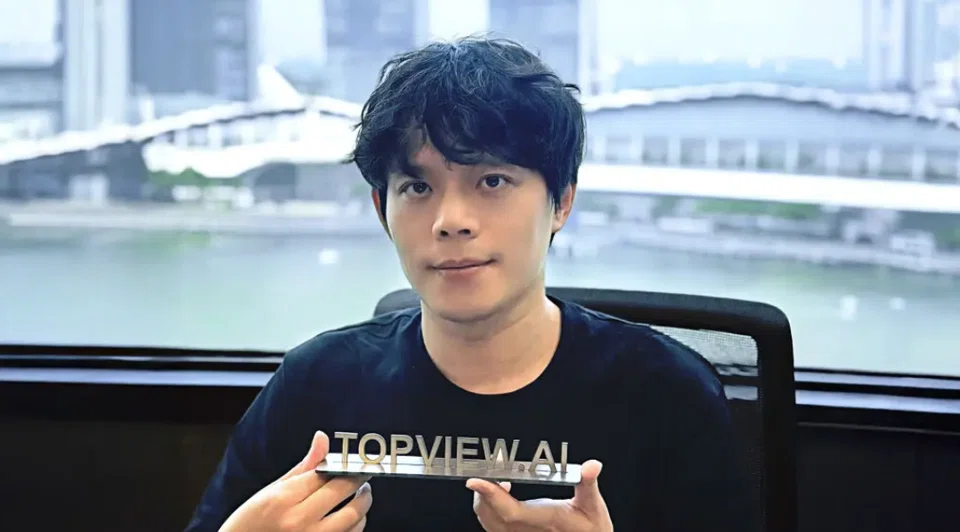
TOPVIEW, an artificial intelligence (AI) video editing tool valued at US$30.7 million, wants to do for videos what Canva has done for graphic design.
Launched in 2024, the Singapore-based firm is one of a few up-and-coming platforms focused on AI-generated videos. Across Asia, some 15 companies have secured over US$10 million in funding each since 2016.
Co-founded by Jensen Wu and Albert Chen, both former Alibaba executives, Topview offers an AI editor that lets brands create anything from user-generated content and video ads – complete with scripts – to AI livestreaming hosts in just under five minutes.
Videos created by the platform feature AI avatars that can wear, hold, and interact with products. For example, they may appear to adjust an earpiece, put on a pair of socks, or hold up a bottle – all generated from a single product image, product URL, or a reference video.
This feature sets Topview apart from other AI video tools like HeyGen, a US$440 million Los Angeles-based firm specialising in AI avatars and voice that aren’t tailored for product marketing.
The idea of brands using AI to create “user-generated” content may sound disingenuous. After all, rapport with random people on the internet is the whole reason why influencer marketing works.
Still, Topview’s tool helps brands save the time and money they need to hire influencers for an arguably comparable end-product. It also lets them iterate quickly – a benefit enough to bring thousands of creators and brands on board.
The company’s main product is a video AI agent that integrates Sora 2 via API and Avatar 4, a self-developed image-to-video AI model fine-tuned based on Alibaba’s Qwen Wan 2.2 and optimized for facial expressions, hand gestures, body language, and lip-syncing.
Topview’s AI agents can study a reference video, mimic its style, and recreate a similar version based on a brand’s product. First, it asks questions about the user’s target customer segment and market, as well as the product’s unique selling points they’d like to highlight.
After summarising the brief, the video agent designs a storyboard with five different scenes. Each one is complete with descriptions, which can be modified by the user.“We’ve now reached a point where our AI agentic product can do it better than humans,” Wu, who is also Topview’s chief executive offiver, told Tech in Asia.
The company is tracking an annual recurring revenue of just under US$3 million – an annualised figure based on the firm’s October revenue, Wu said. South Korea and the US are its fastest-growing markets, followed by South-east Asia.
In August, Topview raised US$8.4 million in a series A round led by family office Kamet Capital.
From working at Alibaba to serving Alibaba
In building products, Wu – formerly a product manager at ecommerce marketplace Taobao – draws on over a decade of experience working with brands and addressing their pain points.
As for Chen, Topview’s CTO, he was a technical lead for UC Browser, the mobile browser operated by UCWeb and acquired by Alibaba Group in 2014.
On Topview, generating a video costs roughly US$3. However, the cost varies depending on the product and subscription plan.
Wu said the company is making positive gross profit margins on every user. Currently, it can access Sora 2 at a discounted API partner price that’s lower than OpenAI’s official rates. Still, Topview’s reliance on Sora 2 means any future pricing increase could potentially eat into its margins.
Today, users of Topview’s AI editor include Alibaba-owned platforms like Lazada and AliExpress. The tool’s AI avatars are also being used to host livestreams on Taobao and Shopee. Makeup brands such as L’Oreal and Maybelline, alongside sportswear labels like Fila and Anta, likewise turn to Topview to promote their products.
While regional ecommerce platforms use Topview, its primary users are professional consumers – employees in a marketing agency, ecommerce sellers, or dropshippers – and small- to medium-sized businesses.
Wu hopes to change this as the company pushes to scale to the size of Canva in the next five to 10 years. To do so, Topview will need to move beyond its current core clients.
Later, it wants to expand into adjacent industries like real estate, where property agents can use its tools to create marketing materials, and education, where it can help schools make training videos.
Topview also aims to enter the finance sector, where its tools can be used for ads promoting financial services, AI-powered customer service avatars in bank branches, and internal training videos, Wu shares.
The company’s tools are free to use, but paid users get access to its most advanced AI model, Avatar 4, and more ways to customize avatars, video backgrounds, and storyboards.
Topview said it currently has some 1.5 million registered users and a total of 10,000 paid clients who are mainly from the US, South Korea, Japan, Brazil, and Vietnam.
Growth drivers
Between January to March and May to June this year, Topview’s revenue grew by 50 per cent month on month, coinciding with major product updates, said Wu.
He added that the product is “much easier to use” compared to the firm’s other tools and produces videos with “significantly better” quality.
For instance, it can create realistic, zoomed-in videos of a pendant adorning the wearer’s neck, a person strutting toward the camera, and a product being unboxed. Generating scenes like these would have been possible using Topview’s other products, but only with elaborate prompts – something most casual users struggle with, Wu explained.
Livestreaming is now a fast-growing part of the business, too, with revenue from livestreams increasing at some 30 per cent month on month.
According to Wu, some of Topview’s AI avatars can already match 80 per cent of the gross merchandise value of products sold by a human livestreamer in a single session.
Its core products – Avatar 4, Product Avatar, and Link-to-Video – are also being offered to ecommerce enablers, marketing agencies, and brands via APIs.
In September, Anymind Group launched a library of AI avatars that creators on its platform can pick from for their livestreams. These AI avatars are built using a combination of various audio, response, and visual models – including Topview’s – and further fine-tuned and developed by the e-commerce enablement firm.
More brands are using AI to complement human hosts in live commerce.
“We’re seeing this happen across South-east Asia, where markets such as Thailand, Malaysia, and Vietnam are more open to experimentation,” Akinori Kubo, managing director of AnyMind Group’s global ecommerce division, told Tech in Asia.
In particular, beauty, FMCG, home care, baby care, and electronics brands have been adopting AI avatars for live commerce more speedily.
Kubo noted that the firm is also seeing a growing appetite from content creators and livestream hosts “to develop their own AI avatars” and co-host with them.
Staying ahead
Despite its current traction, Topview faces a host of competition from dozens of existing and upcoming AI video editors.
Wu said that to stay ahead, improvements to memory – how well its models can retain a user’s style preferences – are underway. The goal is to make users and brands more “sticky” to the platform.
Also in the works is a content library of top-performing videos from TikTok or Meta, which brands can use as templates when creating videos.
Still, brands – and customers – may need convincing.
Earlier this year, the trial run of an AI host by Indonesia’s Avatara Labs had to be cut short after drawing a host of angry comments.
Wu shared that its AI avatar livestreams have been well-received in the country, adding that the more realistic and high-quality AI avatars appear, the more receptive customers are likely to be.
Meanwhile, other users have taken to public forums to voice out issues like “unnatural” lip-syncing. Yet, Wu noted that this feature has vastly improved with the platform’s Avatar 4 model.
As of April, Canva’s annual recurring revenue stands at US$3 billion, with 230 million monthly users.
“We hope to become as big as Canva,” Wu said. TECH IN ASIA
TRENDING NOW

Vietnam’s northern provinces, not Hanoi or Ho Chi Minh City, are powering near 10% GDP growth

VietJet hit with global asset freeze in FitzWalter dispute

Gridlock or growth? The Asean Power Grid faces a critical window of opportunity

LNG, stronger regional power links key to Asean’s energy resilience: Shell

