

Robotaxis and Grab’s billion-dollar dilemma
THE rise of autonomous driving technology puts ride-hailing firms in a dilemma: Adopt the technology now at a high cost for an uncertain payout, or wait and see and risk losing market share.
The answer is not clear cut.
Adopting the tech is likely to upset drivers – a core pillar of any ride-hailing platform today. Mobility firms that go slow, on the other hand, risk missing the boat on a disruptive tech.
Waymo’s track record in San Francisco, where it launched last June, offers an example: As at last November, the Alphabet unit’s market share in the city, measured in gross bookings, now matches Lyft’s, according to market research firm YipitData.
Some analysts expect that robotaxis will unlock trillions of US dollars in revenue potential by 2030. Much of this is due to their ability to charge lower fares, which can expand the total addressable market for ride-hailing.
But firms could also lose a lot of money, especially if they intend to develop their own tech from scratch. Last December, General Motors called time on its robotaxi service, Cruise, after racking up billions of US dollars in losses.
For South-east Asia’s ride-hailing platforms such as Grab, the timing of any move will be a delicate balancing act and could become a hot potato issue.
Grab’s opportunity
Like Uber, Grab has only recently gotten in the black, reporting its first company-wide profit in the fourth quarter of 2023, after more than a decade of operations.
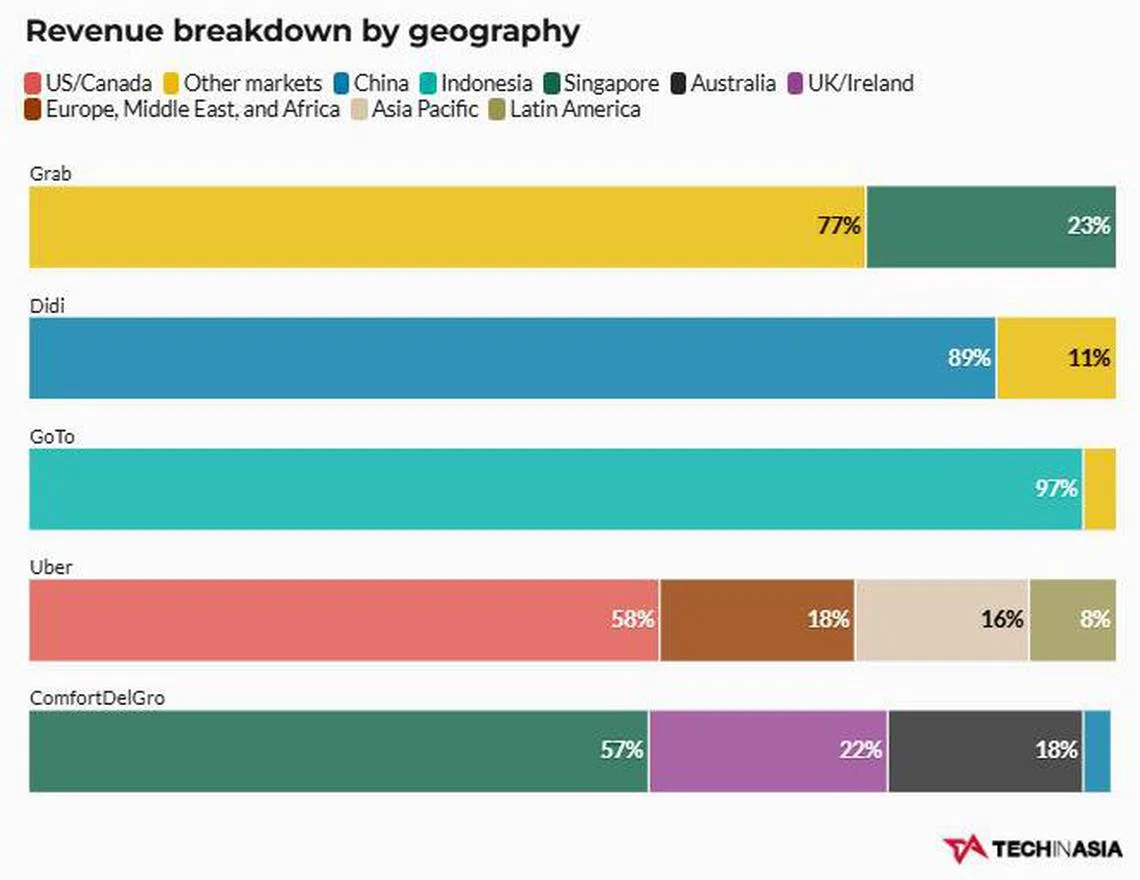
With Grab making roughly a fifth of its revenues in Singapore, where labour costs are relatively high, adopting autonomous tech could reduce the need for human drivers and cut the cost of running a fleet.
Grab declined to comment on its plans for the technology.
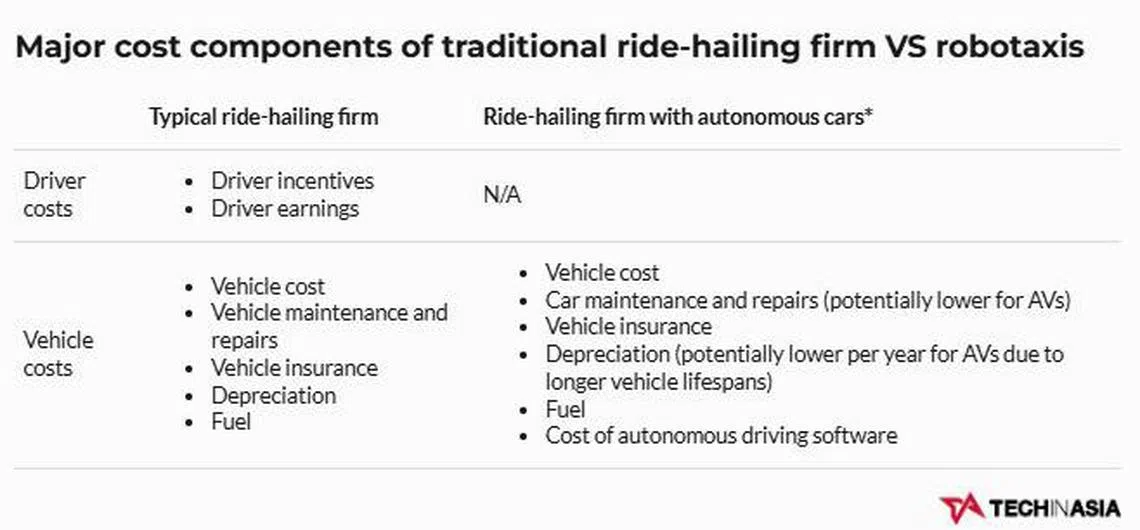
Between July and September 2024, Grab’s cost of revenue – which includes incentives paid out to drivers – was US$409 million or 57 per cent of total revenue, which also includes its food delivery and fintech businesses.
Of course, going the autonomous route will come with its own expenses, which could offset costs saved by eliminating drivers.
Implementing this tech will also require large capital expenditure. Uber has spent over a billion US dollars developing its own autonomous driving tech unit – which it’s since sold off – and now partners with over five autonomous vehicle firms, including Waymo and WeRide.
Last October, Uber CEO Dara Khosrowshahi said that the margins on self-driving cars will be lower than regular ones in the early years, though the tech “can be great for business” in the long term.
Meanwhile, Grab has done trials in the past for this tech. In 2016, it ran a two-month trial with autonomous driving software firm Nutonomy, under which select Grab users could book rides in self-driving cars.
Grab CEO and co-founder Anthony Tan noted at the time that demand from remote locations in Singapore was “underserved”, and that was a gap that robo-cars could help meet.
Since then, however, Grab has been largely silent on plans to apply the tech in its mobility service, though it has piloted the use of autonomous robots in food delivery as recently as in 2022.
Grab’s dilemma
Notwithstanding the benefits to Grab and its shareholders, any payoff from adopting the tech will have to be balanced with the welfare of its drivers.
As the region’s largest ride-hailing platform, Grab works with over five million drivers across South-east Asia as of 2022 – a number that continues to grow. The company is a lightning rod for many issues that ail the gig economy.
During the Covid-19 pandemic, it bore the brunt of public ire after food merchants spoke out about what they felt were excessively high commission fees.
Along with other ride-hailing platforms, Grab also came under fire for the lack of “basic protections” for drivers, then faced backlash after it raised platform fees last December to partially offset the costs of better worker provisions mandated by the government.
While it’s unclear what Grab’s stance is on autonomous vehicle tech, it’s little surprise that the firm is keeping a tight lid on its plans.
In the meantime, the firm is burnishing its image as a pro-driver platform by proactively launching initiatives for these workers. Last week, Grab said it would provide funding support to platform workers in Singapore that wish to take up various diploma and degree programmes with its partner, London School of Business and Finance.
In the US, a decision to allow ride-hailing services using robotaxis in California faced strong opposition from the public, including from city agencies. Worker unions have protested against robotaxis, which they say will do away with the need for human drivers.
Local taxi drivers in the Chinese city of Wuhan, where Baidu is testing its Apollo Go robotaxi service, have also petitioned to limit the use of autonomous driving taxis.
Still, Grab could roll out driverless ride-hailing services relatively quickly by inking partnerships, such as Uber is doing with Waymo in several US cities.
First to the line
Ivan Png, professor of strategy and policy at the National University of Singapore, notes that in South-east Asia, ride-hailing firms that introduce autonomous car offerings sooner could see a first-mover advantage. This is particularly true if they sign exclusive agreements with a tech provider that “lock out” and prevent other ride-hailing firms from also doing the same.
That said, it’s unclear if the government in Singapore – which Png considers the one market within South-east Asia which will see the greatest “economic advantage” from robotaxis – will allow such exclusivity given that it stifles competition.
Other players are not standing still. In Singapore, ComfortDelGro has already begun placing long-term bets.
In July 2024, the taxi firm signed a partnership with Pony.ai to explore the commercialisation of large-scale robotaxi operations. Its first stop is China, Michael Huang, who heads ComfortDelGro’s China business unit, tells Tech in Asia.
This followed a US$4 million investment ComfortDelGro made in autonomous vehicle software firm Ottopia in 2023. By complementing existing fleets, self-driving cars can alleviate a “global driver shortage” and meet the transport demand of underserved areas”, Huang said
ComfortDelGro’s presence in developed markets – over 97 per cent of its revenue is from Singapore, the UK, and Australia – could explain its proactive approach towards autonomous driving relative to its peers in the region.
Those that move first could gain valuable data on user patterns and driving behaviour and use that to fine-tune the self-driving algorithm, Alex Yao, co-head of Asia technology, media, and telecommunications research at JP Morgan, told Tech in Asia.
But mobility firms that do not jump into the trend immediately will not necessarily lose out.
“At the end of the day, even if [incumbent mobility operators] are slower to the market, they can accumulate data highly efficiently,” Yao noted.
With the cost of autonomous vehicles expected to fall by “40 to 60 per cent” for each generation, units made in China will reach a “commercially sensible” price tag of between US$35,000 to US$40,000 “in a year or two,” Yao estimated.
Grab, which has to juggle its millions of stakeholders – from users, drivers, shareholders, to the government – is certainly proceeding with caution. But it should not sit on its decision for too long. TECH IN ASIA
TRENDING NOW

LTA proposes combining car COE categories, adding rebate-surcharge system

StarHub to acquire MyRepublic’s mobile business amid ongoing telco consolidation

DBS, OCBC, UOB rout lops billions off STI as inflation, rate concerns spook investors

Grab CEO’s wife Chloe Tong on life with Anthony Tan and finding her purpose

