

Tech investors test South-east Asian waters in the wake of SoftBank vacuum


SOME global investors who missed the South-east Asian venture boom are now quietly betting on the region’s startups, attracted by saner valuations and a chance to tap a rising market.
The step-up in activity is rippling across the world, from Gulf funds to South Korean companies. This comes as heavyweight foreign investors who were active during the boom stop or slow down investments, amid macroeconomic pains.
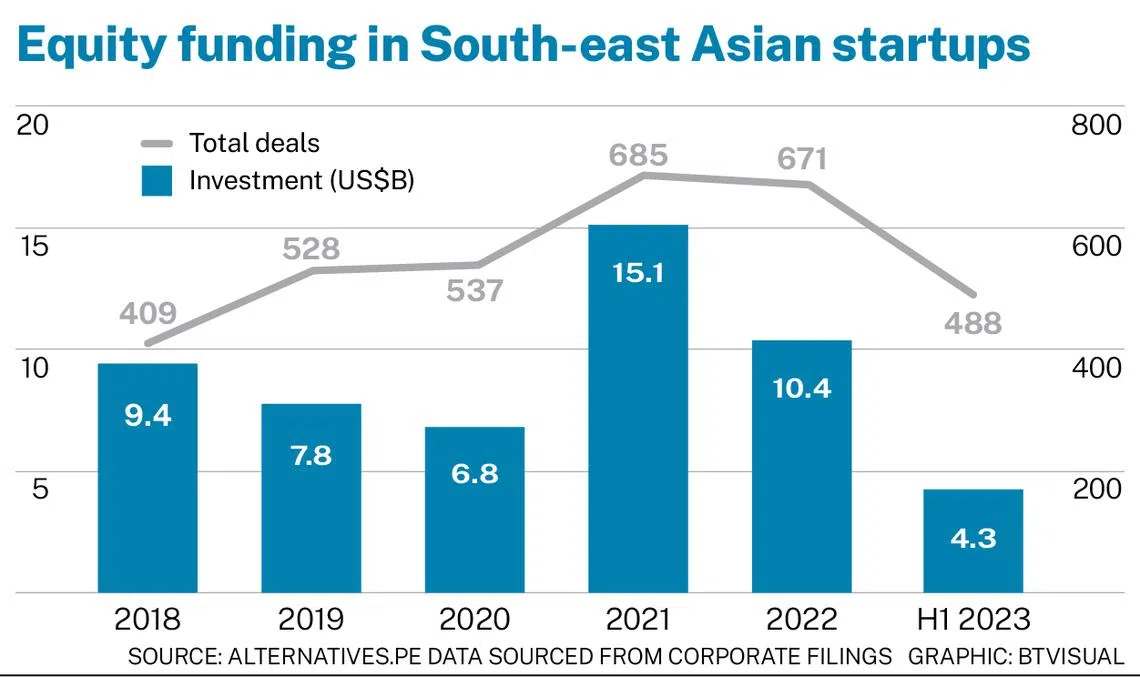
South-east Asia experienced rapid growth from 2019 to 2021 as international tech investors rushed in, contributing to some US$41 billion poured into the region, Preqin data showed.
Their presence helped to drive an explosive rise in valuations, but recent venture capital (VC) funding has struggled to match the same heights.
Average pre-money valuation at the Series A and B stages were down 34 per cent and 42 per cent year on year in H1 2023, indicated a study by private market data platform Alternative.pe, formerly known as VentureCap Insights.
It prompted new players to enter or increase their exposure to South-east Asia amid the lull.
“These are investors who missed the likes of Sea, Grab and GoTo,” said Roshan Raj Behera, a partner at Redseer Strategy Consultants. “They missed the entire wave but saw that there are big companies coming out of South-east Asia… and found that current market conditions are good for a bigger presence here.”
Joel Shen, a partner at law firm Withersworldwide, is seeing more limited partners invest directly in startups instead of only through VC funds.
“(Many) would now have developed a better understanding of the region and, over the years, developed a confidence to make direct investments,” said Shen.
Middle Eastern investors have emerged in greater numbers over the past two years. Gulf-based funds participated in 59 deals from 2022 to 2023, data from Refinitiv showed, up from seven deals in 2018 to 2019.
Sovereign wealth funds were a major driver of investments. The Qatar Investment Authority led the US$150 million equity financing round of mixed martial arts promoter One Championship; last year, it backed a funding round for Malaysian car e-commerce unicorn Carsome.
Meanwhile, other investors in the Gulf are expanding. Aramco Ventures, a unit of oil giant Saudi Aramco, made its first South-east Asia investment when it led a US$10 million round in Singapore-based sustainable tech startup Redex in October.
VC firm Nuwa Capital, based in Dubai, closed its US$100 million debut fund and plans to expand to South-east Asia, DealstreetAsia reported.
Investors from other parts of the world have also allocated investments to the region. Seoul-based SV Investment launched a fund with a US$100 million target, together with early Tokopedia-backer East Ventures.
Last year, SV Investment backed rewards platform ShopBack’s Series F US$195 million fundraise – a rare major late-stage round amid the drought.
Other international investors, including US-based New Enterprise Associates and European asset manager Eurazeo, have also backed South-east Asian startups in 2023.
Late-stage vacuum
The slowdown of investors such as SoftBank and hedge fund Tiger Global has sparked ripple effects in the later stage funding scene.
SoftBank Vision Fund fuelled the rise of some of the biggest names in South-east Asia, including Grab. In recent times, though, its aggressive bets on loss-making companies have backfired.
The Vision Fund unit posted a US$1.7 billion loss for the quarter ended September, partially from a write-down in its stake in bankrupt WeWork.
SoftBank Ventures Asia, a separate unit focusing on early-stage investments, was sold off last year to a Singapore-based company co-founded by Taizo Son, brother of SoftBank CEO Masayoshi Son.
SoftBank and Tiger Global were not the only foreign investors pumping money into the ecosystem, but their startling pace and rampant bullishness set the tone for dealmaking at the peak of the market. It gave earlier-stage investors the confidence to make bets.
“The previous strategy was very much to invest, and then sell to one of these foreign funds... And now that these foreign funds are not picking up the investments, (the regional funds) are a lot more cautious,” said David Yin, a partner at global VC firm GSR Ventures, which manages over US$3.7 billion in assets.
Shauraya Bhutani, partner at boutique investment bank CapConnect, sees a clear growth stage funding gap as investors who were active during the boom now remain on the fence.
“(It) continues to persist as most mature tech companies in the region fail to prove a clear business case,” he said.
These same companies previously raised money at eye-watering valuations that they are unable to command under current market conditions.
Chinese investors were hot in South-east Asia during the boom, but their presence has now dulled. Tencent and Alibaba, once some of the most high-profile investors in the region’s e-commerce and fintech scene, have mostly retreated.
Some Chinese VCs, including HongShan (formerly Sequoia China) and Matrix Partners China, set up offices in Singapore last year.
But that may not immediately translate into a pick-up in regional investments. Singapore provides fund managers with a comfortable regulatory framework to conduct their international activities, which are not limited to South-east Asia.
“The Chinese VCs quickly find that South-east Asia is not the next China – the market size is a fraction of it, and business models are relatively at nascent stages,” said Bhutani.
In addition, founders in China are of a calibre that is difficult to match, GSR’s Yin said. “A lot of the companies in China that succeeded in recent years – the founders have been serial entrepreneurs with a lot of experience.”
As some global investors hit the brakes, patient capital that is less bound by investment cycles has become more valuable to startups. Sovereign wealth funds, development funds and impact funds have continued to invest amid the downturn.
Indonesia aquaculture startup eFishery hit unicorn status after it raised US$200 million in July. The round was led by 42XFund, a joint fund set up by Abu Dhabi tech company G42 and sovereign wealth fund Abu Dhabi Growth Fund.
Malaysia’s state pension fund Kumpulan Wang Persaraan Diperbadankan plans to invest up to RM500 million (S$142.4 million) over the next two years in the country’s venture and startup ecosystem.
Meanwhile, government-backed development investors, including the US International Development Finance Corporation and the Dutch Good Growth Fund, were among those that committed to venture builder Wavemaker Impact’s inaugural US$60 million fund.
In-Q-Tel, a non-profit venture investor relied on by US intelligence and defence agencies, has opened its first Asia-Pacific office in Singapore. Its portfolio of over 700 companies includes Transcelestial, a Singapore-based laser communications startup.
While foreign investors have always played an important role in the local tech scene, CapConnect’s Bhutani believes it is increasingly important for South-east Asia’s startup ecosystem to become more self-sufficient.
Regional corporates and family offices need to be a source of both capital and commercial collaboration, he said.
“We are seeing early signs of this in Indonesia and Thailand, with local players setting up their own tech-focused investment vehicles, backing the homegrown venture capital funds or even investing directly from their balance sheet,” he added.






